

How Does Underwater Archaeology Reveal Lost History?
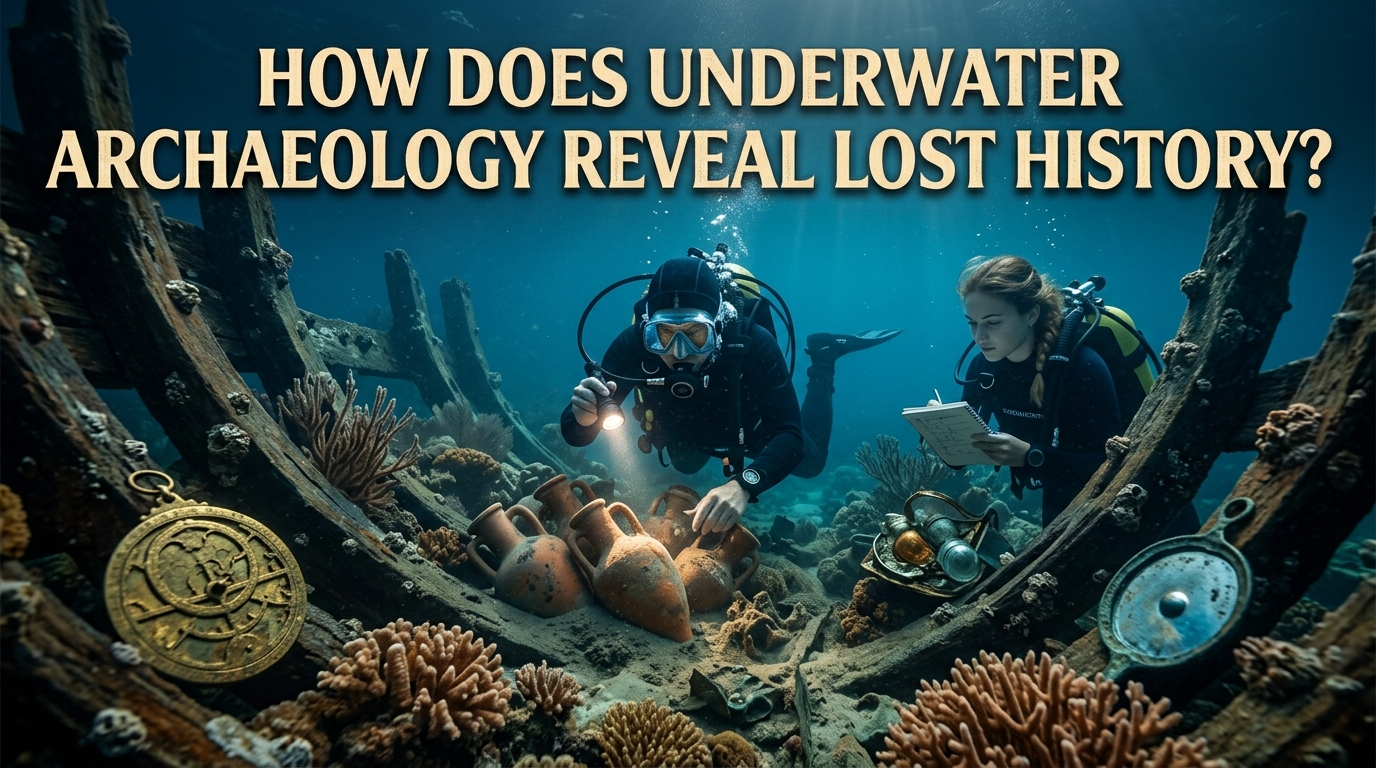
Underwater archaeology helps researchers uncover historical evidence hidden beneath oceans, lakes, rivers, and other bodies of water. For centuries, shipwrecks, submerged settlements, ancient harbors, and lost objects have remained underwater, preserving valuable clues about past civilizations. These discoveries can reveal stories that written records never documented or that historians have struggled to explain.
By combining scientific research, specialized equipment, and careful exploration, archaeologists can investigate these hidden places and learn how people lived, traveled, traded, and interacted with their environments. Underwater archaeology reveals lost history by studying physical evidence preserved beneath the water and connecting discoveries with broader historical knowledge. It also helps protect underwater cultural heritage for future generations.
WHAT IS UNDERWATER ARCHAEOLOGY?
Underwater archaeology is the study of human history through archaeological remains found beneath water. These remains include shipwrecks, submerged buildings, ancient ports, tools, pottery, and other objects connected to past human activities. Researchers investigate these sites to understand how societies developed, how people used waterways, and how historical events affected their communities.
Unlike ordinary archaeological excavations on land, underwater investigations require specialized methods and equipment. Archaeologists may work with trained divers, remotely operated vehicles, sonar systems, and underwater cameras. They must also consider water depth, visibility, currents, and the condition of the remains. Careful documentation and scientific analysis help ensure that discoveries provide reliable historical information without unnecessary damage to the site.
HOW SHIPWRECKS REVEAL LOST HISTORY
Shipwrecks are among the most valuable sources of evidence in underwater archaeology. A sunken vessel may preserve its hull, cargo, navigation equipment, personal belongings, and everyday objects used by its crew. Together, these discoveries can reveal how ships were constructed, what goods they transported, and what life was like during maritime journeys.
Cargo can also provide clues about ancient trade networks and connections between distant communities. For example, a ship carrying pottery from one region and metal objects from another may indicate commercial exchange between different societies. Researchers compare these findings with historical documents and discoveries from land-based sites to reconstruct possible trading routes. Shipwrecks preserve snapshots of maritime activity, helping researchers understand economic relationships, navigation practices, and the risks faced by sailors.
HOW UNDERWATER ARCHAEOLOGISTS DISCOVER HIDDEN SITES
Finding an underwater archaeological site often begins with historical research and environmental investigation. Researchers examine old maps, shipping records, local accounts, and reports of known wrecks to identify promising locations. They may also investigate unusual features on the seabed or examine areas where ancient coastlines have become submerged.
Modern technology makes underwater exploration more efficient. Sonar systems use sound waves to detect objects and structures beneath the water, while remotely operated vehicles can investigate places that are difficult or dangerous for divers to reach. Underwater photography and three-dimensional mapping help researchers record the shape and location of discoveries. However, unusual features must be carefully examined before researchers can determine whether they are archaeological remains.
WHAT SUBMERGED SETTLEMENTS REVEAL ABOUT ANCIENT CIVILIZATIONS
Not all underwater archaeological sites are shipwrecks. Some contain the remains of ancient settlements that were submerged because of rising sea levels, coastal erosion, earthquakes, land subsidence, or changes in water systems. These sites may include houses, streets, walls, wells, and everyday objects that reveal how communities were organized.
Studying submerged settlements helps archaeologists investigate how people adapted to environmental changes and used coastal or freshwater resources. The remains of buildings can reveal construction methods, while pottery and tools may provide clues about food production, trade, and domestic activities. Researchers also study the surrounding sediment and environmental evidence to understand the conditions that led to submergence. Submerged settlements provide valuable evidence of human adaptation and environmental change across different periods of history.
HOW ARTIFACTS PRESERVED UNDERWATER TELL STORIES
Objects recovered from underwater sites can provide detailed information about the people who made, transported, or used them. Pottery may reveal food storage practices, coins can help establish historical dates, and tools may show the technologies available to a community. Inscriptions and markings can sometimes identify producers, owners, or trading connections.
However, underwater conditions affect different materials in different ways. Wood and other organic materials may survive well in oxygen-poor sediments, while metal objects can corrode in seawater. Ceramics and stone may remain relatively durable, although they can still be damaged by movement, chemical processes, or changes in their environment. The condition and location of each artifact matter as much as the object itself, because its archaeological context helps researchers interpret its original purpose and significance.
THE ROLE OF SCIENTIFIC METHODS IN UNDERWATER ARCHAEOLOGY
Scientific methods help archaeologists establish when underwater sites were used and how they relate to historical events. Researchers may study pottery styles, coins, inscriptions, construction techniques, and the position of objects within the site. When suitable organic materials are available, radiocarbon dating can help estimate their age, although the result does not necessarily indicate the exact date when a ship sank or a settlement became submerged.
Environmental analysis can provide additional evidence. Researchers may examine sediment, plant remains, animal bones, and other materials to reconstruct past conditions. They can also compare underwater discoveries with historical records and archaeological sites on land. Combining different types of evidence produces stronger interpretations and reduces the risk of relying on a single artifact or uncertain historical account.
FAMOUS DISCOVERIES THAT CHANGED HISTORICAL UNDERSTANDING
Several underwater discoveries have significantly expanded knowledge of ancient societies. The Uluburun shipwreck, discovered off the coast of present-day Türkiye, dates to the Late Bronze Age and contained a diverse cargo, including copper and tin, glass, pottery, and other valuable materials. Its contents provide important evidence of long-distance exchange and connections among societies around the eastern Mediterranean.
Another example is the Antikythera shipwreck near Greece, which yielded sculptures and the Antikythera Mechanism, an ancient geared device associated with astronomical calculations. The discovery demonstrated the sophistication of certain ancient Greek mechanical technologies. Submerged archaeological sites in Southeast Asia have also contributed to research into historical maritime commerce connecting China, India, and other regions. These discoveries show how underwater archaeology can reveal trade, technology, and cultural connections that might otherwise remain poorly understood.
THE CHALLENGES OF UNDERWATER ARCHAEOLOGY
Underwater archaeology involves technical, environmental, and financial challenges. Deep water, strong currents, limited visibility, and difficult weather conditions can make fieldwork dangerous and expensive. Researchers also need specialized equipment, trained personnel, and careful planning to document discoveries safely.
Preserving recovered objects creates additional difficulties. Materials that survived underwater for centuries may deteriorate rapidly when exposed to air, changes in moisture, or different temperatures. Shipwrecks and submerged settlements are also threatened by looting, fishing activities, coastal development, pollution, and environmental change. Responsible excavation, conservation planning, and site protection are essential to prevent the permanent loss of archaeological information.
WHY UNDERWATER CULTURAL HERITAGE MUST BE PROTECTED
Underwater archaeological sites are important records of human history and should be treated as cultural resources rather than simply sources of valuable objects. Removing artifacts without recording their original positions can destroy evidence about trade, ship construction, and past human activities. Illegal salvage and uncontrolled collecting can therefore cause serious and irreversible damage.
Underwater cultural heritage preservation involves documenting sites, monitoring environmental conditions, preventing unauthorized disturbance, and conserving recovered materials appropriately. In many cases, leaving a site undisturbed may be the best option when excavation is unnecessary or preservation resources are limited. Governments, researchers, local communities, and heritage organizations can work together to improve protection and public awareness. Responsible management ensures that future generations can continue learning from these remarkable underwater discoveries.
CONCLUSION
Underwater archaeology reveals lost history by examining shipwrecks, submerged settlements, ancient artifacts, and other remains hidden beneath water. These discoveries help researchers understand maritime trade, shipbuilding, daily life, technological achievements, and the ways human societies responded to environmental change. By combining archaeological evidence with scientific dating and historical research, specialists can reconstruct important parts of the past.
Although underwater investigations present significant challenges, modern technology and careful conservation have made many discoveries possible. Protecting underwater archaeological sites is essential for preserving historical evidence and cultural heritage. Through continued research and responsible exploration, underwater archaeology will keep uncovering stories that deepen our understanding of humanity's shared history.
Recent Posts

Bagaimana Sistem SKS pada Program Kuliah... 22.11.2026/50 View

How Does Technology Make Daily Evaluation... 21.11.2026/80 View

Apa Strategi Menghadapi Kesenjangan antara Kompetensi... 21.11.2026/79 View

Mengapa Inventaris Aset Penting bagi Kelancaran... 21.11.2026/75 View

When Should Musicians Join a Record... 21.11.2026/80 View
