

How Does Visual Intelligence Support Design and Creative Careers?
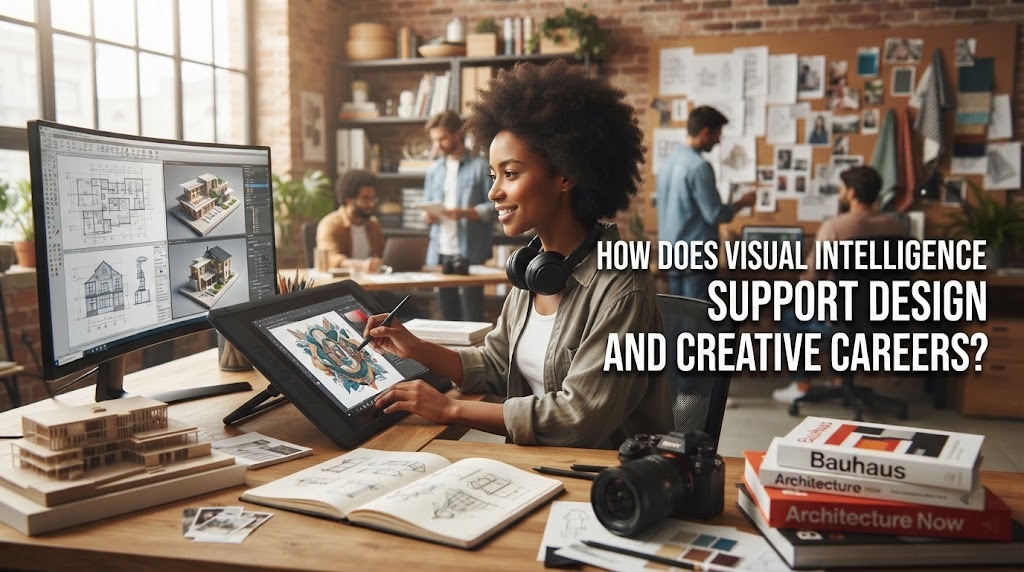
Visual intelligence is the ability to understand and process information through images, shapes, colors, patterns, and spatial relationships. This ability plays an important role in many creative fields where people need to create, organize, and communicate visual ideas. Strong visual intelligence can help creative professionals turn ideas into clear and engaging visual work.
Design and creative careers include graphic design, architecture, photography, animation, interior design, fashion, advertising, and digital content creation. Although technical skills are important, the ability to understand visual information can also influence how professionals develop ideas and solve creative challenges. Developing visual intelligence can therefore provide useful support for people interested in creative careers.
THE ROLE OF VISUAL INTELLIGENCE IN DESIGN
Designers constantly work with visual elements such as colors, shapes, typography, images, proportions, and layouts. Visual intelligence helps them understand how these elements interact and how they can be arranged effectively. This allows designers to create compositions that are organized and easier for audiences to understand.
Visual thinking can also help designers imagine a final product before completing it. Mental visualization allows creative professionals to explore different possibilities before turning an idea into a finished design. This can be useful when developing posters, websites, logos, presentations, packaging, or other visual materials.
VISUAL INTELLIGENCE AND CREATIVE PROBLEM SOLVING
Creative careers often involve solving visual problems. A designer may need to make a complicated message easier to understand, improve the layout of a website, or create an attractive design within specific limitations. Visual intelligence can help professionals examine these challenges from different perspectives.
Instead of immediately choosing the first idea, a person can visualize several possible solutions and compare them. This process combines visual thinking with problem solving and creativity. As a result, visual intelligence can help creative professionals make thoughtful adjustments to their work.
IMPORTANCE OF COLOR, SHAPE, AND COMPOSITION
Understanding visual relationships is important when working with colors, shapes, images, and composition. Creative professionals need to consider how different elements appear together and how they affect the overall impression of a design. Visual intelligence can help them notice balance, contrast, alignment, proportion, and hierarchy.
These skills are useful across many creative careers. Graphic designers use them for layouts, photographers use them when composing images, and interior designers use them when arranging spaces. The ability to recognize visual relationships can help make creative work more balanced and purposeful.
VISUAL INTELLIGENCE IN DIGITAL CREATIVE CAREERS
Digital technology has created many careers that depend heavily on visual communication. UI and UX designers, video editors, digital illustrators, animators, social media creators, and content designers regularly work with visual information. They need to understand how images, movement, text, and space work together on digital platforms.
Visual intelligence can also help professionals adapt their ideas for different screen sizes and digital formats. For example, a social media design may need to communicate a message quickly, while a website may require a more detailed visual structure. Strong visual thinking can help creators organize digital content according to its purpose and audience.
VISUAL INTELLIGENCE IN ARCHITECTURE AND SPATIAL DESIGN
Architecture and interior design require a strong understanding of space. Professionals need to imagine how objects, rooms, structures, and materials will relate to one another. Visual intelligence can support this process by helping them mentally visualize spaces before construction or implementation.
Spatial awareness is especially important when considering dimensions, proportions, movement, and arrangement. Being able to imagine a space from different perspectives can support planning and design decisions. These skills can also be useful in fields such as industrial design, landscape design, and 3D modeling.
HOW TO DEVELOP VISUAL INTELLIGENCE FOR CREATIVE CAREERS
People interested in creative careers can develop visual intelligence through regular practice. Drawing, photography, sketching, design exercises, puzzles, mood boards, and visual analysis can help strengthen observation and visual thinking. Studying different forms of design can also help people understand how professionals use visual elements.
It is also useful to practice creating and reviewing personal work. After completing a design, a person can examine its composition, spacing, colors, hierarchy, and overall message. Regular practice and constructive feedback can gradually improve both visual awareness and creative decision making.
CONCLUSION
Visual intelligence can provide valuable support for people pursuing design and creative careers. It helps with visualization, observation, spatial awareness, creative problem solving, composition, and visual communication. These abilities are relevant to many fields, from graphic design and photography to architecture, animation, and digital content creation.
Visual intelligence is not simply about being good at drawing. It is also about understanding how visual elements work together and using that understanding to communicate ideas effectively. By practicing observation, visualization, design, and creative problem solving, aspiring professionals can continue developing skills that are useful in a wide range of creative careers.
Recent Posts

Bagaimana Sistem SKS pada Program Kuliah... 22.11.2026/21 View

How Does Technology Make Daily Evaluation... 21.11.2026/64 View

Apa Strategi Menghadapi Kesenjangan antara Kompetensi... 21.11.2026/65 View

Mengapa Inventaris Aset Penting bagi Kelancaran... 21.11.2026/62 View

When Should Musicians Join a Record... 21.11.2026/60 View
