

How Does Visual Learning Help Students Understand Study Materials?
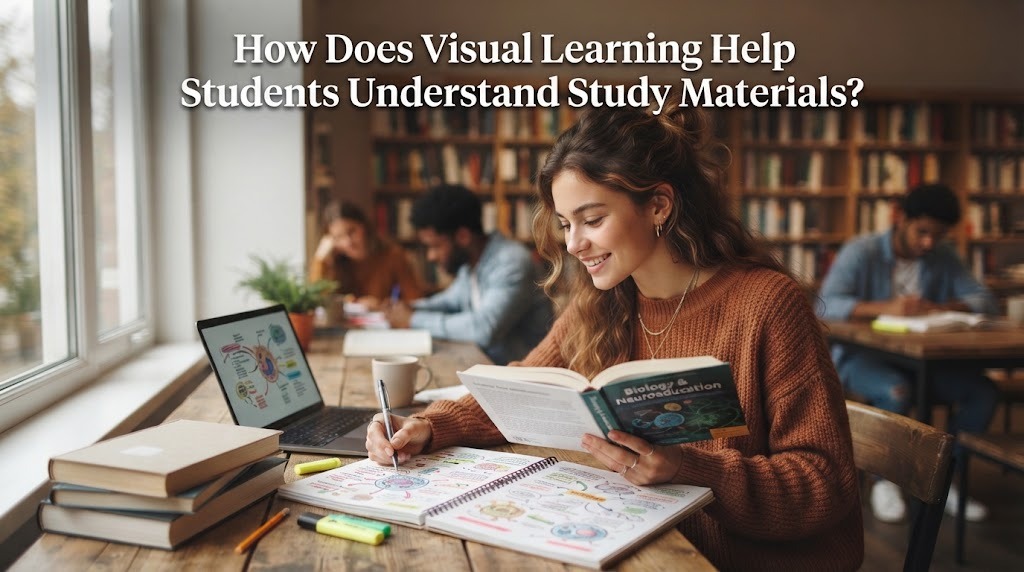
Students receive a large amount of information during their education. Textbooks, lecture notes, presentations, diagrams, and online materials can sometimes feel difficult to understand when information is presented in only one form. Visual learning can help students organize information through images, diagrams, charts, colors, and other visual elements.
Visual learning does not mean that a student can only learn through pictures. Instead, visual materials can be used as one of several strategies to make information clearer and easier to process. When used appropriately, visual learning can support students in understanding concepts, organizing ideas, remembering important information, and reviewing study materials.
MAKING COMPLEX INFORMATION EASIER TO UNDERSTAND
Visual materials can help students break complicated information into simpler parts. A diagram, flowchart, or concept map can show how different ideas are connected. This can be especially useful when students need to understand a process, sequence, comparison, or relationship between several concepts.
For example, a flowchart can show the stages of a process more clearly than a long paragraph. A mind map can also place the main topic in the center and connect it with supporting ideas. By organizing information visually, students may find it easier to identify the most important points in their study materials.
HELPING STUDENTS ORGANIZE STUDY MATERIALS
One challenge students often face is having too much information to review. Notes can become long and difficult to navigate when every detail is written in the same format. Visual organization allows students to separate main ideas, supporting information, examples, and important terms.
Students can use headings, diagrams, tables, timelines, mind maps, and simple symbols to organize their notes. They can also create summary sheets that contain only the most important concepts from a lesson. This approach can make study materials easier to review before assignments, quizzes, or examinations.
SUPPORTING MEMORY AND RECALL
Visual information can provide another way for students to connect ideas with meaningful representations. For example, a timeline can help students understand the order of historical events, while a labeled diagram can help them identify parts of a system. These representations can give students useful cues when they try to recall information later.
However, simply looking at pictures does not guarantee better memory. Students still need to actively process the information by explaining concepts, asking questions, practicing, and testing their understanding. Combining visual materials with active learning can make study sessions more meaningful than simply rereading or looking at images.
IMPROVING FOCUS DURING STUDY
Long blocks of text can sometimes make students lose focus, especially when the material contains many unfamiliar concepts. Visual elements can create structure and make information easier to scan. Charts, illustrations, highlighted terms, and diagrams can help students identify important information more quickly.
Students can also use visual techniques to make their own study sessions more engaging. For example, they can turn a chapter into a one-page concept map or create a simple diagram from their lecture notes. The goal should not be to decorate notes excessively, but to make important information easier to understand and use.
HELPING STUDENTS SEE CONNECTIONS BETWEEN IDEAS
Many academic subjects require students to understand how different concepts are related. Visual tools can make these relationships more visible. A concept map, for example, can connect a main idea with causes, effects, examples, and related concepts.
This can be useful when studying subjects that contain multiple processes or interconnected topics. Students can create arrows, categories, timelines, or comparison charts to show relationships between ideas. Visual learning strategies can therefore help students move beyond memorizing individual facts and begin understanding how information fits together.
USING VISUAL LEARNING WITH OTHER STUDY METHODS
Visual learning can be more effective when combined with other study strategies. Students can look at a diagram, explain it aloud, write a summary, and then answer practice questions. This combination allows students to interact with the same material in different ways and check whether they actually understand it.
Students should also choose visual tools based on the type of material they are studying. A timeline may be useful for historical events, while a flowchart may work better for a process and a diagram may be appropriate for explaining parts of a system. Effective study methods should focus on understanding and practice rather than simply making notes look attractive.
CONCLUSION
Visual learning can help students understand study materials by making complex information easier to organize, showing relationships between ideas, supporting recall, and improving focus. Diagrams, charts, mind maps, timelines, and other visual tools can provide useful ways to process academic information.
However, students do not need to rely on visual learning alone. Combining visual materials with reading, discussion, writing, practice questions, and self-testing can provide a more flexible learning experience. The most important goal is to use visual tools purposefully so that they support real understanding rather than simply making study materials more attractive.
Recent Posts

Bagaimana Sistem SKS pada Program Kuliah... 22.11.2026/21 View

How Does Technology Make Daily Evaluation... 21.11.2026/63 View

Apa Strategi Menghadapi Kesenjangan antara Kompetensi... 21.11.2026/65 View

Mengapa Inventaris Aset Penting bagi Kelancaran... 21.11.2026/62 View

When Should Musicians Join a Record... 21.11.2026/59 View
