

How Has History Shaped the Development of Indonesian Cultural Heritage?
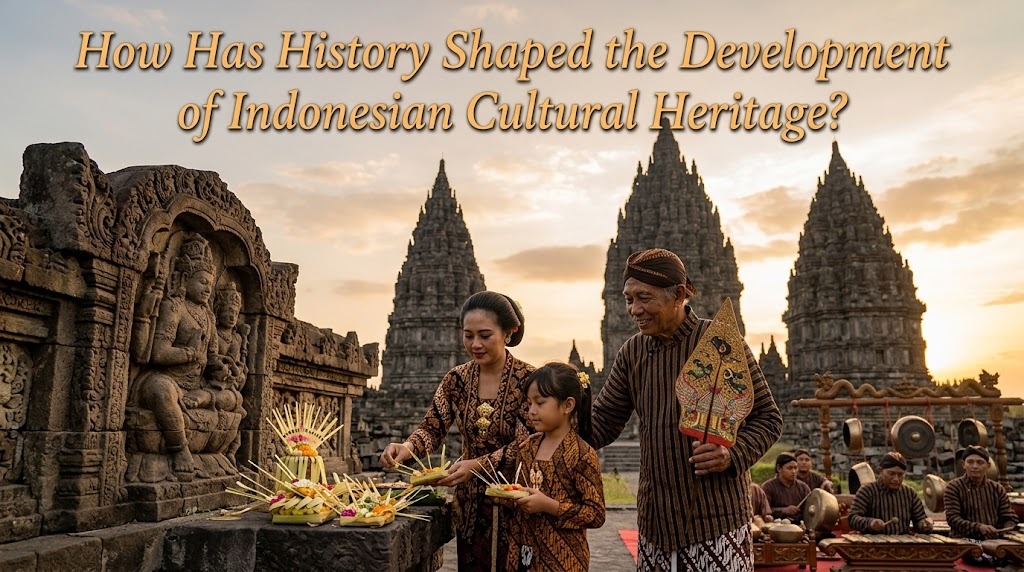
Indonesian cultural heritage has developed through centuries of historical changes, cultural exchanges, migration, trade, and social development. As an archipelago located along important maritime trade routes, Indonesia has interacted with people from many regions, including India, China, the Middle East, and Europe. These interactions influenced local traditions, religious practices, architecture, literature, food, and art. However, Indonesian communities have also maintained their own customs and adapted outside influences to suit their local values and environments. Understanding how history shaped Indonesian cultural heritage helps explain the country's cultural diversity and the importance of preserving it for future generations.
EARLY CIVILIZATIONS AND INDIGENOUS TRADITIONS
Long before major foreign influences reached the Indonesian archipelago, local communities had developed their own cultural traditions, social systems, and practical knowledge. These traditions included farming practices, fishing techniques, pottery, weaving, metalworking, oral storytelling, and traditional ceremonies. Communities also developed distinctive architectural styles using materials available in their surroundings. Beliefs connected with ancestors, nature, and the spiritual world influenced many traditional practices, although customs varied across regions. These early traditions provided an important foundation for the development of Indonesian cultural heritage.
Some indigenous cultural practices have continued through generations and remain meaningful today. Traditional houses, local languages, customary laws, and community ceremonies reflect knowledge developed through long relationships with the environment. For example, many traditional Indonesian communities maintain distinctive building techniques suited to their local climates and natural resources. Oral traditions also preserve stories about ancestors, community origins, and historical experiences. These examples demonstrate that Indonesian cultural heritage did not begin with foreign contact but developed from the creativity and experiences of local societies.
THE INFLUENCE OF HINDUISM AND BUDDHISM
Trade and cultural connections with South Asia contributed to the spread of Hinduism and Buddhism in parts of the Indonesian archipelago during the early centuries of the Common Era. These religions interacted with existing local beliefs and political traditions, influencing the development of kingdoms, literature, art, and architecture. Several historical kingdoms, including Srivijaya and Majapahit, played important roles in regional political and cultural development. Their connections with trade networks helped circulate religious ideas, artistic styles, and forms of knowledge. Over time, these influences became part of the region's diverse cultural history.
The influence of Hinduism and Buddhism can be seen in important historical monuments and artistic traditions. Borobudur in Central Java is a major Buddhist monument known for its architecture and extensive stone reliefs. Prambanan is a significant Hindu temple complex recognized for its tall structures and detailed carvings. Stories from the Ramayana and Mahabharata also influenced forms of literature, dance, and wayang performances in several Indonesian communities. Local artists and communities adapted these stories and traditions to their own cultural settings. This process illustrates how foreign influences became integrated into Indonesian heritage rather than simply replacing local traditions.
THE SPREAD OF ISLAM AND ITS CULTURAL INFLUENCE
Islam spread across parts of the Indonesian archipelago through trade, religious teaching, migration, and political developments over several centuries. Muslim trading communities and local leaders contributed to the growth of Islamic cultural and educational centers, particularly in coastal areas. The development of Islamic sultanates strengthened the role of Islam in regional political and social life. As the religion spread, it interacted with existing customs, artistic traditions, and community practices. This interaction produced different cultural expressions across Indonesia rather than a single uniform tradition.
Islamic influence can be seen in mosque architecture, calligraphy, religious literature, clothing, music, and celebrations. Some traditional mosques in Java feature multi-tiered roofs that reflect local architectural approaches rather than the domes commonly associated with some other Islamic regions. Islamic teachings also influenced literary works and educational traditions, while local communities adapted celebrations and artistic forms to their cultural environments. In some regions, older customs continued alongside Islamic practices, creating distinctive local traditions. These historical developments demonstrate the importance of cultural exchange in shaping Indonesia's religious and artistic heritage.
THE INFLUENCE OF CHINESE AND OTHER ASIAN CULTURES
For centuries, maritime trade connected Indonesian ports with Chinese and other Asian communities. Traders, migrants, and their descendants contributed to economic activity and cultural exchange in various parts of the archipelago. These connections influenced local food, decorative arts, ceramics, architecture, and commercial traditions. In several communities, Chinese cultural elements became part of local life through long-term interaction and adaptation. The extent of these influences varies across regions because Indonesia has a diverse history of migration and settlement.
Chinese-Indonesian cultural traditions can be seen in certain culinary practices, festivals, temples, decorative designs, and forms of craftsmanship. Peranakan culture, which developed through interactions between Chinese communities and local societies in parts of Southeast Asia, provides an example of cultural blending. Its expressions may include distinctive clothing, food, language, and domestic traditions. Chinese ceramics and other traded objects have also contributed to the archaeological record of historical Indonesian trade. These examples show how commerce and migration helped shape cultural heritage beyond religious and political influences.
EUROPEAN COLONIALISM AND ITS IMPACT ON CULTURAL HERITAGE
European involvement in the Indonesian archipelago expanded through maritime trade and colonial competition, beginning with Portuguese and Spanish activities in some regions and later dominated by Dutch colonial rule across much of the territory. Colonialism transformed political institutions, economic systems, urban development, and social relationships. European architectural styles influenced government buildings, churches, residences, and infrastructure in several cities. Colonial administration also affected education, publishing, and the documentation of local cultures. These changes became part of Indonesia's complex historical heritage, although colonial rule also involved exploitation, inequality, and resistance.
Some colonial-era buildings remain important historical landmarks in Indonesian cities. Old Town areas in Jakarta and Semarang contain buildings that reflect aspects of Dutch colonial urban development. Fortifications, railway stations, administrative buildings, and other structures can provide evidence of changing economic and political systems. At the same time, colonial history is preserved through stories of resistance, independence movements, and community struggles. Understanding these sites requires recognizing both their architectural significance and the unequal historical conditions under which many were built and used.
THE STRUGGLE FOR INDEPENDENCE AND NATIONAL IDENTITY
The Indonesian independence movement played a major role in shaping the country's modern cultural identity. During the colonial period, different communities increasingly developed political connections through education, print media, organizations, and nationalist movements. The Youth Pledge of 1928 expressed a commitment to one homeland, one nation, and one language: Indonesia. This declaration helped strengthen a shared national identity among people from different ethnic and regional backgrounds. Following the proclamation of independence on August 17, 1945, cultural diversity became an important part of discussions about building a unified nation.
The development of Indonesian as the national language helped people from different regions communicate and participate in national life. National symbols, literature, music, museums, and educational programs also contributed to the formation of a shared historical narrative. However, national identity did not eliminate regional identities or local traditions. Instead, Indonesia's cultural heritage continued to include many languages, customary practices, artistic forms, and regional histories. The relationship between national unity and cultural diversity remains an important characteristic of Indonesian society.
GLOBALIZATION AND THE MODERN DEVELOPMENT OF CULTURAL HERITAGE
In the modern era, globalization, urbanization, tourism, and digital technology have changed how Indonesian cultural heritage is practiced and shared. Traditional arts and crafts can now reach wider audiences through online platforms, cultural festivals, and international exhibitions. Digital archives and educational videos also help document local languages, historical sites, and traditional knowledge. These developments create new opportunities for cultural education and preservation. They also allow younger generations to explore their heritage while participating in a connected world.
However, modernization can create challenges for cultural continuity. Historical buildings may be threatened by urban development, while some traditional languages and practices face declining use among younger generations. Commercialization can also change cultural activities when they are adapted mainly for tourism or entertainment. Communities therefore need opportunities to maintain control over their traditions and decide how their heritage should be shared. By combining appropriate modern tools with community participation and education, Indonesia can preserve cultural heritage while allowing traditions to evolve naturally.
WHY IS HISTORY IMPORTANT FOR UNDERSTANDING INDONESIAN CULTURAL HERITAGE?
History helps explain why Indonesian cultural heritage is so diverse. Different regions experienced distinct combinations of indigenous development, trade, religious exchange, migration, colonial rule, and political change. These historical experiences influenced local architecture, food, clothing, languages, arts, and social practices. Studying history helps people understand that cultural traditions are often the result of long-term interaction rather than isolated development. It also encourages respect for the different experiences that have shaped communities across the archipelago.
Historical knowledge is also essential for protecting cultural heritage responsibly. Understanding the origins and meanings of traditions helps communities identify what should be documented, maintained, or passed on to younger generations. Historical research can support the conservation of buildings, artifacts, manuscripts, and cultural landscapes. It can also help correct misunderstandings and recognize the contributions of communities that may have been overlooked in popular historical narratives. By learning from the past, Indonesians can make informed decisions about preserving their cultural resources for the future.
CONCLUSION
History has shaped Indonesian cultural heritage through indigenous traditions, religious influences, international trade, migration, colonialism, the independence movement, and modern globalization. Each period contributed different ideas, practices, and artistic expressions that communities adapted to their local environments and cultural values. This long process produced a diverse heritage that includes historical temples, traditional houses, regional languages, music, food, literature, and customary practices.
Understanding these historical influences helps explain the connections between Indonesia's regional cultures and its shared national identity. It also highlights the importance of protecting historical sites and keeping living traditions meaningful for future generations. Preservation requires cooperation among communities, families, educational institutions, cultural practitioners, and governments. By respecting its complex history and supporting its cultural diversity, Indonesia can continue to protect and celebrate its valuable heritage.
Recent Posts

Bagaimana Sistem SKS pada Program Kuliah... 22.11.2026/49 View

How Does Technology Make Daily Evaluation... 21.11.2026/76 View

Apa Strategi Menghadapi Kesenjangan antara Kompetensi... 21.11.2026/78 View

Mengapa Inventaris Aset Penting bagi Kelancaran... 21.11.2026/74 View

When Should Musicians Join a Record... 21.11.2026/78 View
