

How Has the Industrial Revolution Influenced the Development of Modern Transportation?
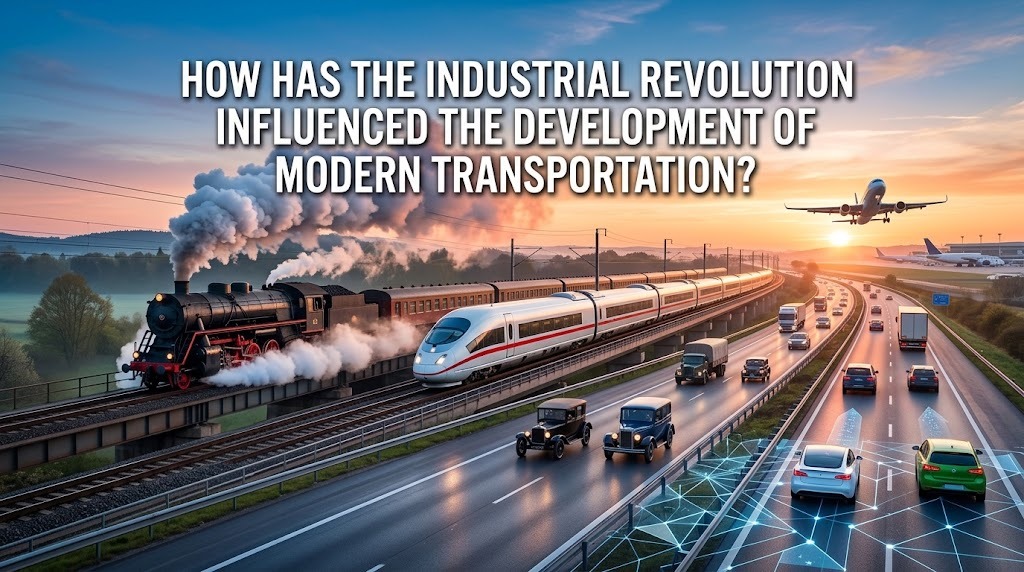
The Industrial Revolution has significantly transformed transportation by introducing new technologies that make travel and the movement of goods faster, more efficient, and more reliable. Before industrialization, people mainly depended on walking, animal-drawn vehicles, sailing ships, and other traditional methods of transportation. The development of steam engines, railways, automobiles, and aircraft gradually changed how people traveled between cities and countries. Today, digital technology, automation, and artificial intelligence continue to improve transportation systems around the world. These developments support economic growth and international connections, although they also create challenges involving pollution, traffic congestion, and infrastructure costs.
THE DEVELOPMENT OF TRANSPORTATION DURING THE INDUSTRIAL REVOLUTION
The First Industrial Revolution, which began in Britain during the eighteenth century, introduced important changes to transportation through the development of steam power. Steam engines made it possible to operate locomotives and steamships, allowing people and goods to travel farther than many traditional methods permitted. Railways connected industrial centers with ports, markets, and rural communities, helping businesses distribute products more efficiently. Steamships also improved the movement of goods across rivers and oceans.
These developments reduced some transportation limitations and supported the expansion of industrial production and trade. Manufacturers could obtain raw materials from more distant locations and distribute finished products to larger markets. Passenger travel also became more accessible as railway networks expanded. Railways and steam-powered ships therefore played a major role in connecting communities and supporting the growth of modern economies. However, early industrial transportation also depended heavily on coal and contributed to air pollution.
THE RISE OF AUTOMOBILES AND MODERN ROAD NETWORKS
The development of the internal combustion engine helped transform transportation during the Second Industrial Revolution. Automobiles became increasingly important as manufacturing techniques improved and vehicles became more widely available. The introduction of assembly-line production helped manufacturers produce cars more efficiently, reducing production costs over time. As automobile ownership increased, many countries expanded their road networks and developed supporting infrastructure such as bridges, fuel stations, and parking facilities.
Modern road transportation provides flexibility because vehicles can travel directly between many locations without requiring railway stations or ports. Trucks also play an essential role in supply chains by transporting food, construction materials, industrial equipment, and consumer products. However, growing dependence on private vehicles has contributed to traffic congestion, road accidents, noise, and greenhouse gas emissions. To address these problems, cities need effective public transportation, safer road designs, and better traffic management. Efficient and sustainable road systems are important for meeting transportation needs while reducing negative effects on communities and the environment.
THE DEVELOPMENT OF AVIATION AND GLOBAL CONNECTIVITY
The development of powered aircraft created another major transformation in transportation. During the twentieth century, improvements in aircraft design, engines, navigation, and safety systems made air travel increasingly practical for passengers and commercial cargo. Aircraft can connect distant cities and countries much faster than most land or sea transportation methods. This capability has strengthened international tourism, business travel, and global trade.
Air transportation is particularly important for moving time-sensitive goods, including certain medical supplies, electronic components, and perishable products. International airports also support economic activities by connecting businesses with customers, suppliers, and partners around the world. However, aviation requires substantial infrastructure and fuel, and it contributes to greenhouse gas emissions. The industry continues to explore more efficient aircraft, sustainable aviation fuels, and improved flight operations. Global connectivity through aviation has expanded economic and social opportunities, but its environmental impact remains an important consideration.
DIGITAL TECHNOLOGY AND INTELLIGENT TRANSPORTATION
The modern Industrial Revolution has introduced digital technology into transportation systems. Global positioning systems, digital maps, mobile applications, and real-time traffic information help travelers choose routes and estimate journey times. Logistics companies can use digital platforms to monitor shipments, coordinate deliveries, and manage vehicle schedules. These tools improve visibility across transportation networks and help businesses respond to delays or changing customer requirements.
Artificial intelligence and automation are also influencing modern transportation. AI-powered systems can analyze traffic patterns, support public transport planning, and help logistics operators optimize delivery routes. Some vehicles use driver-assistance technologies to detect nearby obstacles, maintain safe distances, and support parking. Automated trains and other forms of intelligent transport are used in certain locations under specific operating conditions. Nevertheless, these technologies require reliable infrastructure, cybersecurity protection, careful testing, and appropriate human oversight. Smart transportation systems can improve efficiency and safety when implemented responsibly.
THE IMPACT OF MODERN TRANSPORTATION ON SOCIETY AND THE ECONOMY
Modern transportation supports economic growth by helping people access jobs, education, healthcare, and commercial services. Reliable transport networks allow businesses to move raw materials and finished products efficiently, supporting manufacturing, agriculture, tourism, and retail. Public transportation can also reduce travel costs for people who cannot afford private vehicles. In addition, better connections between urban and rural areas can improve access to essential services and create opportunities for regional development.
However, the benefits of transportation are not distributed equally. Communities with limited infrastructure may experience longer travel times and reduced access to employment or healthcare. Urban areas can face congestion, road safety problems, and air pollution, while large infrastructure projects may require significant financial investment and land use. Governments need to balance economic development with environmental protection and public needs. Affordable public transport, accessible infrastructure, road safety, and cleaner technologies can help create transportation systems that benefit more people while reducing harmful environmental effects.
THE FUTURE OF TRANSPORTATION AND SUSTAINABLE MOBILITY
The future of transportation will increasingly depend on innovation and sustainability. Electric vehicles are becoming an important option for reducing direct exhaust emissions, particularly when supported by cleaner electricity generation. Governments and businesses are also investing in public transportation, cycling infrastructure, and improved railway services to reduce dependence on private cars. These approaches can help cities manage congestion and improve the efficiency of passenger movement.
Further developments in AI, connected vehicles, and automated systems may improve traffic coordination and logistics operations. However, autonomous vehicles still face technical, regulatory, safety, and infrastructure challenges, and their capabilities vary across systems and operating environments. Transportation planners must also consider the environmental impact of batteries, electricity generation, road construction, and vehicle production. Sustainable mobility requires coordinated planning, technological improvements, effective public policies, and responsible travel choices. By combining innovation with environmental and social priorities, societies can develop transportation networks that are safer, more efficient, and more accessible.
KESIMPULAN
The Industrial Revolution transformed transportation through steam-powered trains and ships, automobiles, aircraft, and modern digital systems. Each stage of development has improved the movement of people and goods while supporting economic growth and global connectivity. Today, artificial intelligence, automation, electric vehicles, and intelligent transport systems are creating new opportunities to improve efficiency and safety. However, transportation systems must also address pollution, congestion, infrastructure inequality, and road safety. By investing in sustainable technology and accessible public transportation, societies can build more reliable mobility systems that serve both present and future generations.
Recent Posts

Bagaimana Sistem SKS pada Program Kuliah... 22.11.2026/50 View

How Does Technology Make Daily Evaluation... 21.11.2026/80 View

Apa Strategi Menghadapi Kesenjangan antara Kompetensi... 21.11.2026/79 View

Mengapa Inventaris Aset Penting bagi Kelancaran... 21.11.2026/75 View

When Should Musicians Join a Record... 21.11.2026/80 View
