

How Is Artificial Intelligence Changing the Demand for Professional Skills?
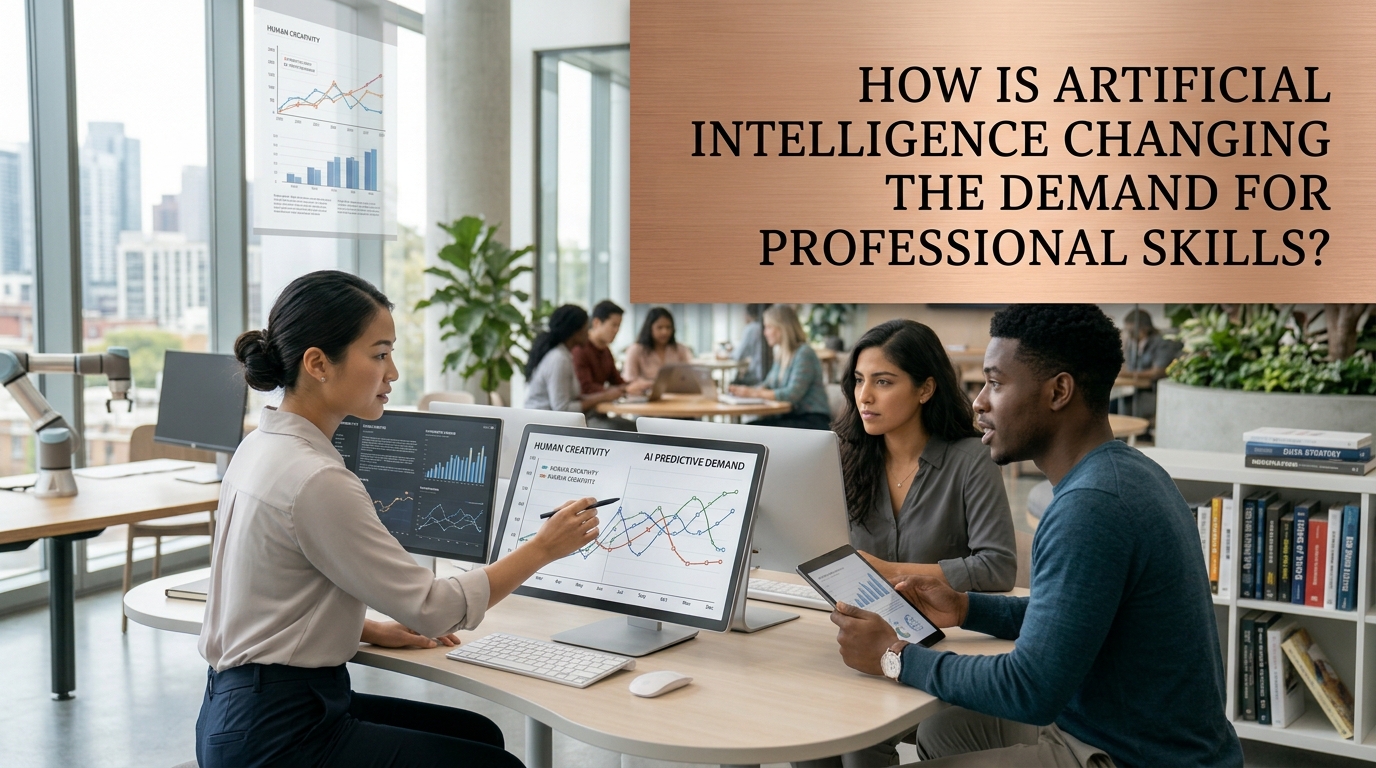
Artificial Intelligence (AI) is transforming the way people work, communicate, and complete professional tasks. Many organizations now use AI technology to process information, automate repetitive activities, analyze data, and improve business operations. These developments are changing the types of abilities employers expect from workers in different industries.
As technology continues to advance, professionals need to develop new competencies to remain competitive in the job market. Some traditional tasks are becoming automated, while new responsibilities require digital knowledge, creativity, and critical thinking. Understanding how Artificial Intelligence changes professional skill demands can help students, graduates, and employees prepare for future career opportunities.
1. AUTOMATING REPETITIVE WORKPLACE TASKS
One of the most significant effects of Artificial Intelligence is its ability to automate repetitive tasks. AI-powered systems can help employees organize documents, process information, respond to basic customer inquiries, and manage routine administrative activities. This allows workers to spend more time on tasks that require human judgment and interaction.
However, automation does not mean that every job will disappear. In many situations, AI changes specific tasks within a job rather than replacing the entire profession. Employees need to understand how automation works and learn to use these tools effectively to improve their productivity.
2. INCREASING THE IMPORTANCE OF DIGITAL LITERACY
As companies adopt AI technology, digital literacy is becoming an essential professional skill. Employees need to understand how digital platforms operate, how to use AI applications, and how to manage information responsibly. These abilities are useful not only in technology companies but also in education, healthcare, finance, marketing, and manufacturing.
Professionals should also understand the limitations of AI-generated information. AI systems can produce inaccurate results, so users must check information before applying it to important decisions. Developing digital knowledge helps employees use technology more confidently and responsibly.
3. CREATING DEMAND FOR DATA ANALYSIS SKILLS
Artificial Intelligence depends heavily on data to identify patterns, generate predictions, and support decision-making. As a result, companies increasingly value employees who can understand, organize, and interpret information. Data analysis skills help professionals evaluate business performance and identify opportunities for improvement.
Workers who understand data can also collaborate more effectively with AI-powered systems. They can examine generated results, recognize possible errors, and determine whether the information is relevant to a particular situation. Knowledge of spreadsheets, statistics, SQL, and data visualization can provide a useful foundation for developing these abilities.
4. STRENGTHENING CRITICAL THINKING AND PROBLEM-SOLVING
Although AI can process large amounts of information, human judgment remains important when evaluating complex situations. Professionals must be able to question results, identify possible mistakes, and consider the consequences of different decisions. This makes critical thinking an increasingly valuable skill in AI-supported workplaces.
Problem-solving is also important because technology cannot independently understand every human need or organizational challenge. Employees must combine available information with practical experience to choose appropriate solutions. Those who can evaluate AI recommendations carefully may contribute more effectively to their organizations.
5. MAKING CREATIVITY AND INNOVATION MORE VALUABLE
AI can generate text, images, ideas, and other digital content, but human creativity remains important in defining goals and producing meaningful work. Professionals need to develop original ideas, understand audience needs, and evaluate whether generated content is suitable for its purpose. Creativity allows employees to use AI as a supporting tool rather than depending on it entirely.
Innovation also requires the ability to identify opportunities and develop new approaches. For example, businesses can use AI to explore customer trends, while employees develop strategies based on those insights. Creative thinking and innovation help organizations create value and respond to changing market demands.
6. INCREASING THE NEED FOR COMMUNICATION AND COLLABORATION
AI technology may automate certain communication activities, but human interaction remains essential in professional environments. Employees still need to explain ideas, negotiate, provide feedback, and build relationships with colleagues and customers. Strong communication skills help ensure that technology supports teamwork instead of creating additional misunderstandings.
Collaboration is equally important because many projects involve people with different professional backgrounds. Employees must be able to work with technical specialists, managers, and other team members to achieve shared objectives. The ability to combine human communication with technological knowledge can become an important professional advantage.
7. CREATING NEW CAREER OPPORTUNITIES
The development of AI is creating demand for new roles and specialized professional abilities. Some examples include AI engineers, machine learning specialists, data scientists, AI researchers, and AI governance professionals. These positions require different combinations of technical knowledge, mathematics, programming, and problem-solving abilities.
AI also creates opportunities in existing professions. Marketing specialists can use AI to analyze customer behavior, teachers can use it to support learning activities, and healthcare professionals can work with AI-assisted systems. However, these tools support professional judgment rather than replacing the need for qualified human expertise.
8. MAKING ADAPTABILITY AND CONTINUOUS LEARNING ESSENTIAL
Artificial Intelligence continues to develop, and the tools used in workplaces may change over time. Professionals need to remain open to learning new applications, updating their knowledge, and adjusting their working methods. Adaptability helps employees respond to technological changes without losing their ability to perform effectively.
Continuous learning can be achieved through online courses, professional training, workshops, and practical projects. Employees should focus on technologies that are relevant to their industries and career goals. By regularly improving their abilities, they can remain prepared for changing job requirements.
9. HIGHLIGHTING HUMAN SKILLS THAT AI CANNOT FULLY REPLACE
As AI becomes more capable, human-centered abilities remain important in many professional situations. Empathy, ethical judgment, leadership, emotional intelligence, and interpersonal communication help individuals understand people and manage sensitive situations. These skills are particularly valuable in professions involving education, healthcare, management, and customer relationships.
AI can provide recommendations, but humans remain responsible for evaluating decisions and considering their wider impact. Professionals must understand issues such as privacy, fairness, accountability, and responsible technology use. Human judgment and ethical responsibility are therefore important parts of working effectively with AI.
CONCLUSION
Artificial Intelligence is changing the demand for professional skills by automating routine tasks, increasing the importance of digital literacy, and creating new career opportunities. At the same time, employers continue to value human abilities such as critical thinking, creativity, communication, leadership, and adaptability.
To remain competitive, students and professionals should learn how to work alongside AI rather than view it only as a replacement for human effort. Combining technical knowledge with strong human skills can help individuals adapt to workplace changes and prepare for future career opportunities.
Recent Posts

Bagaimana Sistem SKS pada Program Kuliah... 22.11.2026/40 View

How Does Technology Make Daily Evaluation... 21.11.2026/71 View

Apa Strategi Menghadapi Kesenjangan antara Kompetensi... 21.11.2026/73 View

Mengapa Inventaris Aset Penting bagi Kelancaran... 21.11.2026/69 View

When Should Musicians Join a Record... 21.11.2026/73 View
