

How Is Artificial Intelligence Changing the Design Industry?
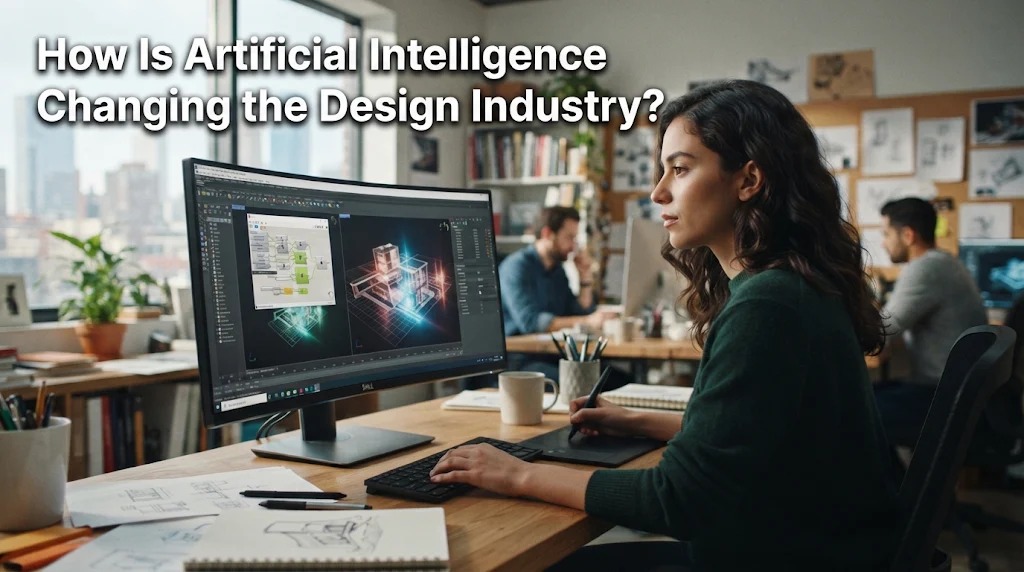
Artificial Intelligence (AI) is changing the design industry by introducing new ways to create, develop, and improve visual content. Many designers now use AI-powered tools to generate ideas, edit images, create layouts, and complete creative tasks more efficiently. These technologies help reduce repetitive work and allow designers to focus more on creativity, problem-solving, and design quality.
The development of AI also changes the skills required in the creative profession. Designers are expected to understand how technology works and how to use it effectively without losing their creative identity. Although AI provides many benefits, it also creates challenges related to originality, copyright, and the role of human creativity.
THE ROLE OF ARTIFICIAL INTELLIGENCE IN MODERN DESIGN
Artificial Intelligence plays an increasingly important role in modern design by helping professionals complete various creative tasks. AI-powered applications can generate images, suggest color combinations, create visual layouts, and provide design recommendations based on written instructions. These features make the creative process more accessible, especially for beginners who are still learning design techniques. Designers can also use AI to explore different concepts before choosing the most suitable direction for a project.
In addition, AI can analyze information and identify patterns that help designers understand audience preferences. For example, businesses can use AI-supported tools to study customer behavior and develop visual content that matches their target markets. This technology is useful in graphic design, web design, advertising, and digital content production. As AI continues to develop, its role in the design industry is expected to become increasingly significant.
AI MAKES THE DESIGN PROCESS FASTER AND MORE EFFICIENT
One of the biggest advantages of AI in the design industry is its ability to speed up the creative process. Designers can use AI tools to remove image backgrounds, improve image quality, generate initial concepts, and perform repetitive editing tasks. Activities that previously required considerable time can now be completed more quickly with the assistance of intelligent software. This allows professionals to manage multiple projects and spend more time improving their final results.
AI can also support the revision process by providing alternative layouts, visual suggestions, and creative references. However, designers still need to review these results to ensure that they meet project requirements. AI-generated content may contain visual errors, inconsistent details, or unsuitable elements. Therefore, combining automated assistance with human judgment is important for maintaining design quality and efficiency.
AI CREATES NEW CREATIVE POSSIBILITIES FOR DESIGNERS
Artificial Intelligence provides designers with new opportunities to experiment with creative ideas. Through generative AI, users can produce images, illustrations, patterns, and visual concepts by entering text descriptions. This technology allows designers to explore different styles and creative directions without starting every element manually. It can also help beginners understand visual composition and discover new approaches to solving design problems.
Furthermore, AI can support collaboration between different creative fields. Graphic designers, illustrators, marketers, and content creators can use AI-generated materials as starting points for their projects. For example, a graphic designer can generate several visual concepts before developing a final advertisement. However, successful results still depend on the designer's ability to select, modify, and combine ideas according to the project's objectives.
CHANGES IN THE SKILLS REQUIRED BY PROFESSIONAL DESIGNERS
The development of AI is changing the skills that designers need to remain competitive. In addition to understanding colors, typography, composition, and visual communication, designers increasingly benefit from learning how to use AI-powered applications. They should also understand prompt writing, digital editing, and the process of evaluating AI-generated results. These abilities help professionals use technology effectively while maintaining control over their creative work.
However, technical knowledge alone is not enough to build a successful design career. Creativity, critical thinking, communication, problem-solving, and an understanding of client needs remain essential. Designers must be able to recognize whether an AI-generated concept is suitable for a particular audience or brand. The combination of human creativity and technological knowledge can help designers adapt to changes in the modern creative industry.
CHALLENGES AND LIMITATIONS OF AI IN THE DESIGN INDUSTRY
Although AI offers many advantages, its use also creates several challenges. One major concern is originality because AI-generated designs may resemble existing visual works or produce content that lacks a distinctive creative identity. Copyright and ownership issues can also become complicated, especially when AI systems are trained using existing creative materials. Designers should understand the relevant rules and check the terms of the tools they use before applying generated content commercially.
Another limitation is that AI does not always understand emotions, cultural context, or specific client expectations accurately. Its results may look attractive but fail to communicate the intended message. Excessive dependence on automated tools can also reduce opportunities to develop fundamental design skills. For these reasons, designers should treat AI as a supporting technology rather than a complete replacement for professional judgment and creativity.
CONCLUSION
Artificial Intelligence is transforming the design industry by making creative processes faster, introducing new possibilities, and changing the skills required by professionals. AI tools can help designers generate ideas, edit visual content, and improve productivity across different design fields. However, challenges involving originality, copyright, and creative quality must also be considered.
To succeed in this changing industry, designers need to balance technological knowledge with human creativity. Learning to use AI effectively while developing fundamental design abilities can create better career opportunities. Rather than replacing creativity, AI can become a valuable tool that helps designers produce more innovative and meaningful work.
Recent Posts

How Does Technology Make Daily Evaluation... 21.11.2026/58 View

Apa Strategi Menghadapi Kesenjangan antara Kompetensi... 21.11.2026/60 View

Mengapa Inventaris Aset Penting bagi Kelancaran... 21.11.2026/56 View

When Should Musicians Join a Record... 21.11.2026/55 View

Daily Evaluation or Daily Planning Which... 21.11.2026/63 View
