

How Is Basic Research Conducted at Universities?
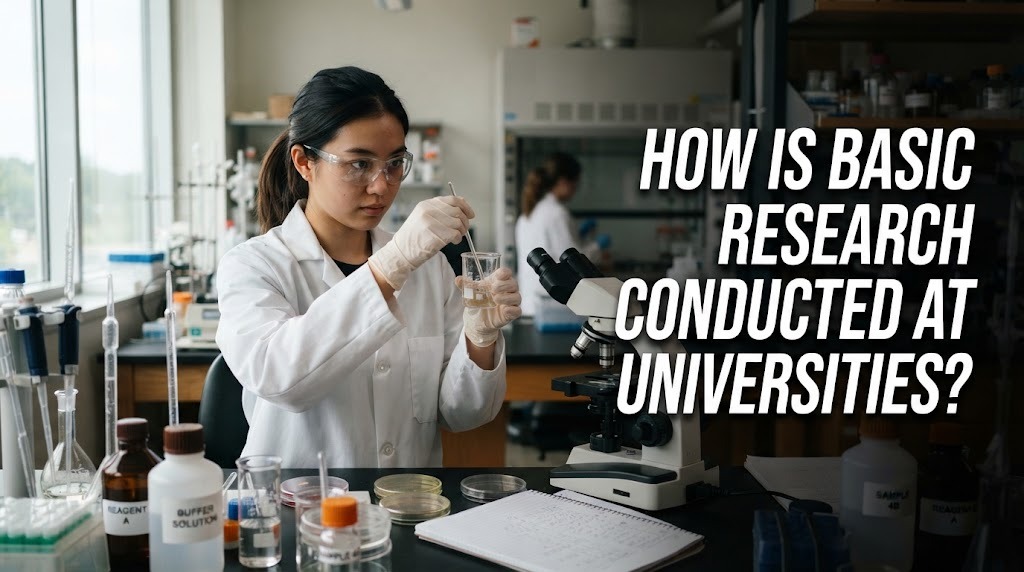
Basic research is an important part of university activities because it helps researchers expand scientific knowledge and understand fundamental questions about the world. Universities provide an environment where lecturers, students, and researchers can investigate scientific phenomena, test theories, and explore new ideas. Unlike applied research, which focuses on solving specific practical problems, basic research primarily aims to develop a deeper understanding of fundamental concepts and principles.
The process of conducting basic research involves several stages, including identifying research questions, reviewing existing literature, developing hypotheses, collecting data, and analyzing results. Universities support these activities through research facilities, academic supervision, funding opportunities, and collaboration between different departments. Although basic research may not produce immediate practical benefits, its findings can become valuable foundations for future discoveries and technological advancements.
IDENTIFYING RESEARCH QUESTIONS AND TOPICS
The first step in conducting basic research at universities is identifying a research question that is relevant to a particular field of study. Researchers often begin by examining existing scientific knowledge and identifying areas that remain unexplained or require further investigation. These questions may come from previous studies, classroom discussions, scientific observations, or emerging theories. A well-defined research question helps researchers establish the purpose and direction of their investigation. It also ensures that the research focuses on a specific issue that can be explored systematically.
For example, a biology researcher might investigate how certain microorganisms respond to environmental changes, while a physics researcher could study the properties of a particular material. University students may also participate in identifying research topics under the guidance of lecturers or academic supervisors. Before proceeding, researchers consider whether the question is scientifically meaningful and whether suitable research methods are available. This initial stage provides the foundation for the entire research process.
REVIEWING EXISTING SCIENTIFIC LITERATURE
After identifying a research topic, researchers review scientific literature to understand what is already known about the subject. They examine journal articles, academic books, previous research reports, and other credible scholarly sources. This process helps researchers understand existing theories, recognize important findings, and identify gaps in current knowledge. It also prevents unnecessary duplication of studies that have already answered the same questions. A thorough literature review allows researchers to develop a stronger scientific foundation for their investigations.
At universities, literature reviews are often conducted through academic databases, university libraries, and scientific journals. Researchers compare findings from different studies to determine where evidence agrees or differs. They also evaluate the quality of previous research and identify limitations that may require further investigation. Based on this information, they can refine their research questions and select appropriate methods. A strong literature review helps ensure that new research contributes meaningful information to the academic community.
DEVELOPING HYPOTHESES AND RESEARCH METHODS
Once researchers understand the existing literature, they may develop a hypothesis to explain a phenomenon or predict a possible relationship between variables. A hypothesis is a proposed explanation that can be examined using appropriate evidence. However, not every basic research project requires a hypothesis, particularly when the study is exploratory or primarily theoretical. Researchers must choose an approach that fits their research questions and the nature of the subject. Careful planning helps ensure that the investigation can produce useful and reliable findings.
Research methods may include laboratory experiments, observational studies, mathematical modeling, theoretical analysis, or computational simulations. For example, chemistry researchers may conduct controlled experiments to investigate the properties of a substance, while mathematics researchers may explore relationships through logical proofs. University researchers also determine what equipment, materials, data, and technical expertise they need. In addition, they consider research ethics, safety procedures, and possible limitations before beginning the investigation. Selecting appropriate methods is essential for producing credible scientific results.
COLLECTING DATA THROUGH EXPERIMENTS AND OBSERVATIONS
Data collection is a central stage in basic research because it provides the evidence needed to examine research questions. Depending on the study, researchers may gather information through experiments, measurements, observations, or the analysis of existing datasets. Universities often provide laboratories, specialized instruments, computing facilities, and other resources to support these activities. Researchers must follow established procedures to ensure that their data are recorded accurately and consistently. Proper documentation also helps other scientists understand how the research was conducted.
For example, a biology research team may observe cellular behavior under different conditions, while an environmental science team may measure changes in water quality to understand underlying chemical processes. Researchers usually repeat measurements or experiments when appropriate to assess consistency and reduce the influence of random errors. They also record unexpected results rather than ignoring evidence that does not match their initial expectations. If human participants, animals, or sensitive information are involved, additional ethical requirements may apply. Reliable data collection creates a solid foundation for the next stage of the research process.
ANALYZING DATA AND INTERPRETING FINDINGS
After collecting data, researchers analyze the information to identify patterns, relationships, and possible explanations. Depending on the research design, they may use statistical methods, specialized software, mathematical calculations, or qualitative analysis. The purpose is to determine what the evidence reveals about the original research question. Researchers must interpret their results carefully and avoid making claims that go beyond the available evidence. This stage may also reveal unexpected findings that lead to additional questions.
University research teams often discuss their findings with colleagues and academic supervisors to examine different interpretations. They compare their results with previous studies to determine whether the findings support, challenge, or extend existing knowledge. If the evidence is insufficient, researchers may need to conduct further experiments or revise their explanations. Not every investigation produces a clear answer, and results that do not support a hypothesis can still contribute valuable knowledge. Through careful analysis, researchers develop conclusions that can be evaluated by the wider scientific community.
THE ROLE OF LECTURERS, STUDENTS, AND RESEARCH TEAMS
Universities encourage basic research by bringing together lecturers, students, laboratory specialists, and researchers with different areas of expertise. Lecturers often guide research projects, help students refine their questions, and provide advice on scientific methods. Students can participate in laboratory activities, research discussions, data analysis, and academic writing. These experiences allow students to develop critical thinking, problem-solving, and scientific communication skills. They also introduce students to the process of producing knowledge rather than simply learning established theories.
Research teams can improve the quality of an investigation by combining different perspectives and technical skills. For instance, a project investigating the fundamental properties of a biological material may benefit from collaboration between biologists, chemists, and data analysts. Universities may also establish partnerships with other academic institutions to share specialized equipment, expertise, and research resources. Such cooperation is particularly valuable when a research question requires knowledge from multiple disciplines. By supporting collaboration and mentorship, universities help researchers explore complex scientific questions more effectively.
FUNDING, RESEARCH FACILITIES, AND ETHICAL STANDARDS
Basic research at universities requires suitable resources, including funding, equipment, laboratory space, research materials, and access to academic publications. Funding may come from university budgets, government research programs, research foundations, or other legitimate sources. These resources allow researchers to conduct experiments, maintain facilities, hire technical assistance, and continue investigations over extended periods. Since basic research does not always lead to immediate commercial benefits, long-term financial support is especially important. Without adequate resources, promising research projects may face delays or limitations.
Universities must also ensure that research follows appropriate ethical and safety standards. Researchers are expected to report their findings honestly, protect confidential information, and acknowledge the contributions of other scholars. Studies involving human participants or animals may require formal ethical review and approval before they begin. Laboratory research must also follow relevant safety procedures to protect researchers and the surrounding environment. Maintaining these standards helps preserve scientific credibility and ensures that the pursuit of new knowledge is conducted responsibly.
PUBLISHING AND SHARING RESEARCH FINDINGS
Once a study is completed, researchers often prepare a scientific paper, conference presentation, or university research report to communicate their findings. Academic publications typically explain the research question, relevant literature, methods, results, and conclusions. Many scientific journals use peer review, in which independent experts evaluate a manuscript before a publication decision is made. This process can help identify weaknesses, improve clarity, and assess the significance of the work. However, peer review does not guarantee that every finding is correct, so further examination and verification remain important.
Sharing research findings allows other scientists to evaluate the evidence, repeat experiments where appropriate, and explore new research questions. Universities may also organize seminars, academic conferences, and research exhibitions to encourage the exchange of ideas. When findings are shared openly and responsibly, researchers can build on one another's work instead of conducting every investigation independently. Some discoveries may inspire further basic research, while others may eventually contribute to practical applications. This exchange of knowledge helps scientific understanding develop over time.
CONCLUSION
Basic research at universities is conducted through a systematic process that begins with identifying research questions and reviewing existing scientific literature. Researchers then select suitable methods, collect and analyze evidence, interpret their findings, and communicate their results to the academic community. Throughout this process, lecturers, students, research teams, funding organizations, and university facilities play important supporting roles.
Although basic research may not provide immediate solutions to practical problems, it helps expand fundamental knowledge and creates opportunities for future discoveries. Strong research methods, ethical practices, collaboration, and reliable funding are essential for producing credible findings. By maintaining a supportive research environment, universities contribute to scientific progress and prepare future generations to explore unanswered questions.
Recent Posts

Bagaimana Sistem SKS pada Program Kuliah... 22.11.2026/43 View

How Does Technology Make Daily Evaluation... 21.11.2026/72 View

Apa Strategi Menghadapi Kesenjangan antara Kompetensi... 21.11.2026/74 View

Mengapa Inventaris Aset Penting bagi Kelancaran... 21.11.2026/70 View

When Should Musicians Join a Record... 21.11.2026/74 View
