

How Is Human Evolution Connected to the Development of Language?
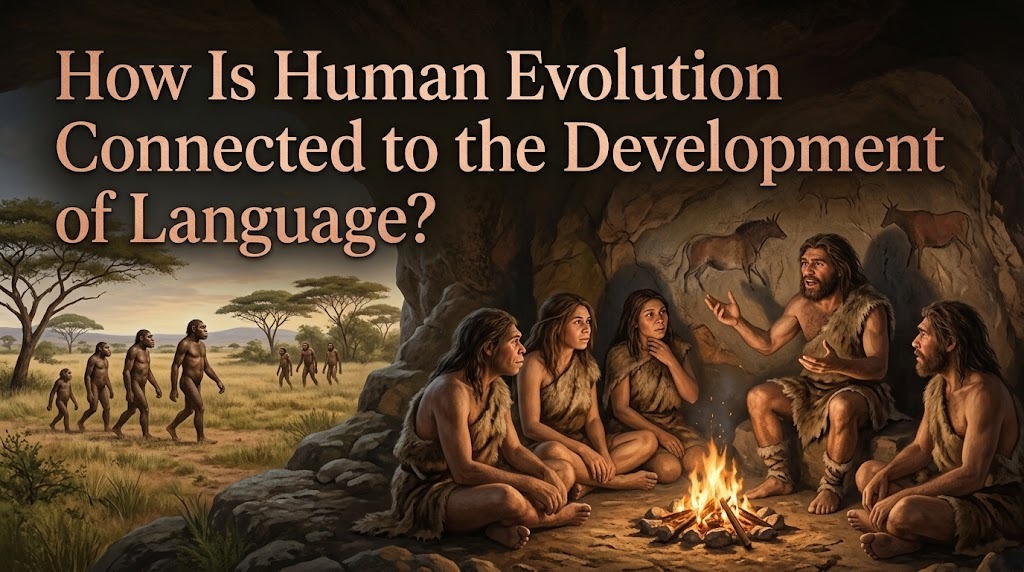
Human evolution and the development of language are closely connected because both have played important roles in shaping human communication, social relationships, and cultural development. Over millions of years, human ancestors developed physical and cognitive abilities that eventually supported complex forms of communication. Changes in the brain, vocal tract, and social behavior helped create the conditions for language to emerge. Although scientists do not know exactly when spoken language first developed, fossil evidence, archaeological discoveries, and genetic research provide valuable clues. Understanding this connection helps explain how humans became capable of sharing complex ideas, preserving knowledge, and building societies.
HOW HUMAN EVOLUTION CREATED THE FOUNDATIONS OF LANGUAGE
Human evolution involved gradual changes in the body and brain that supported increasingly complex behavior. Early human ancestors used gestures, facial expressions, and sounds to communicate information about their surroundings. As social groups became more complex, effective communication may have helped individuals cooperate, find food, and protect one another. Over time, the abilities needed for more advanced communication developed alongside other aspects of human evolution. However, language did not necessarily emerge through one sudden change, and scientists continue to investigate how these abilities developed.
The development of language likely involved several interacting factors, including memory, attention, social understanding, and the ability to associate sounds with meanings. These abilities allowed humans to communicate information beyond immediate needs, such as describing past events or planning future activities. Spoken language may also have developed alongside gestures rather than replacing them completely. Modern humans still use hand movements, facial expressions, and body language when communicating. This suggests that human communication evolved through a combination of biological and social changes.
THE ROLE OF THE HUMAN BRAIN IN LANGUAGE DEVELOPMENT
The human brain plays a central role in understanding and producing language. Several brain regions work together to process speech sounds, recognize words, organize sentences, and communicate meaning. Broca's area is commonly associated with aspects of speech production and language processing, while Wernicke's area has traditionally been linked to language comprehension. However, language depends on broader networks throughout the brain rather than just two isolated regions. The development of these complex networks helped modern humans communicate detailed information and understand increasingly sophisticated messages.
Brain evolution also supported improvements in memory, learning, reasoning, and symbolic thinking. These abilities are important because language requires people to remember vocabulary, understand relationships between words, and interpret meaning in different situations. Fossil skulls can provide information about brain size and the shape of the braincase, but they cannot directly reveal whether an extinct species used fully developed language. Scientists therefore combine fossil evidence with archaeological discoveries and studies of modern human biology. This approach helps researchers investigate the possible cognitive abilities of ancient human ancestors without making unsupported conclusions.
HOW THE HUMAN VOCAL TRACT SUPPORTED SPOKEN LANGUAGE
The human vocal tract includes structures such as the larynx, tongue, lips, and vocal passages that help produce speech sounds. Changes in these structures contributed to the range of sounds modern humans can produce. Precise movements of the tongue and lips allow people to distinguish many different speech sounds, while control of breathing helps support continuous speech. These physical abilities are important for spoken language, but they are not enough by themselves to create a language. Humans also need the cognitive abilities to connect sounds with meanings and organize them according to shared rules.
Scientists study fossilized skulls and other anatomical evidence to investigate the speech abilities of ancient hominins. However, soft tissues such as the tongue and vocal cords rarely survive in the fossil record, making direct reconstruction difficult. The position of certain bones, including the hyoid bone, can provide useful clues about the anatomy involved in speech and swallowing. For example, a Neanderthal hyoid bone discovered in Kebara Cave in Israel has structural similarities to that of modern humans. Nevertheless, anatomical similarities alone cannot prove exactly how Neanderthals communicated or whether their language resembled modern speech.
THE IMPORTANCE OF SOCIAL LIFE IN THE EVOLUTION OF LANGUAGE
Human beings have long depended on cooperation to survive and raise their young. Living in social groups created many situations in which communication could provide an advantage. Individuals needed to share information about food, danger, relationships, and group activities. More effective communication may have strengthened cooperation and helped groups coordinate their actions. These social pressures could have contributed to the gradual development of more complex communication abilities.
Language also made it possible to share knowledge across generations. People could teach others about useful resources, tools, traditions, and ways to solve problems. As communication became more sophisticated, communities could develop shared rules, social identities, and cultural practices. Language may also have helped humans maintain relationships with individuals who were not physically present. Although the exact evolutionary pathway remains uncertain, the relationship between social cooperation and language is an important area of scientific research.
HOW ARCHAEOLOGICAL EVIDENCE HELPS EXPLAIN LANGUAGE EVOLUTION
Because spoken words rarely leave direct physical traces, scientists use archaeological evidence to investigate the possible development of language. Stone tools, symbolic objects, personal ornaments, and cave art can reveal aspects of planning, learning, and cultural expression. Some of these discoveries suggest that ancient humans could share complex knowledge and communicate meanings through objects or images. However, symbolic behavior does not automatically prove the existence of fully developed spoken language. Researchers must examine the age, location, and context of each discovery before drawing conclusions.
The appearance of increasingly complex tools and symbolic objects provides clues about changes in human thinking and social learning. For example, creating specialized tools often requires knowledge of several steps, while teaching others how to make them may involve detailed communication. Evidence of ornaments and artistic objects can also suggest that people shared social meanings or group identities. These behaviors became important parts of human culture, although their relationship with spoken language is not always clear. By combining archaeological evidence with genetics and fossil studies, scientists can develop more reliable explanations of how language-related abilities evolved.
THE RELATIONSHIP BETWEEN GENETICS AND LANGUAGE ABILITY
Genetic research provides another way to investigate the biological foundations of language. Scientists study genes involved in brain development, speech-related motor control, and other processes that contribute to communication. One widely studied gene is FOXP2, which plays a role in the development of neural circuits important for speech and language. Certain changes affecting this gene can cause difficulties with speech movements and aspects of language processing. However, FOXP2 is not a single gene responsible for language, because language depends on many genes interacting with development and environmental experience.
Comparisons between modern humans and other species can help researchers understand the evolution of speech-related abilities. Neanderthals, for example, shared some genetic features associated with speech and language with modern humans. These similarities suggest that certain biological foundations of communication existed before the two groups separated evolutionarily. Nevertheless, genetic evidence cannot establish precisely when language emerged or reveal the full complexity of an extinct species' communication. Language development involved multiple biological systems as well as learning and social interaction.
HOW LANGUAGE TRANSFORMED HUMAN CULTURE AND SOCIETY
Once humans developed complex language, they gained powerful ways to exchange ideas and preserve knowledge. Spoken communication allowed people to describe events, explain procedures, coordinate activities, and discuss possibilities that were not immediately visible. These abilities supported cooperation in larger social groups and helped communities pass knowledge from one generation to another. Language also made it easier to share stories, beliefs, and traditions. Over time, these processes contributed to the development of diverse human cultures.
Language continues to influence how people learn and interact today. Children acquire language through exposure, social interaction, and practice, gradually learning the vocabulary and grammatical patterns used by their communities. Different languages also reflect distinct histories and cultural experiences. The development of writing later allowed people to preserve information beyond the limits of spoken memory, supporting education, science, and historical records. Together, language and culture have helped humans adapt to changing environments and build complex societies.
CONCLUSION
Human evolution is connected to the development of language through changes in the brain, vocal anatomy, genetics, and social behavior. These changes gradually created the biological and cognitive foundations that made complex communication possible. Fossils and archaeological discoveries offer important clues, while genetic research helps explain some of the biological mechanisms involved. However, scientists have not established a precise date for the origin of language or fully reconstructed how the earliest languages worked. What is clear is that language became a powerful human ability, supporting cooperation, cultural learning, and the transmission of knowledge across generations.
Recent Posts

Bagaimana Sistem SKS pada Program Kuliah... 22.11.2026/51 View

How Does Technology Make Daily Evaluation... 21.11.2026/81 View

Apa Strategi Menghadapi Kesenjangan antara Kompetensi... 21.11.2026/81 View

Mengapa Inventaris Aset Penting bagi Kelancaran... 21.11.2026/77 View

When Should Musicians Join a Record... 21.11.2026/82 View
