

Manual Bookkeeping or Software, Which Is Better for Your Business?
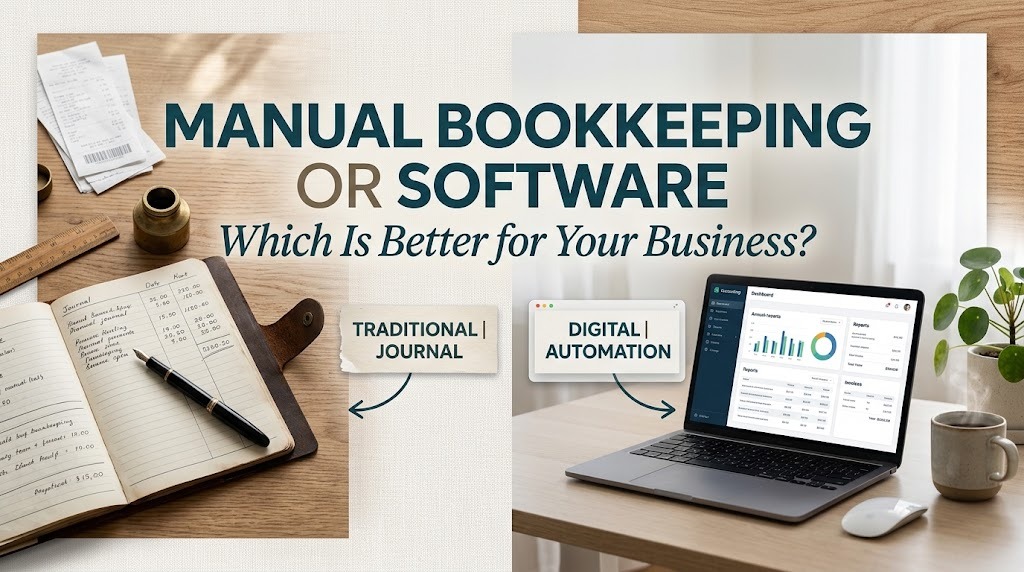
Choosing between manual record-keeping and modern accounting technology is a fundamental decision for every small business owner. Manual bookkeeping relies on physical ledgers or basic spreadsheets to track daily income, operational costs, and general transactions. On the other hand, utilizing cloud bookkeeping software automates data entry, syncs directly with bank accounts, and generates instant financial reports. Both tracking methods aim to maintain accurate financial records, but they differ significantly in speed, cost, and overall data accuracy. Evaluating your transaction volume and operational needs will help determine the best approach for your enterprise.
While manual tracking methods offer low initial setup costs and complete control over data entry, they quickly become inefficient as your business expands. Manual systems require significant time and effort to record entries, balance accounts, and calculate monthly totals correctly. Conversely, digital accounting platforms streamline daily workflows, allowing entrepreneurs to focus on strategic business growth and client acquisition. Comparing the advantages and drawbacks of each system ensures that you select a financial management structure that aligns with your long-term goals.
WHAT ARE THE ADVANTAGES AND LIMITATIONS OF MANUAL BOOKKEEPING?
The primary advantage of manual record-keeping is its low cost and simplicity for early-stage entrepreneurs or solo freelancers. Using paper ledgers or simple spreadsheet templates eliminates recurring software subscription fees, making it an attractive option when operational budgets are tight. Manual tracking forces business owners to manually input every single transaction, fostering a deep, hands-on understanding of their daily cash flow. For very small operations with minimal monthly transactions, manual systems offer a straightforward way to maintain basic financial organization.
However, the limitations of manual record-keeping become glaringly obvious as transaction volumes begin to scale. Manual entry is highly prone to human error, such as mistyped numbers, misplaced invoices, and calculation mistakes that can distort your overall financial picture. Reconciling accounts manually takes hours of tedious effort each month and increases the risk of missing valuable tax deductions. Additionally, manual records lack automated data backups, leaving your financial logs vulnerable to physical damage, loss, or file corruption.
HOW DOES BOOKKEEPING SOFTWARE IMPROVE EFFICIENCY AND ACCURACY?
Adopting automated accounting software transforms financial management by replacing repetitive manual tasks with streamlined digital processes. Modern platforms automatically import bank transactions, categorize routine business expenses, and send automated invoice payment reminders to clients. Automation drastically reduces human error, ensuring high data accuracy across all your financial statements. Saving hours on manual entry allows business owners to reallocate their valuable time toward core business operations and revenue-generating activities.
In addition, digital platforms offer advanced features like mobile receipt scanning, inventory management, and multi-currency support. Cloud-based solutions allow entrepreneurs to access their real-time financial metrics from anywhere using a smartphone or computer. Instant access to updated financial figures enables faster, data-driven decision-making when managing working capital or making major capital purchases. Investing in digital tools turns routine financial tracking into a seamless, highly efficient business habit.
HOW DO BOTH METHODS COMPARE IN TAX PREPARATION AND COMPLIANCE?
Tax preparation can become an overwhelming and stressful ordeal if your business relies on disorganized manual spreadsheets. Gathering physical receipts and manually calculating yearly totals often leads to missing tax write-offs or making expensive filing mistakes. Disorganized paper ledgers also increase the risk of facing penalties during routine tax audits by government authorities. Manual tracking makes collaborating with an external accountant or tax professional slow, tedious, and potentially costly due to added billable hours.
Conversely, bookkeeping software simplifies tax compliance by automatically categorizing tax-deductible expenses throughout the operating year. Digital platforms generate audit-ready reports, such as income statements and balance sheets, with a single click during tax season. Many cloud platforms also allow seamless, read-only access for certified public accountants, enabling smooth collaboration and error-free tax filing. Utilizing digital software guarantees that your enterprise remains compliant while maximizing your eligible tax savings.
WHAT ARE THE COST CONSIDERATIONS FOR EACH TRACKING METHOD?
When evaluating costs, manual record-keeping appears far cheaper on the surface because spreadsheet software is often free or low-cost. However, the hidden cost of manual bookkeeping lies in the valuable time lost on tedious data entry and account balancing. As your business grows, the hours spent maintaining paper ledgers can cost far more in lost productivity than a monthly software subscription. Furthermore, financial errors caused by manual tracking can result in costly bank fees, missed client payments, and tax penalties.
On the flip side, automated bookkeeping software involves a predictable recurring monthly or annual subscription fee. While this represents a direct operational expense, the time saved and error prevention typically offer an outstanding return on investment. Automated tools also reduce the billable hours required when hiring an external professional bookkeeper or tax specialist to clean up your accounts. Weighing subscription costs against long-term operational efficiency clearly favors digital software for growing commercial enterprises.
WHICH BOOKKEEPING METHOD IS RIGHT FOR YOUR BUSINESS GROWTH?
Determining which method is right for your company depends primarily on your transaction complexity, growth trajectory, and personal technical comfort. If you run a micro-business with fewer than twenty transactions a month, a manual spreadsheet may suffice temporarily. However, if you plan to scale your company, hire employees, or seek business loans, transitioning to accounting software early is essential. Upgrading your systems early prevents the chaotic process of migrating years of manual data into digital software later on.
Choosing digital software provides the scalable infrastructure needed to support expanding sales volumes, complex inventory, and multi-channel revenue streams. Automated systems deliver real-time financial reporting, helping you track profit margins and manage working capital with total confidence. Taking a proactive approach to your financial technology builds a resilient, audit-ready framework designed for sustainable commercial success. Selecting the right tools ensures that your accounting system grows smoothly alongside your business.
CONCLUSION
While manual bookkeeping offers low initial costs, adopting bookkeeping software is far better for growing businesses due to superior accuracy, automated efficiency, and easy tax compliance.
Recent Posts

Bagaimana Sistem SKS pada Program Kuliah... 22.11.2026/54 View

How Does Technology Make Daily Evaluation... 21.11.2026/83 View

Apa Strategi Menghadapi Kesenjangan antara Kompetensi... 21.11.2026/81 View

Mengapa Inventaris Aset Penting bagi Kelancaran... 21.11.2026/78 View

When Should Musicians Join a Record... 21.11.2026/82 View
