

What Academic Citation Mistakes Do Students Often Make?
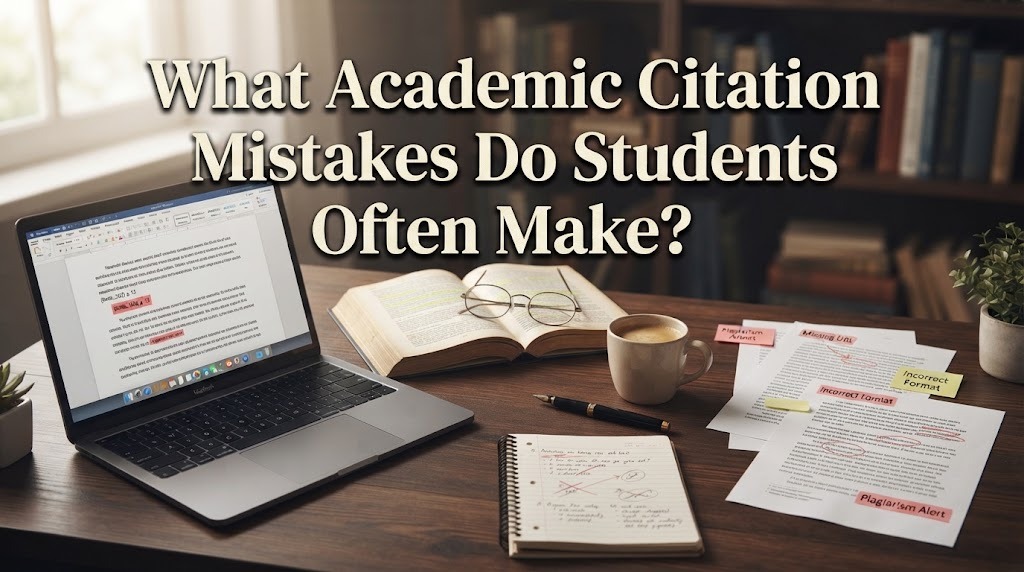
Academic citations are an important part of student writing because they show where information, ideas, and evidence come from. However, many students make citation mistakes because they are unfamiliar with citation rules or do not check their references carefully. Small errors can make an academic paper appear inconsistent and may create problems with source attribution. Understanding common mistakes can help students produce more accurate and responsible academic writing.
FORGETTING TO CITE BORROWED IDEAS
One of the most common academic citation mistakes is forgetting to cite information taken from another source. Some students think that only direct quotations require citations, but ideas that are paraphrased or summarized also generally need to be acknowledged. If a writer uses another person's research, argument, data, or distinctive idea without proper attribution, the work may be considered plagiarism. Students should therefore identify which information comes from their sources during the research process.
A useful habit is to record the source information immediately when taking research notes. Students can write down the author, title, publication date, page number, DOI, or URL when relevant. This makes it easier to add citations later and reduces the risk of forgetting where an idea came from. Careful note-taking is one of the simplest ways to prevent citation problems.
USING THE WRONG CITATION STYLE
Another common mistake is using the wrong citation style for an assignment. Different academic fields and institutions may require styles such as APA, MLA, Chicago, or another system. Each style has different rules for in-text citations, references, punctuation, capitalization, and source organization. Students should always check the instructions provided by their lecturer or institution before starting an assignment.
Students should also avoid mixing different citation styles in the same paper. For example, an APA-style citation should not suddenly be followed by an MLA-style reference format. Even if the source information is correct, inconsistent formatting can make the paper look unprofessional. Choosing one required style and applying it consistently can prevent this problem.
PROVIDING INCOMPLETE SOURCE INFORMATION
Students sometimes create citations without including enough information to identify the original source. Missing details may include the author's name, publication date, title, publisher, page number, DOI, or URL, depending on the citation style and source type. An incomplete citation can make it difficult for readers to locate the material. It can also reduce the credibility of the academic paper.
The information required depends on the type of source being cited. A book, journal article, website, and government report may require different details. Students should therefore avoid using the same citation format for every type of source. Checking the appropriate guidelines can help ensure that important information is not missing.
CITING A SOURCE INCORRECTLY
Another frequent problem is entering incorrect information into a citation or reference. Students may misspell an author's name, use the wrong publication year, change the title, or enter an incorrect page number. These errors can occur when students copy information quickly or rely on incomplete online records. Even small inaccuracies can make a source difficult to locate.
Students should always compare citation information with the original publication whenever possible. Academic databases and citation tools can provide useful information, but their records are not always perfect. Checking the actual book, article, or webpage can confirm whether the details are correct. This additional step improves citation accuracy.
OVERUSING DIRECT QUOTATIONS
Some students use too many direct quotations because they believe quotations make an academic paper stronger. However, an effective paper should usually combine source material with the writer's own explanation and analysis. Excessive quotations can make it difficult to see the student's original argument. Direct quotations should therefore be used when the exact wording of a source is particularly important.
Students can often improve their writing by paraphrasing or summarizing relevant information in their own words while still providing a citation. This demonstrates understanding and allows sources to support rather than dominate the discussion. When a direct quotation is necessary, the quotation should be accurately reproduced and properly cited. The writer should also explain how the quotation supports the argument.
PARAPHRASING TOO CLOSELY
Poor paraphrasing is another common citation problem. This happens when a student changes only a few words from the original source while keeping almost the same sentence structure and wording. Simply replacing words with synonyms does not create a genuinely independent paraphrase. Even when a citation is included, overly close paraphrasing can still be poor academic practice.
Effective paraphrasing requires students to understand the original idea first and then express it using their own sentence structure and language. The meaning of the source should remain accurate, but the wording should be independently constructed. Students should still provide a citation because the underlying idea comes from another author. This approach helps demonstrate both understanding and responsible source use.
MISSING PAGE NUMBERS WHEN REQUIRED
Another mistake is forgetting page numbers when the selected citation style requires them. Page numbers can be particularly important when directly quoting a specific passage from a paginated source. Some styles also recommend or require page or location information for certain types of quotations. Students should check the rules of the citation system they are using rather than assuming that every citation has the same requirements.
Digital sources can make this issue more complicated because some webpages do not have traditional page numbers. In such cases, students should follow the relevant citation style's rules for sources without page numbers. They should never invent a page number. Instead, they should use another permitted method of identifying the relevant part of the source when the style provides one.
MISMATCHING CITATIONS AND REFERENCES
Students sometimes include an in-text citation without adding the corresponding source to the reference list. The opposite problem can also occur when a source appears in the reference list but is never cited in the paper. These mismatches make it difficult for readers to understand which sources actually support the discussion. They can also indicate that the reference list was not carefully reviewed.
Before submitting an assignment, students should compare every in-text citation with the reference list. Author names, publication dates, and other identifying details should correspond appropriately. A final cross-check can reveal missing sources, unnecessary entries, or inconsistent information. This simple review can significantly improve the quality of academic documentation.
RELYING TOO MUCH ON CITATION GENERATORS
Citation generators can save time, but relying on them without checking the results is a common mistake. Automated tools may produce incorrect or incomplete citations when source information is missing or incorrectly identified. They may also use formatting that does not fully match the latest requirements of a particular style. Students remain responsible for checking the citations generated by these tools.
The best approach is to use citation software as a supporting tool rather than a replacement for understanding citation rules. Students should compare generated references with the original source and the required style guide. They should also check whether all important details are present. This combination of technology and human review produces more reliable results.
USING UNRELIABLE ONLINE SOURCES
Not every website found through a search engine is appropriate for academic writing. Students sometimes cite unreliable websites, anonymous pages, or unsupported online claims simply because the information is easy to find. A source should be evaluated based on its author, evidence, publication quality, relevance, and purpose. Search engine ranking alone does not prove that a source is academically reliable.
Students should prioritize credible academic and official sources when appropriate. Peer-reviewed journal articles, scholarly books, government publications, and reputable institutional websites can often provide stronger evidence. However, the best source depends on the research topic and assignment requirements. Evaluating source quality is an important part of responsible academic research.
FAILING TO CHECK CITATION CONSISTENCY
Another mistake is failing to review the entire paper for citation consistency. Students may correctly cite individual sources but use different capitalization, punctuation, author formats, or reference structures throughout the document. These inconsistencies can make the paper difficult to read and may show that multiple citation systems were used accidentally. A final formatting review can help identify these issues.
Students should check the entire citation system as a whole rather than reviewing only one or two references. The same rules should be applied to similar sources throughout the paper. Reference management software can help organize sources, but the final result should still be manually checked. Consistency is an important part of professional academic writing.
CONCLUSION
Students often make academic citation mistakes because citation rules can be detailed and vary between different styles. Common problems include forgetting citations, using the wrong style, providing incomplete information, paraphrasing too closely, overusing quotations, and mismatching citations with references. Other problems include relying too heavily on citation generators and using unreliable online sources.
The best way to avoid these mistakes is to understand the required citation style, keep accurate research notes, verify source information, and review citations before submission. Students should treat citation as an essential part of academic writing rather than a final formatting task. With regular practice and careful checking, they can create clearer, more accurate, and academically responsible papers.
Recent Posts

Bagaimana Sistem SKS pada Program Kuliah... 22.11.2026/40 View

How Does Technology Make Daily Evaluation... 21.11.2026/71 View

Apa Strategi Menghadapi Kesenjangan antara Kompetensi... 21.11.2026/73 View

Mengapa Inventaris Aset Penting bagi Kelancaran... 21.11.2026/69 View

When Should Musicians Join a Record... 21.11.2026/73 View
