

What Activities Can Improve Logical Intelligence Effectively?
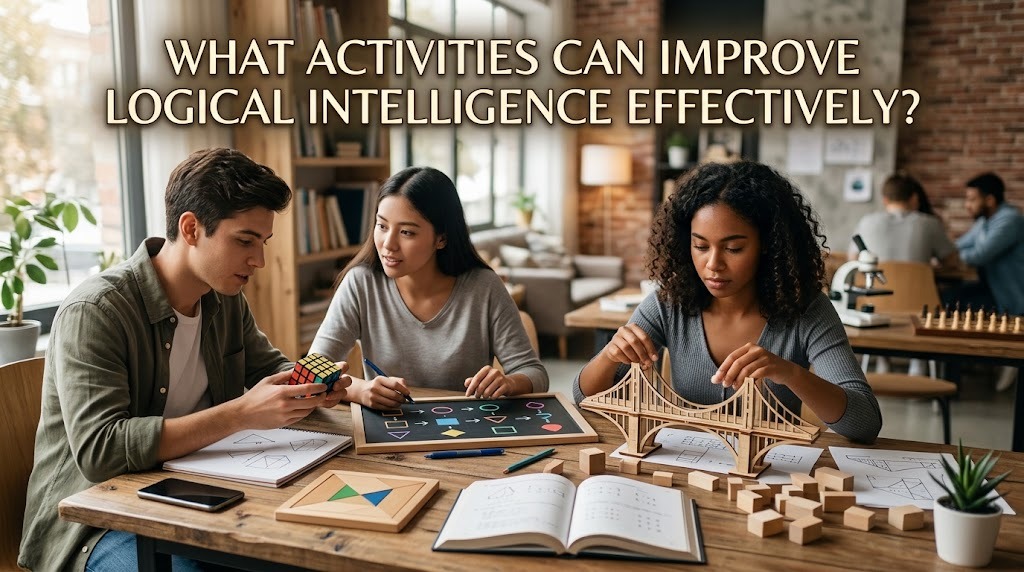
Logical intelligence can be developed through activities that encourage people to analyze information, recognize patterns, understand relationships, and find solutions. These skills are useful for students because many academic tasks require reasoning rather than simple memorization. Activities that involve challenges and decision making can provide opportunities to practice logical thinking. The key is to choose activities that are appropriate for the person's age and ability.
SOLVING PUZZLES AND LOGICAL GAMES
Puzzles and logical games are useful activities for practicing reasoning skills. Sudoku, number puzzles, riddles, mazes, and pattern games require players to examine information and identify possible solutions. These activities encourage people to look for relationships between different elements before making a choice. They can also teach patience because some problems require several attempts.
Logical games can become more challenging as a person's skills improve. Beginners can start with simple patterns or matching activities, while more advanced learners can try problems involving several steps. The goal is not simply to finish the activity quickly. Instead, participants should focus on understanding the reasoning process used to reach the solution.
PLAYING STRATEGY BASED GAMES
Strategy-based games can encourage players to plan ahead, evaluate choices, and predict possible outcomes. Board games, strategy games, and certain digital games often require players to consider what may happen after each decision. This creates opportunities to practice logical reasoning in an engaging environment. Players can also learn from unsuccessful strategies and try different approaches.
These activities can strengthen the ability to connect present actions with future consequences. For example, a player may need to decide whether to prioritize an immediate benefit or prepare for a later challenge. This requires planning, comparison, and decision making. When practiced regularly, these skills can also be applied to academic and everyday situations.
LEARNING CODING AND COMPUTATIONAL THINKING
Coding is another activity that can support logical intelligence because programs usually require instructions to be arranged in a specific sequence. Students need to understand conditions, patterns, and relationships between different parts of a program. When an error occurs, they must examine the code and determine which part needs to be changed. This process provides practical experience with structured problem solving.
Computational thinking does not require everyone to become a professional programmer. Basic coding activities can already introduce important concepts such as sequencing, patterns, conditions, and problem decomposition. Students can start with beginner-friendly exercises and gradually work on more complex projects. This can make logical thinking more practical and connected to technology.
DOING MATHEMATICS AND PATTERN ACTIVITIES
Mathematical activities can provide opportunities to practice reasoning, calculation, pattern recognition, and problem solving. Students can work on number sequences, mathematical puzzles, geometry challenges, and word problems. These activities encourage them to identify relevant information and determine which steps are needed to reach a solution. Mathematics can therefore be one useful way to practice logical thinking.
However, developing logical intelligence is not limited to memorizing formulas. Students should also understand why a particular method works and how it can be applied to different situations. Asking students to explain their solution can help reveal their reasoning process. This makes mathematical learning more focused on understanding rather than simply producing an answer.
CONDUCTING EXPERIMENTS AND OBSERVATIONS
Simple experiments can help students develop logical intelligence by allowing them to observe, predict, test, and evaluate results. Before an experiment, students can make a prediction based on what they already know. After completing the activity, they can compare the actual result with their prediction. This process encourages them to examine cause-and-effect relationships.
Experiments do not always need complicated equipment. Everyday materials can be used for simple activities involving water, objects, plants, measurements, or physical changes. The important part is encouraging students to ask questions and examine the results carefully. Through this process, they can strengthen analytical thinking and evidence-based reasoning.
SOLVING REAL LIFE PROBLEMS
Everyday situations can also become opportunities to improve logical intelligence. Students can practice by planning schedules, organizing belongings, comparing options, managing simple budgets, or deciding the order of tasks. These activities require them to consider priorities and possible consequences. Because they are connected to real situations, students can understand why logical thinking is useful beyond school.
Parents and teachers can encourage students to explain how they reached a decision. For example, they can ask why a certain task should be completed first or why one option may be more suitable than another. This encourages children and students to think about their reasoning instead of simply following instructions. Over time, these habits can support independent thinking and practical problem solving.
CONCLUSION
Several activities can improve logical intelligence effectively, including puzzles, strategy games, coding, mathematics, experiments, and real-life problem solving. Each activity provides different opportunities to practice reasoning, pattern recognition, planning, and decision making. The most useful approach is to practice consistently and choose challenges that match the learner's current ability. Mistakes should also be treated as opportunities to understand different approaches and improve reasoning. By making logical activities part of regular learning, students can gradually develop stronger analytical and problem-solving skills.
Recent Posts

Bagaimana Sistem SKS pada Program Kuliah... 22.11.2026/21 View

How Does Technology Make Daily Evaluation... 21.11.2026/63 View

Apa Strategi Menghadapi Kesenjangan antara Kompetensi... 21.11.2026/65 View

Mengapa Inventaris Aset Penting bagi Kelancaran... 21.11.2026/62 View

When Should Musicians Join a Record... 21.11.2026/59 View
