

What Activities Can Improve Visual Intelligence?
Visual intelligence is the ability to understand, remember, and process information through images, shapes, colors, patterns, and spatial relationships. This skill is useful in learning, work, creativity, and everyday activities. Improving visual intelligence can help people observe details, understand information, and solve problems more effectively.
Fortunately, visual intelligence does not have to be developed through complicated activities. Simple exercises such as drawing, puzzles, photography, and observing patterns can provide regular opportunities to practice visual thinking. With consistent practice, these activities can gradually strengthen visual skills.
DRAWING AND SKETCHING ACTIVITIES
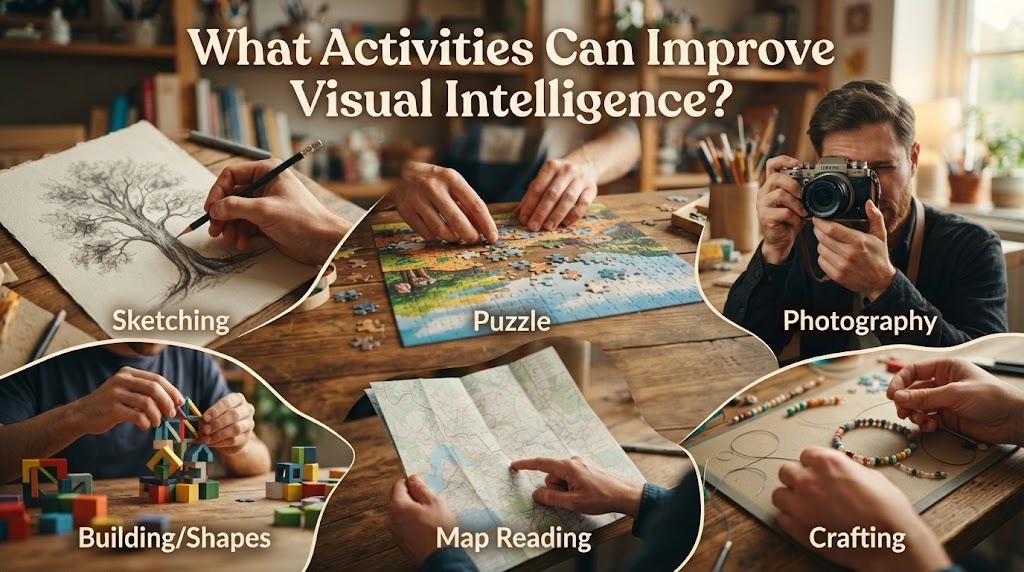
Drawing is one of the simple activities that can improve visual intelligence. When drawing an object, people need to observe its shape, size, position, and details carefully. This process encourages the brain to pay closer attention to visual information.
Drawing from real objects can be especially useful because it requires careful observation rather than simply copying an existing picture. Sketching also supports visual memory and mental visualization because people learn to understand how different parts of an object are connected. The activity can be practiced with simple objects such as cups, books, plants, or household items.
PUZZLES AND BRAIN GAMES
Puzzles can help develop visual intelligence by requiring people to identify shapes, patterns, and relationships. Jigsaw puzzles, tangrams, shape puzzles, and visual matching games are examples of activities that involve visual reasoning. Players need to compare different pieces and determine how they fit together.
These activities can also support problem solving. A person may need to try several possibilities before finding the correct arrangement. Regular puzzle activities can train visual observation, spatial awareness, concentration, and logical thinking in an enjoyable way.
MIND MAPPING AND VISUAL NOTES
Mind mapping is another useful activity for improving visual intelligence. Instead of writing information in long paragraphs, people organize ideas using keywords, branches, symbols, and connections. This approach makes relationships between different ideas easier to see.
Visual notes can be especially helpful for students who want to organize lessons. Using simple diagrams, arrows, icons, and different forms can make information more structured. Creating visual connections between ideas can strengthen both visual thinking and information organization skills.
PHOTOGRAPHY AND VISUAL OBSERVATION
Photography can encourage people to pay attention to composition, distance, lighting, shapes, and details. Even taking simple photographs with a smartphone can become an exercise in visual observation. Before taking a picture, a person needs to decide what should be included in the frame and where different objects should be positioned.
Another useful exercise is observing a scene and identifying details that might normally be ignored. People can compare colors, shapes, textures, and positions within the environment. These activities train the ability to notice visual information more carefully and accurately.
BUILDING AND SPATIAL ACTIVITIES
Building activities can strengthen spatial awareness by requiring people to understand how objects fit together. Children can use blocks or construction toys, while older students and adults can try model building, 3D design, or simple architectural activities. These activities encourage the brain to think about size, distance, direction, and position.
Building also requires mental visualization. Before creating something, a person may imagine what the finished structure will look like and determine which parts should be placed first. This combination of planning and spatial thinking can support visual intelligence and problem solving.
READING MAPS AND INTERPRETING VISUAL INFORMATION
Reading maps is a practical way to develop visual intelligence. Maps require people to understand symbols, directions, distances, and relationships between locations. Navigation activities can therefore help strengthen spatial awareness and visual interpretation.
People can also practice by reading charts, graphs, diagrams, and infographics. These forms of information require the reader to identify patterns and understand relationships between visual elements. Learning to interpret visual information can make it easier to understand complex ideas in academic and everyday situations.
PATTERN RECOGNITION AND DAILY PRACTICE
Pattern recognition is an important part of visual intelligence. People can practice by identifying repeated shapes, colors, numbers, objects, or designs in their surroundings. Activities such as finding differences between pictures or completing visual sequences can also train this ability.
The most important factor is consistency. Small visual exercises performed regularly can gradually improve observation, visual memory, spatial awareness, and visual thinking. People do not need special equipment because many activities can be done using everyday objects, paper, photographs, maps, or digital tools.
CONCLUSION
Many simple activities can help improve visual intelligence. Drawing, puzzles, mind mapping, photography, building, map reading, and pattern recognition provide opportunities to develop visual thinking in practical and enjoyable ways.
The key is to practice regularly and choose activities that match personal interests and abilities. By making visual exercises part of everyday learning or free time, people can gradually improve their ability to observe, organize, visualize, and understand information.
Recent Posts

Bagaimana Sistem SKS pada Program Kuliah... 22.11.2026/21 View

How Does Technology Make Daily Evaluation... 21.11.2026/63 View

Apa Strategi Menghadapi Kesenjangan antara Kompetensi... 21.11.2026/65 View

Mengapa Inventaris Aset Penting bagi Kelancaran... 21.11.2026/62 View

When Should Musicians Join a Record... 21.11.2026/59 View
