

What Are Some Examples of Basic Research Across Different Fields?
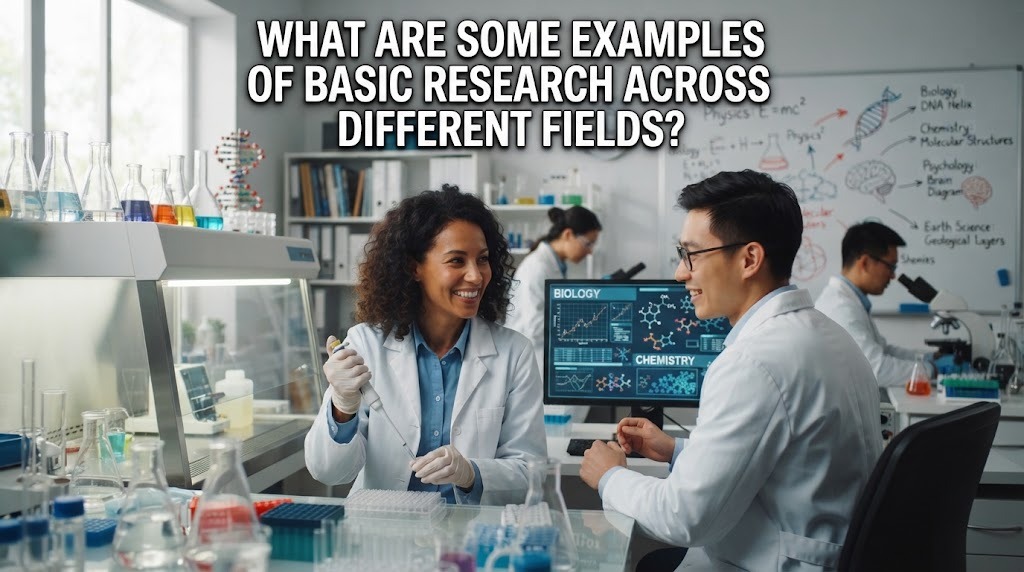
Basic research plays an important role in expanding scientific knowledge and helping people understand how the world works. It focuses on discovering fundamental principles, exploring theories, and investigating phenomena without necessarily aiming to solve an immediate practical problem. Basic research can be conducted in many fields, including biology, physics, chemistry, psychology, education, and social sciences. Although its results may not have immediate applications, they can provide a foundation for future discoveries and technological innovations. Understanding examples of basic research across different fields helps students and researchers recognize its contribution to scientific progress.
BASIC RESEARCH IN BIOLOGY
In biology, basic research focuses on understanding living organisms, their structures, and the processes that support life. Scientists may investigate how cells divide, how genes influence biological characteristics, or how organisms respond to changes in their environments. For example, researchers might study how cells communicate with one another to understand the mechanisms that regulate growth and development. This research aims to explain biological processes rather than immediately develop a medical treatment or commercial product.
Another example is investigating how plants absorb nutrients and respond to environmental conditions. Researchers may examine the role of specific genes in plant growth or explore how plants adapt to different levels of sunlight. These studies expand knowledge about living systems and provide a foundation for future research in agriculture, medicine, and environmental science. The discoveries may eventually support practical applications, even when those applications are not the original purpose of the research.
BASIC RESEARCH IN PHYSICS
Physics explores the fundamental laws governing matter, energy, motion, and the universe. Basic research in this field seeks to understand the principles behind natural phenomena. For example, physicists may investigate the properties of subatomic particles to learn more about the structure of matter. They may also study gravity, electromagnetic interactions, or the behavior of materials under extreme conditions. These investigations primarily aim to improve scientific understanding rather than produce an immediate commercial application.
Another example is research into quantum mechanics, which examines how matter and energy behave at very small scales. Scientists investigate concepts such as quantum states, particle interactions, and the behavior of light. The findings can improve our understanding of the physical world and contribute to future technological developments. However, the main objective of basic physics research is to explain fundamental principles, even when the practical benefits remain uncertain.
BASIC RESEARCH IN CHEMISTRY
Basic research in chemistry investigates the composition, structure, properties, and reactions of substances. Chemists may study how atoms form chemical bonds or why certain molecules react differently under specific conditions. For example, researchers might investigate the behavior of a particular molecule when exposed to different temperatures or pressures. The goal is to understand the underlying chemical mechanisms rather than immediately create a marketable product.
Another example involves examining how catalysts influence chemical reactions at the molecular level. Researchers may investigate why certain substances increase reaction rates and how their structures affect chemical behavior. Such studies can improve fundamental knowledge of chemical processes. Although the findings may later support the development of medicines, cleaner energy technologies, or industrial materials, the original research may focus entirely on understanding the chemistry involved.
BASIC RESEARCH IN PSYCHOLOGY
In psychology, basic research aims to understand human thoughts, emotions, learning, memory, and behavior. Researchers may investigate how people form memories, recognize patterns, or respond to different types of information. For example, a psychologist might study how attention affects the amount of information a person remembers after reading a passage. The purpose is to understand the mental processes involved rather than immediately develop a treatment or training program.
Another example is investigating how people make decisions when presented with several choices. Researchers may examine how uncertainty, previous experiences, or cognitive biases influence decision-making. These studies can help explain why people sometimes make different choices in similar situations. Their findings may eventually contribute to education, mental health services, and organizational practices, but basic psychological research primarily seeks to develop a clearer understanding of human behavior.
BASIC RESEARCH IN EDUCATION
Basic research in education investigates how people learn, develop knowledge, and process information. Researchers may explore the relationship between attention and memory, the development of reasoning skills, or the ways people understand complex concepts. For example, a study might investigate how students organize information in their memory when learning unfamiliar subjects. The aim is to understand the learning process rather than immediately introduce a new teaching method.
Another example is examining how prior knowledge influences a person's ability to understand new information. Researchers may compare how individuals with different levels of background knowledge approach the same learning task. The findings can help explain differences in comprehension and knowledge retention. Although this research may later inform teaching strategies, its primary purpose is to expand understanding of the mechanisms behind learning.
BASIC RESEARCH IN ASTRONOMY
Astronomy uses basic research to investigate celestial objects, cosmic structures, and the origins of the universe. Scientists may study the formation of stars, the movement of planets, or the properties of distant galaxies. For example, researchers might analyze the light emitted by a distant star to understand its temperature, chemical composition, and physical characteristics. Such investigations help explain how celestial objects form and evolve over time.
Another example is studying cosmic background radiation to learn about the early universe. Researchers analyze this radiation to investigate the conditions that existed shortly after the Big Bang. Their work helps test theories about the universe's origin and development. Although astronomical discoveries can eventually support technological advances in observation and measurement, the central objective of basic astronomy research is to improve our understanding of the cosmos.
BASIC RESEARCH IN SOCIAL SCIENCES
Basic research in social sciences examines how people interact, form communities, develop cultures, and organize societies. Researchers may investigate social relationships, group behavior, cultural values, or the factors that influence human cooperation. For example, a sociologist might study how social norms develop within different communities. The goal is to understand the patterns and mechanisms that shape social life rather than immediately create a policy or intervention.
Another example is research into how people develop trust within groups. Researchers may examine whether shared experiences, social identity, or communication patterns influence trust between individuals. These findings can improve theoretical understanding of social relationships and collective behavior. In the future, such knowledge may inform community programs, organizational management, and public policy, although these applications are not necessarily the original research objective.
BASIC RESEARCH IN MATHEMATICS
Basic research in mathematics focuses on discovering mathematical relationships, developing theories, and proving abstract principles. Mathematicians may investigate number patterns, geometric structures, or properties of mathematical systems. For example, a researcher might explore whether a particular relationship holds true for an entire class of numbers and then attempt to prove it. The objective is to establish mathematical knowledge rather than solve an immediate real-world problem.
Another example is studying prime numbers and their distribution. Researchers investigate patterns in prime numbers to develop a deeper understanding of number theory. Even when a discovery has no immediate practical use, it can strengthen the foundations of mathematics. Some mathematical theories later become important in computer science, cryptography, and engineering, demonstrating how abstract knowledge can eventually support practical applications.
BASIC RESEARCH IN ENVIRONMENTAL SCIENCE
Basic research in environmental science investigates natural systems and the interactions between organisms, ecosystems, and their surroundings. Scientists may study how carbon moves through ecosystems, how microorganisms contribute to soil processes, or how species interact within a habitat. For example, researchers might investigate the relationship between soil microorganisms and the natural decomposition of organic matter. This work helps explain fundamental ecological processes without necessarily aiming to create an immediate environmental solution.
Another example is examining how ocean currents influence the distribution of heat across the planet. Researchers may analyze ocean circulation patterns to understand their relationship with global climate systems. These findings contribute to scientific knowledge about Earth's natural processes. Although they can eventually support climate modeling and environmental management, basic research primarily seeks to explain how ecosystems and the planet function.
WHY BASIC RESEARCH IS IMPORTANT ACROSS DIFFERENT FIELDS
Basic research is important because it builds the foundation for scientific discovery and long-term innovation. By investigating fundamental questions, researchers can identify patterns, develop theories, and challenge existing assumptions. Its findings can also connect different disciplines by revealing shared principles or new research questions. Although the results may not lead to immediate practical benefits, they can become essential to future scientific and technological developments.
Basic research also encourages curiosity, critical thinking, and evidence-based reasoning. Universities and research institutions often support this work because new knowledge can benefit society in ways that are difficult to predict in advance. For example, a discovery about the properties of a material may eventually influence electronics, medicine, or energy technology. This shows why basic research deserves continued support, even when its immediate economic or practical value is not clear.
CONCLUSION
Examples of basic research can be found across biology, physics, chemistry, psychology, education, astronomy, social sciences, mathematics, and environmental science. Each field uses systematic investigation to answer fundamental questions and expand knowledge. While the subjects and methods differ, the central purpose remains the same: to understand how things work and why phenomena occur. Basic research does not always produce immediate solutions, but its discoveries can establish the foundation for future applications and innovation. By supporting basic research across different disciplines, society can strengthen scientific knowledge and create opportunities for future progress.
Recent Posts

Bagaimana Sistem SKS pada Program Kuliah... 22.11.2026/43 View

How Does Technology Make Daily Evaluation... 21.11.2026/72 View

Apa Strategi Menghadapi Kesenjangan antara Kompetensi... 21.11.2026/74 View

Mengapa Inventaris Aset Penting bagi Kelancaran... 21.11.2026/70 View

When Should Musicians Join a Record... 21.11.2026/74 View
