

What Are Some Popular Examples of Regional Accents in Indonesia?
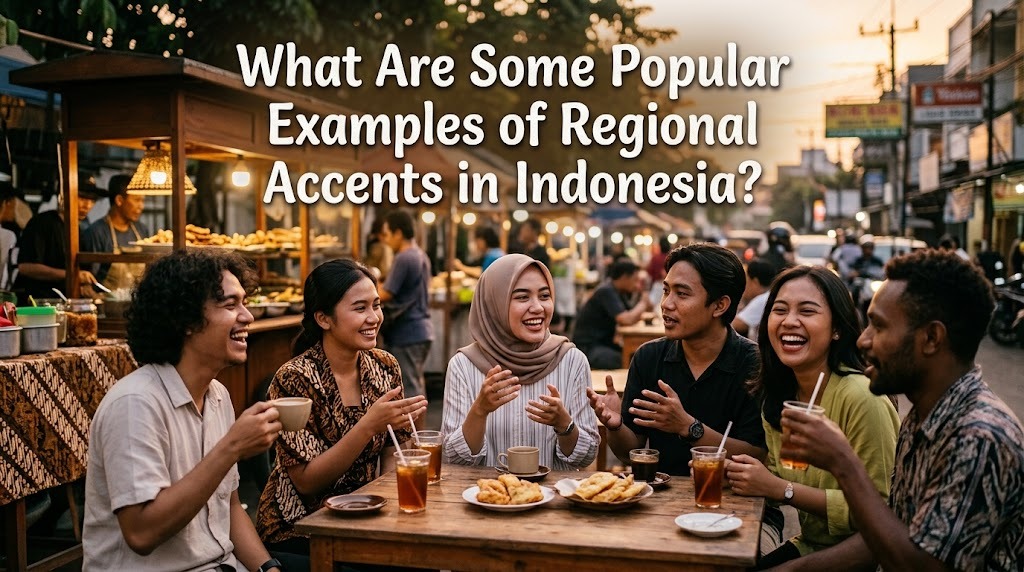
Indonesia is known for its rich cultural and linguistic diversity, which can be heard in the way people speak Indonesian across different regions. Although Bahasa Indonesia serves as the national language, speakers from Java, Sumatra, Bali, Sulawesi, and eastern Indonesia often have distinctive accents. These accents can differ in pronunciation, intonation, speaking rhythm, and the influence of local languages.
Regional accents are part of everyday communication and reflect the history and cultural identity of local communities. Some accents are widely recognized because of their distinctive sounds, while others are familiar mainly within particular areas. Understanding popular examples of regional accents in Indonesia helps people appreciate the country's linguistic diversity and communicate more respectfully with speakers from different backgrounds.
JAVANESE ACCENT FROM CENTRAL AND EASTERN JAVA
The Javanese accent is one of the most recognizable regional accents in Indonesia. It is commonly heard in Central Java and East Java, although pronunciation and speaking styles vary considerably between cities and communities. The accent is influenced by the Javanese language, which has its own sound patterns, vocabulary, and speech conventions. Some Javanese speakers may pronounce certain Indonesian words with distinctive vowel qualities or use an intonation pattern influenced by their first language.
In everyday conversation, some speakers from Central Java may sound relatively soft or measured, while certain East Javanese varieties can sound more direct and energetic. However, these descriptions are general impressions rather than fixed rules for every speaker. Javanese speech also varies according to social context, age, and local identity. These differences demonstrate how a shared regional language can produce several recognizable accents rather than just one uniform way of speaking.
SUNDANESE ACCENT FROM WEST JAVA
The Sundanese accent is commonly associated with West Java, including areas around Bandung and other Sundanese-speaking communities. It is influenced by the Sundanese language, which has distinct pronunciation patterns and a characteristic intonation. When speaking Indonesian, some Sundanese speakers carry over these patterns, making their speech recognizable to listeners familiar with the region. The extent of this influence differs from person to person.
Sundanese communication also has cultural conventions related to politeness and social relationships. These conventions may influence word choice and speaking style, although they are not exclusively features of an accent. People from Bandung and surrounding areas may sound different from speakers in other parts of West Java because of local linguistic variation. The Sundanese accent illustrates how regional language and cultural practices can influence the way people use the national language.
BETAWI ACCENT FROM JAKARTA
The Betawi accent is strongly associated with Jakarta and the Betawi community, whose language developed through long-term contact among different ethnic and linguistic groups. Betawi speech has been influenced by Malay and other languages spoken in the region, reflecting Jakarta's history as a center of trade and migration. When speaking Indonesian, some Betawi speakers use distinctive intonation, relaxed pronunciation, and expressions associated with everyday urban communication.
Betawi speech is also widely represented in Indonesian television, films, comedy, and popular entertainment. This exposure has made certain Betawi expressions and speech patterns familiar to audiences across the country. However, not everyone living in Jakarta speaks with a Betawi accent, and urban Indonesian varies according to family background and social environment. The Betawi accent is therefore an important example of how a regional way of speaking can influence popular culture and everyday language.
MINANGKABAU ACCENT FROM WEST SUMATRA
The Minangkabau accent is associated with West Sumatra and communities that speak the Minangkabau language. When Minangkabau speakers use Indonesian, their pronunciation and intonation may reflect patterns from their local language. Some speakers have distinctive vowel sounds, speech rhythms, or ways of emphasizing words that listeners may recognize as Minangkabau-influenced. These characteristics can vary between areas and individual speakers.
Minangkabau communities have a long history of migration and cultural exchange, which has helped spread their language and cultural traditions to other parts of Indonesia. As a result, Minangkabau-influenced speech can also be heard outside West Sumatra. People who move to other cities may retain some regional pronunciation while adapting their language to new environments. This accent shows how migration can spread regional speech patterns beyond their original geographical boundaries.
BATAK ACCENT FROM NORTH SUMATRA
The Batak accent is commonly associated with speakers from North Sumatra, including communities with Batak language varieties such as Toba Batak, Karo, and Simalungun. Because Batak refers to several distinct ethnic and linguistic groups, there is no single accent that represents every Batak speaker. When speaking Indonesian, some individuals carry over pronunciation, rhythm, and intonation patterns influenced by their particular regional language.
Some listeners may perceive certain Batak-influenced speech as firm, energetic, or strongly articulated. However, these are subjective impressions and should not be treated as universal characteristics of Batak people. Actual pronunciation depends on the speaker's language background, location, age, and personal speaking style. Recognizing this diversity helps avoid stereotypes and provides a more accurate understanding of regional accents in Indonesia.
BALINESE ACCENT FROM BALI
The Balinese accent is influenced by the Balinese language, which is widely spoken in Bali alongside Indonesian. When speaking Indonesian, some Balinese speakers retain pronunciation patterns and intonation influenced by their local language. Their speech may also reflect the linguistic environment in which they grew up, including the languages used at home, school, and work. As with other regional accents, the features differ among individuals and communities.
Bali's tourism industry brings residents into frequent contact with visitors from other parts of Indonesia and abroad. This interaction encourages many people to use Indonesian and other languages in different situations. Some speakers adjust their pronunciation depending on whom they are speaking with, while others maintain a more noticeable Balinese accent. The Balinese accent demonstrates how local linguistic traditions can remain present even in communities with extensive international contact.
BUGIS ACCENT FROM SOUTH SULAWESI
The Bugis accent is associated with speakers from South Sulawesi, particularly those whose first language is Bugis. The Bugis language has its own sound system and pronunciation patterns, which can influence how speakers pronounce Indonesian words. Depending on the individual, these influences may be noticeable in vowel and consonant production, intonation, or speech rhythm.
South Sulawesi is home to several linguistic communities, including Bugis and Makassarese speakers. Consequently, not every accent from the region is the same, and a person's speech may reflect more than one linguistic influence. Migration and contact with speakers from other regions can also affect pronunciation over time. The Bugis accent is an important example of the linguistic diversity found across the Indonesian archipelago.
MAKASSARESE ACCENT FROM SOUTH SULAWESI
The Makassarese accent is associated with the Makassarese language and communities around Makassar and other parts of South Sulawesi. When speaking Indonesian, some Makassarese speakers carry over pronunciation and intonation patterns from their local language. These features can create a recognizable regional sound, although the exact characteristics vary among speakers.
Makassar is an important urban and commercial center in eastern Indonesia, bringing together people from many linguistic backgrounds. Daily interactions among these communities create opportunities for regional speech patterns to mix and change. Some residents use Indonesian with a strong local influence, while others develop speech patterns shaped by education, migration, and contact with different groups. The Makassarese accent highlights the continuing relationship between regional languages and urban communication.
PAPUAN ACCENTS FROM PAPUA AND SURROUNDING AREAS
Papuans speak many different local languages, so there is no single accent that represents everyone in Papua. In some communities, Indonesian is spoken with pronunciation and intonation influenced by local languages or regional varieties of Malay. Papuan Malay, for example, is an important language variety used for everyday communication in parts of Papua and has its own linguistic characteristics. The way people speak Indonesian can be influenced by their experience with Papuan Malay and their first language.
Speech patterns also vary across Papua because the region contains many distinct linguistic and cultural communities. Differences in local language, location, education, and social interaction all contribute to this variation. It is therefore inaccurate to assume that every Papuan speaker has the same accent. These examples show why Indonesia's regional accents should be understood as a diverse collection of speech patterns rather than a small set of uniform categories.
WHY INDONESIAN REGIONAL ACCENTS SOUND DIFFERENT
Regional accents develop when people learn and use languages within particular communities. The pronunciation habits of a first language can influence the way a person speaks Indonesian, especially when the two languages have different sound systems or intonation patterns. Geography and history can also contribute to differences by shaping how communities interact and exchange linguistic features. Over generations, these influences can create recognizable regional ways of speaking.
Modern communication, migration, education, and social media continue to influence Indonesian accents. People who move between regions may adapt their speech, while others maintain strong connections to their original accents. Some speakers also switch between different ways of speaking depending on whether they are at home, at school, or in a professional environment. These changes show that accents are not fixed but can evolve throughout a person's life.
THE IMPORTANCE OF RESPECTING REGIONAL ACCENTS
Regional accents are an important part of Indonesia's linguistic and cultural heritage. They provide clues about the languages and communities that have influenced a person's speech, although an accent alone cannot reliably determine someone's birthplace or identity. Different accents also make everyday conversations more culturally interesting by reflecting the experiences of people across the country.
Respecting regional accents helps build better communication and reduces unfair judgments based on pronunciation. No regional accent is inherently more intelligent, correct, or professional than another. In formal situations, speakers may choose standardized Indonesian to support clear communication, but this does not mean they must eliminate their natural accents. Appreciating these differences supports cultural understanding and helps preserve Indonesia's linguistic diversity.
CONCLUSION
Popular examples of regional accents in Indonesia include Javanese, Sundanese, Betawi, Minangkabau, Batak, Balinese, Bugis, Makassarese, and the diverse accents heard in Papua. Each is influenced by local languages, cultural traditions, geographical conditions, and patterns of social interaction. However, these accents are not uniform, and speakers from the same region can sound different from one another.
Understanding regional accents helps explain why Indonesian can sound different across the archipelago even when people use the same national language. Rather than viewing these differences as barriers, people can appreciate them as expressions of Indonesia's cultural richness. By respecting the many ways Indonesians speak, society can encourage more inclusive communication and strengthen appreciation for the country's linguistic heritage.
Recent Posts

Bagaimana Sistem SKS pada Program Kuliah... 22.11.2026/54 View

How Does Technology Make Daily Evaluation... 21.11.2026/83 View

Apa Strategi Menghadapi Kesenjangan antara Kompetensi... 21.11.2026/82 View

Mengapa Inventaris Aset Penting bagi Kelancaran... 21.11.2026/78 View

When Should Musicians Join a Record... 21.11.2026/84 View
