

What Are the Advantages of Google Scholar Compared With Other Academic Search Engines?
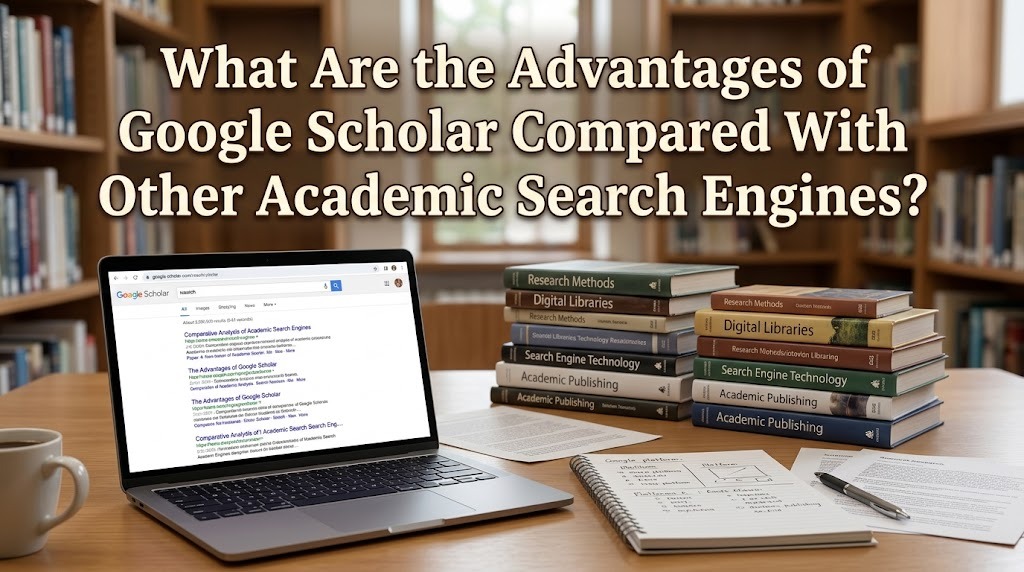
Students and researchers often need academic search engines to find journal articles, research papers, theses, books, and other scholarly publications. Among the available options, Google Scholar is widely used because it provides a simple way to discover academic literature from different sources. Its broad search coverage and familiar interface can make the research process more convenient. However, understanding its advantages compared with other academic search engines can help students choose the right research tool for their needs.
BROAD ACADEMIC SEARCH COVERAGE
One major advantage of Google Scholar is its ability to search across a wide range of scholarly literature. Users can discover journal articles, conference papers, theses, dissertations, books, and other academic materials through a single search interface. This can be useful when students are still exploring a research topic and do not yet know which specific publications or journals they need. A broad search can help create an initial overview of the available literature.
Compared with platforms that focus primarily on particular disciplines or databases, Google Scholar can provide cross-disciplinary results. A student researching artificial intelligence in education, for example, may find publications from computer science, education, psychology, and other related fields. This broad perspective can be useful for interdisciplinary research. However, students should still evaluate every result because broad coverage does not automatically mean that every publication is equally suitable.
SIMPLE AND ACCESSIBLE SEARCH PROCESS
Google Scholar has a simple search interface that is familiar to many users. Students can enter keywords without needing extensive training in database searching. This makes it especially useful for beginners who are learning how to conduct academic research. The straightforward interface can help students begin literature searches quickly.
Google Scholar can also be accessed through a standard web browser, making it convenient for students working from different locations and devices. Some academic databases require institutional subscriptions or specialized access, while Google Scholar can be used as a general discovery tool. However, access to the complete text of a publication may still depend on the publisher, repository, or the user's institutional access. Students should distinguish between discovering an article and obtaining full access to it.
HELPS DISCOVER RELATED RESEARCH
Another advantage is the ability to explore related academic publications from an article that has already been found. Students can use features such as related articles and citation links to identify additional research. This can help them expand their literature review without starting a completely new search each time. A single useful publication can therefore become a starting point for discovering a wider academic discussion.
The Cited by feature is particularly useful for tracing how research has been used by later publications. Students can examine newer studies that cite an earlier article and determine whether those studies are relevant to their research. This can help identify developments in a research field. Citation tracking is especially useful when students want to find newer evidence related to an established study.
SUPPORTS DIFFERENT RESEARCH NEEDS
Google Scholar can be useful for students, lecturers, researchers, and other academic users because it covers many subjects. Students can use it for simple assignments, literature reviews, research papers, and thesis preparation. Researchers can also use it to discover publications outside their immediate discipline. This flexibility makes it a practical starting point for many types of academic searches.
However, specialized academic databases can sometimes offer more advanced discipline-specific features. Certain databases provide detailed filters, controlled subject terms, specialized indexing, or extensive information about particular types of publications. Therefore, Google Scholar should not necessarily replace every academic database. Instead, students can use Google Scholar for broad discovery and combine it with specialized databases when their research requires more precise searching.
MAKES REFERENCE DISCOVERY MORE EFFICIENT
Google Scholar can make the process of discovering academic references more efficient. Students can search by keywords, author names, publication titles, or specific phrases. They can also limit results by publication period when they need newer studies. These options allow students to move from a broad topic toward more focused research.
The platform can also help students identify important publications and research connections relatively quickly. Once a relevant source is found, students can examine its related articles and citations to discover more literature. This reduces the need to repeatedly search for completely new keywords. Nevertheless, students should keep organized records of the sources they select and verify bibliographic information before citing them.
CONCLUSION
Google Scholar offers several advantages compared with other academic search engines, particularly its broad coverage, simple interface, cross-disciplinary search capability, and citation connections. It can help students discover scholarly literature quickly and explore related publications from different academic fields. These features make it a useful starting point for assignments, research projects, literature reviews, and theses.
However, Google Scholar has a different role from specialized academic databases. Its broad search approach is useful for discovering literature, while discipline-specific databases may provide more detailed indexing and advanced search functions. The most effective strategy is often to use Google Scholar alongside other appropriate academic resources. By combining broad discovery with careful source evaluation, students can build a stronger and more reliable academic reference collection.
Recent Posts

Bagaimana Sistem SKS pada Program Kuliah... 22.11.2026/40 View

How Does Technology Make Daily Evaluation... 21.11.2026/71 View

Apa Strategi Menghadapi Kesenjangan antara Kompetensi... 21.11.2026/73 View

Mengapa Inventaris Aset Penting bagi Kelancaran... 21.11.2026/69 View

When Should Musicians Join a Record... 21.11.2026/73 View
