

What Are the Benefits of Visual Intelligence for Better Thinking Skills?
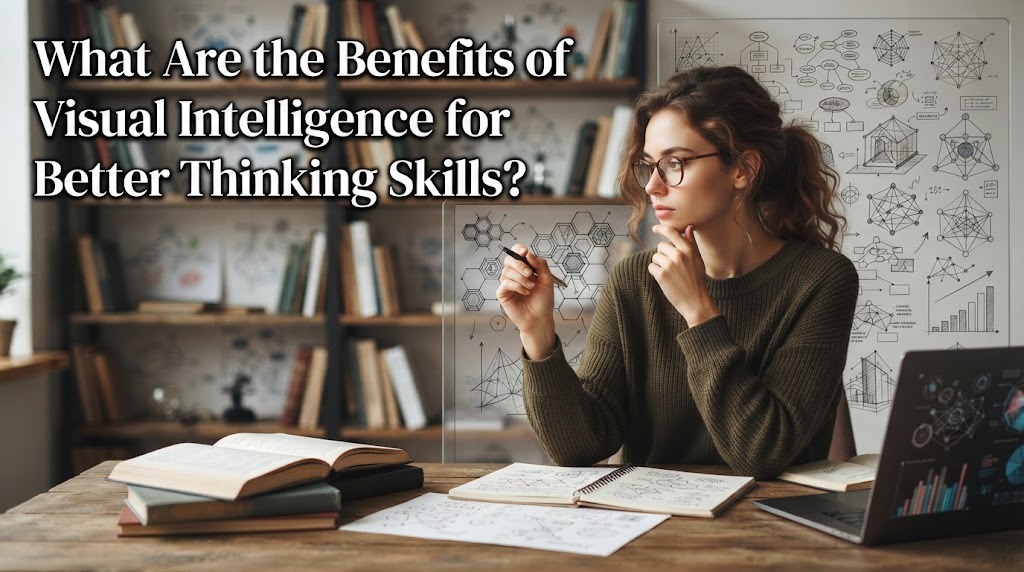
Visual intelligence is the ability to understand, process, remember, and use information through images, shapes, colors, patterns, and spatial relationships. This ability is useful not only for artists or designers but also for students, professionals, and people in everyday situations. Strong visual intelligence can support better thinking skills by helping people organize information and understand relationships more clearly.
In learning and working environments, people often deal with charts, diagrams, maps, presentations, and digital content. Being able to process visual information can make it easier to recognize patterns, understand complex ideas, and find solutions. For this reason, developing visual intelligence can become an important part of improving overall thinking skills.
WHAT IS VISUAL INTELLIGENCE?
Visual intelligence refers to the ability to understand and work with visual information. A person with good visual intelligence can recognize shapes, imagine objects, understand directions, and identify relationships between different visual elements. This ability also involves mental visualization, which allows someone to create or manipulate images in their mind.
Visual intelligence is closely connected to visual thinking and spatial awareness. For example, someone may use visual intelligence when reading a map, arranging furniture, interpreting a graph, or understanding a diagram. These simple activities show how visual intelligence can support thinking in practical situations.
HOW DOES VISUAL INTELLIGENCE SUPPORT BETTER THINKING?
Visual intelligence helps people organize information in a way that is easier to understand. Instead of processing information only through words, people can use images, diagrams, patterns, or spatial relationships to see how different ideas are connected. This can make complicated information feel more structured and manageable.
Another important benefit is improved observation. People who regularly practice visual thinking may become more attentive to details, differences, similarities, and patterns. Better observation can support logical thinking because identifying useful details is often the first step toward understanding a problem.
BENEFITS OF VISUAL INTELLIGENCE FOR PROBLEM SOLVING
Visual intelligence can help people approach problems from different perspectives. When a problem is represented through a drawing, chart, diagram, or mental image, its structure may become easier to understand. This can help a person identify possible causes, relationships, and solutions.
For students, this skill can be useful when solving mathematics, science, or technical problems. For example, diagrams can help explain how a system works, while graphs can show changes in data more clearly. Visual problem solving allows people to transform abstract information into something more concrete and easier to analyze.
VISUAL INTELLIGENCE AND CREATIVE THINKING
Visual intelligence can also encourage creativity by helping people imagine new ideas. Mental visualization allows someone to picture different possibilities before creating or testing them in the real world. This process is commonly used in areas such as design, architecture, marketing, technology, and content creation.
Creativity does not always depend on artistic talent. It can also involve finding new ways to organize information or solve everyday problems. Visual thinking can support creative thinking by helping people combine shapes, ideas, patterns, and concepts in new ways.
HOW VISUAL INTELLIGENCE IMPROVES MEMORY AND LEARNING
Visual information can make certain ideas easier to remember because people can associate information with images, colors, shapes, or spatial arrangements. Mind maps, diagrams, timelines, and illustrations are examples of tools that can support this process. They can help learners see the main idea and its relationship with supporting information.
Visual intelligence can therefore complement traditional learning methods. Students can use diagrams to summarize lessons, charts to compare information, and simple illustrations to explain difficult concepts. Combining visual learning with reading, writing, and practice can create a more organized learning experience.
HOW TO DEVELOP VISUAL INTELLIGENCE FOR BETTER THINKING
Visual intelligence can be developed through regular practice and simple activities. Drawing, solving puzzles, reading maps, creating mind maps, arranging objects, and observing patterns are practical ways to train visual thinking. People can also practice by describing objects from memory or imagining how an object would look from another angle.
Digital tools can provide additional opportunities to develop these skills. Creating presentations, editing images, designing simple graphics, or working with charts can encourage people to organize visual information. The key is to practice consistently and focus on understanding relationships, patterns, details, and spatial information rather than simply creating attractive visuals.
CONCLUSION
Visual intelligence provides several benefits for developing better thinking skills. It can support problem solving, creativity, observation, memory, learning, and information organization. By understanding visual relationships and using mental visualization, people can approach information from different perspectives.
Developing visual intelligence does not require advanced artistic abilities. Simple activities such as drawing, puzzles, mind mapping, observing patterns, and interpreting charts can gradually strengthen these skills. With regular practice, visual intelligence can become a useful tool for improving thinking and handling information in both academic and everyday situations.
Recent Posts

Bagaimana Sistem SKS pada Program Kuliah... 22.11.2026/21 View

How Does Technology Make Daily Evaluation... 21.11.2026/63 View

Apa Strategi Menghadapi Kesenjangan antara Kompetensi... 21.11.2026/65 View

Mengapa Inventaris Aset Penting bagi Kelancaran... 21.11.2026/62 View

When Should Musicians Join a Record... 21.11.2026/60 View
