

What Are the Biggest Challenges in Preserving Regional Languages in Indonesia?
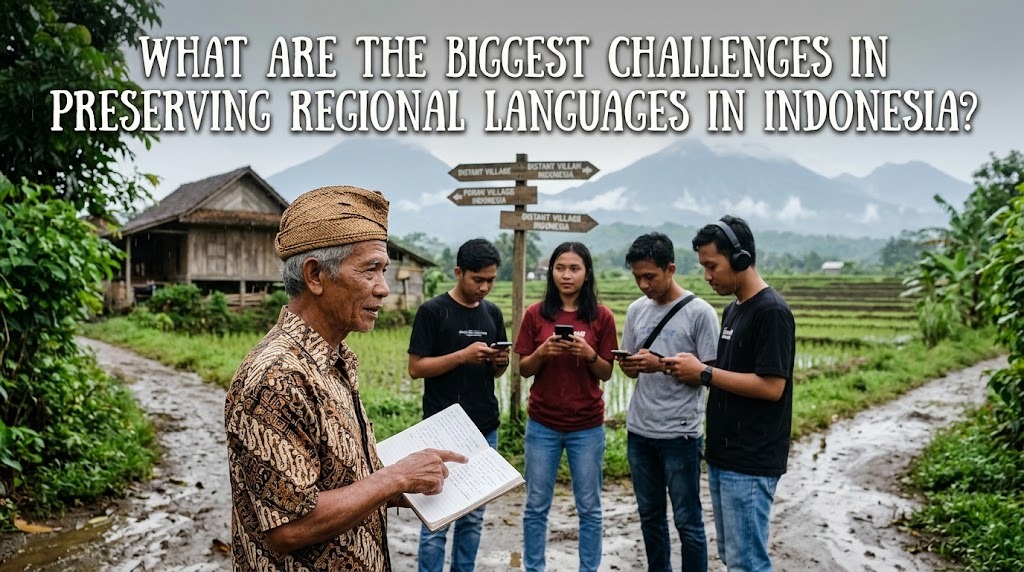
Indonesia is home to hundreds of regional languages that represent the cultural identity, history, and traditions of different communities. These languages are used to communicate within families, share traditional knowledge, and maintain relationships across generations. However, many regional languages face challenges as Indonesian and international languages become more prominent in education, employment, media, and daily communication. Some languages continue to be widely spoken, while others have fewer young speakers and face the risk of disappearing. Preserving regional languages requires cooperation between families, schools, communities, and the government to ensure that linguistic diversity remains part of Indonesia’s future.
DECLINING USE AMONG YOUNGER GENERATIONS
One of the biggest challenges in preserving regional languages is the declining use of some languages among children and young people. In many families, Indonesian is increasingly used for everyday conversations because it is widely understood across different regions. As a result, children may have fewer opportunities to learn their parents’ or grandparents’ regional language naturally. Over time, they may understand only a limited number of words or become less confident speaking it.
This situation can affect the transmission of language from one generation to another. When children do not regularly use a regional language, they may struggle to understand traditional expressions, stories, and conversations with older relatives. Families can help by using regional languages during meals, family gatherings, and daily activities. A language is more likely to survive when children hear it, understand it, and use it regularly. Encouraging practical communication at home is therefore an important step toward preserving regional languages.
THE DOMINANCE OF INDONESIAN IN FORMAL AND PUBLIC SETTINGS
Indonesian serves as the national language and plays an essential role in education, government, business, and communication between people from different regions. Its widespread use helps unite communities with different linguistic backgrounds. However, when Indonesian becomes the main language in nearly every setting, regional languages may receive fewer opportunities for practical use. Students may become more familiar with Indonesian vocabulary and academic expressions than with the regional language spoken by their families.
The challenge is not that Indonesian should be used less, but that regional languages also need space to develop. Schools can introduce local-language lessons, cultural projects, and storytelling activities that make regional languages relevant to students’ lives. Families and communities can complement these activities by encouraging children to speak their regional languages outside school. National communication and regional-language preservation can support each other rather than compete. A balanced approach allows people to use Indonesian widely while maintaining their local linguistic heritage.
LIMITED LEARNING MATERIALS AND EDUCATIONAL RESOURCES
Some regional languages have fewer textbooks, dictionaries, children's books, recordings, and digital learning materials than widely used languages. This shortage can make it difficult for teachers to prepare engaging lessons and for learners to study independently. Languages with limited written resources may also depend heavily on oral transmission, which can become vulnerable when fluent speakers are no longer available. Without accessible materials, younger generations may find it harder to develop their vocabulary and literacy skills.
Creating useful resources requires cooperation between fluent speakers, teachers, researchers, writers, and local communities. Educational materials should reflect the vocabulary, pronunciation, and cultural context of the language being taught. Audio recordings and videos can help preserve pronunciation and everyday expressions, while dictionaries and story collections can support learning. Accessible learning materials make regional languages easier to teach, study, and pass on. Digital platforms can help distribute these resources to people living both within and outside their traditional communities.
MIGRATION AND CHANGES IN COMMUNITY LIFE
Migration can influence how often regional languages are used. People who move to cities or other provinces for education, employment, or family reasons often need to communicate with people from different linguistic backgrounds. In these environments, Indonesian may become the most convenient language for daily interaction. Children growing up in multilingual households may consequently have fewer opportunities to practice their parents’ regional languages.
Changes in community life can also reduce opportunities for language learning. In some urban neighborhoods, families may have fewer regular interactions with other speakers of their regional language. Nevertheless, migration does not automatically lead to language loss. Families can maintain their language through conversations, cultural gatherings, community organizations, and online communication with relatives. Regional languages can remain active even when speakers live far from their ancestral homes. Creating opportunities for regular use helps migrants and their children maintain connections with their linguistic heritage.
LIMITED AWARENESS AND NEGATIVE ATTITUDES TOWARD REGIONAL LANGUAGES
Another challenge is the belief that regional languages are less useful than Indonesian or international languages. Some young people may worry that speaking a regional language sounds old-fashioned or is unsuitable for modern education and professional environments. If such attitudes become widespread, children may feel embarrassed about using the language or avoid learning it altogether. This can weaken the language’s role in everyday communication.
Changing these attitudes requires showing that regional languages have cultural, social, and educational value. Teachers, parents, community leaders, and content creators can demonstrate that regional languages can be used in storytelling, music, digital videos, cultural events, and creative projects. Public campaigns can also celebrate local-language speakers and highlight the importance of linguistic diversity. Speaking a regional language should be seen as a valuable skill rather than an obstacle to progress. Positive attitudes can motivate young people to learn their heritage language while continuing to develop Indonesian and other language skills.
INSUFFICIENT DOCUMENTATION AND LONG-TERM SUPPORT
Some regional languages have limited documentation, particularly when they are spoken by small communities or have few written resources. If fluent speakers pass away before their knowledge is recorded, important vocabulary, pronunciation, stories, and grammatical patterns may become difficult to recover. Documentation is especially important for languages that are no longer being transmitted consistently to children. Without organized preservation efforts, valuable linguistic information may disappear.
Long-term preservation requires more than recording words in a dictionary. Researchers and community members can document conversations, oral histories, songs, traditional expressions, and local storytelling practices. Government institutions, universities, schools, and cultural organizations can support these efforts through funding, training, archives, and community programs. Documentation is most effective when it is combined with efforts to help people continue using the language. Recordings and written materials can preserve valuable information, but everyday communication remains essential for keeping a language alive.
CONCLUSION
The biggest challenges in preserving regional languages in Indonesia include declining use among younger generations, the dominance of Indonesian in many settings, limited educational resources, migration, negative attitudes, and insufficient documentation. These challenges are connected, so they require coordinated solutions rather than isolated activities. Families can encourage daily conversations, schools can provide meaningful learning opportunities, and communities can document traditional knowledge. Government institutions and researchers can contribute through educational support and long-term preservation programs. Protecting regional languages means maintaining Indonesia’s cultural diversity while ensuring that future generations can learn and use their linguistic heritage.
Recent Posts

Bagaimana Sistem SKS pada Program Kuliah... 22.11.2026/49 View

How Does Technology Make Daily Evaluation... 21.11.2026/77 View

Apa Strategi Menghadapi Kesenjangan antara Kompetensi... 21.11.2026/78 View

Mengapa Inventaris Aset Penting bagi Kelancaran... 21.11.2026/74 View

When Should Musicians Join a Record... 21.11.2026/79 View
