

What Are the Characteristics of Kinesthetic Learners?
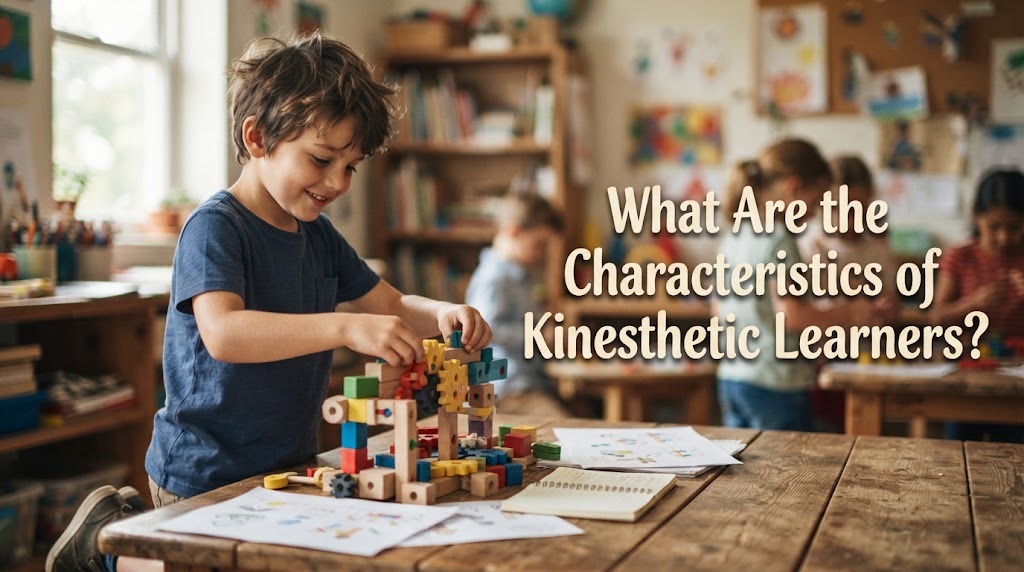
Every student has different preferences when learning. Some students enjoy reading and observing visual materials, while others understand ideas more easily through practice and direct experience. Students who prefer learning through physical activity and hands-on experiences are often described as having a kinesthetic learning preference.
Kinesthetic learning can involve movement, practice, experiments, projects, simulations, and real-life activities. However, students should not be treated as having one fixed learning style because learning preferences can change depending on the subject and situation. Understanding the characteristics of kinesthetic learners can help students explore study methods that involve active participation.
ENJOY LEARNING THROUGH PRACTICAL ACTIVITIES
One common characteristic of students with a kinesthetic learning preference is that they enjoy practical activities. They may understand a concept more clearly after trying it rather than only reading an explanation. Activities such as experiments, demonstrations, simulations, and projects can give them an opportunity to connect theory with practice.
For example, a student studying science may understand a process better by performing an experiment under appropriate guidance. A student learning a technical skill may also benefit from practicing the procedure directly. Hands-on learning can make abstract information more concrete when the activity is clearly connected to the learning objective.
PREFER ACTIVE PARTICIPATION
Kinesthetic learners often prefer being actively involved during the learning process. They may find it difficult to remain engaged when a lesson requires them to listen or read for a long period without interaction. Taking part in discussions, demonstrations, classroom activities, or projects can help maintain their attention.
Active participation does not always mean physical movement. Students can also become active by solving problems, creating something, practicing a skill, or explaining a process while working on a task. Active learning encourages students to interact with information instead of only receiving it passively.
LEARN WELL THROUGH PRACTICE AND REPETITION
Students with a kinesthetic preference may benefit from repeating a skill through direct practice. Reading instructions once may not be enough for them to understand how something works. Performing the steps several times can help them become more familiar with the process and identify mistakes that need improvement.
This approach can be useful for subjects that involve procedures, techniques, or practical skills. Students can practice through laboratory activities, role-playing, simulations, projects, or guided exercises. However, repetition should be combined with reflection so students understand why each step is performed rather than simply memorizing a sequence.
CONNECT THEORY WITH REAL LIFE
Another characteristic is an interest in understanding how academic concepts can be applied in real situations. Kinesthetic learners may become more engaged when they can see a clear connection between what they study and what people do in everyday life or professional settings. Real examples can make abstract concepts feel more meaningful.
Students can use this preference by looking for practical examples related to their lessons. They can create small projects, conduct observations, participate in internships, or solve real-world problems when appropriate. Practical learning can help students understand not only what a concept means but also how it can be applied.
MAY PREFER PROJECTS AND EXPERIMENTS
Projects and experiments provide opportunities for students to learn by doing. Instead of only receiving information, students need to plan activities, make decisions, solve problems, and evaluate results. These activities can be especially useful for students who enjoy direct involvement in the learning process.
Project-based activities can also develop other important skills, such as teamwork, communication, creativity, and problem-solving. However, projects should have clear goals and instructions so that students remain focused on what they are expected to learn. The purpose of kinesthetic learning is not simply to keep students physically active but to help them understand concepts through meaningful experience.
USE DIFFERENT METHODS TO SUPPORT LEARNING
Although kinesthetic learners may enjoy hands-on activities, they do not need to study through movement all the time. Different subjects require different learning strategies, and students can benefit from combining practical activities with reading, visual materials, explanations, writing, and practice questions.
For example, a student can read a short explanation before performing an experiment, watch a demonstration, complete the activity, and then write a summary of what was learned. Combining methods allows students to process information in different ways. Effective study methods should therefore be selected based on the learning goal and type of material rather than relying on a single fixed learning style.
CONCLUSION
Kinesthetic learners may prefer practical activities, active participation, repetition, real-life applications, projects, and experiments. These characteristics can help students identify study strategies that involve direct experience and meaningful practice.
However, kinesthetic learning should be viewed as a preference rather than a permanent label. Students can use different methods depending on the subject, learning goal, and situation. Combining hands-on activities with reading, visual resources, explanations, and practice can provide a more flexible and effective learning experience.
Recent Posts

Bagaimana Sistem SKS pada Program Kuliah... 22.11.2026/21 View

How Does Technology Make Daily Evaluation... 21.11.2026/63 View

Apa Strategi Menghadapi Kesenjangan antara Kompetensi... 21.11.2026/65 View

Mengapa Inventaris Aset Penting bagi Kelancaran... 21.11.2026/62 View

When Should Musicians Join a Record... 21.11.2026/60 View
