

What Are the Common Myths and Facts About Global Warming?
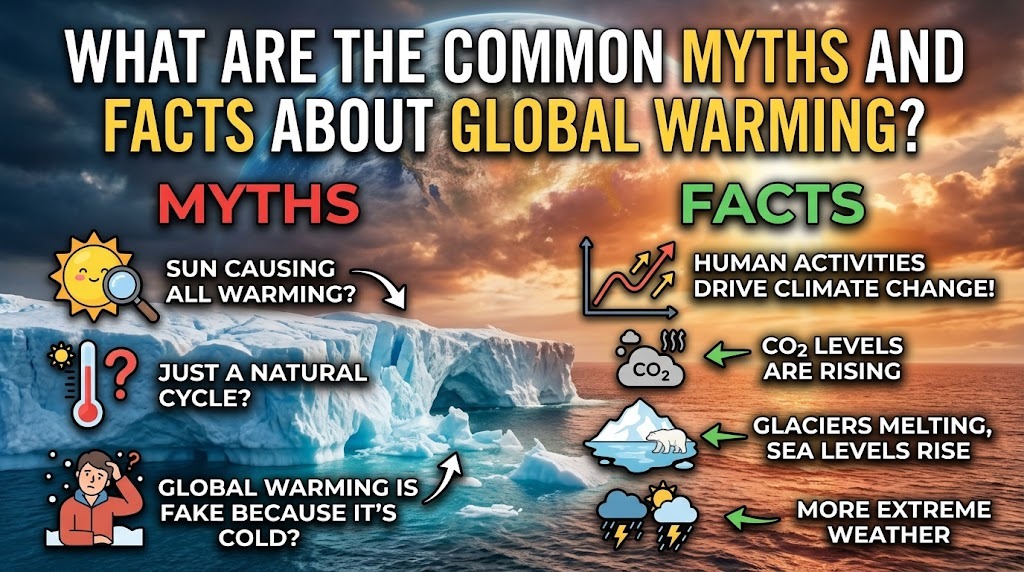
Global warming is one of the most important environmental challenges facing the world today. It refers to the long-term increase in the Earth's average surface temperature, primarily caused by human activities that release greenhouse gases into the atmosphere. Despite extensive scientific research, misunderstandings about global warming continue to influence how people interpret climate information and environmental changes.
Some common claims confuse natural climate variability with the long-term warming trend, while others underestimate the role of human activities. Understanding the difference between global warming myths and facts can help people evaluate information more critically and make decisions based on reliable scientific evidence.
MYTH: GLOBAL WARMING IS ONLY A NATURAL PHENOMENON
Earth's climate has changed naturally throughout its history. Volcanic eruptions, changes in solar activity, ocean circulation, and variations in Earth's orbit have all influenced the climate at different times. However, natural climate changes do not fully explain the rapid warming observed since the industrial era.
Scientific evidence shows that the current long-term warming trend is primarily caused by human activities, especially burning fossil fuels and clearing forests. These activities increase the concentration of greenhouse gases, including carbon dioxide and methane, which trap heat in the atmosphere. Natural factors continue to influence year-to-year temperature changes, but they do not account for the overall pattern of recent warming. The fact about global warming is that human-caused greenhouse gas emissions are the main driver of the current long-term increase in global temperatures.
MYTH: COLD WEATHER PROVES THAT GLOBAL WARMING IS NOT HAPPENING
Some people believe that a cold day or unusually snowy winter disproves global warming. This misunderstanding occurs because short-term weather conditions are sometimes confused with long-term climate trends. Weather describes atmospheric conditions over a relatively short period, while climate refers to patterns measured over many years.
Even as global average temperatures rise, cold weather can still occur in particular locations and seasons. Regional weather is influenced by many factors, including atmospheric circulation, ocean conditions, and seasonal changes. A cold spell in one country does not cancel out the broader warming trend observed across the planet. The difference between weather and climate is therefore essential for understanding why individual cold events do not disprove global warming.
MYTH: SCIENTISTS DO NOT KNOW WHAT CAUSES GLOBAL WARMING
Another common myth suggests that scientists do not understand the causes of global warming. In reality, researchers have studied greenhouse gases, atmospheric temperatures, ocean heat, ice loss, and other climate indicators for decades. Multiple independent lines of evidence support the conclusion that human activities are responsible for most of the warming observed since the mid-20th century.
Scientists continue to investigate details such as regional climate impacts, future emissions pathways, and the timing and severity of specific environmental changes. Scientific uncertainty about particular outcomes does not mean that the basic cause of current global warming is unknown. Instead, research helps refine estimates and improve predictions. Understanding climate science means recognizing both the strong evidence for human-caused warming and the areas where further investigation can improve knowledge.
FACT: GREENHOUSE GASES TRAP HEAT IN THE ATMOSPHERE
Greenhouse gases are a natural part of Earth's climate system. They absorb and re-emit some of the infrared radiation emitted by Earth's surface, helping keep the planet warm enough to support life. Without the natural greenhouse effect, Earth's average temperature would be much lower.
However, human activities have increased the concentration of several greenhouse gases in the atmosphere. Burning coal, oil, and natural gas releases carbon dioxide, while agriculture, waste management, and fossil fuel production contribute methane emissions. Deforestation also reduces carbon storage and can release carbon previously held in vegetation and soil. This strengthened greenhouse effect contributes to global warming caused by human activities. Reducing emissions is therefore essential to limiting further increases in global temperatures.
FACT: GLOBAL WARMING CAN AFFECT ECOSYSTEMS AND HUMAN COMMUNITIES
Rising global temperatures can influence ecosystems, water resources, agriculture, and human health. Higher temperatures contribute to the melting of land-based ice and the expansion of warming seawater, both of which raise global sea levels. Climate change can also influence the likelihood or intensity of certain extreme weather events, although the causes of individual events vary.
Communities may face challenges from extreme heat, coastal flooding, changing rainfall, and disruptions to food production. Ecosystems can also experience habitat loss and shifts in the distribution of plants and animals as environmental conditions change. The specific effects differ by region, and local preparedness influences how severely people are affected. These impacts demonstrate why climate change mitigation and adaptation are both important: mitigation reduces future warming, while adaptation helps communities manage climate-related risks.
CONCLUSION
Common myths about global warming often arise from misunderstandings about natural climate variability, short-term weather, and the role of greenhouse gases. Scientific evidence shows that human activities are the main cause of the current long-term warming trend, while natural processes continue to influence climate conditions.
Understanding the facts helps people evaluate environmental claims more carefully and avoid drawing conclusions from isolated weather events or unreliable information. Reducing greenhouse gas emissions, protecting natural ecosystems, improving energy efficiency, and preparing for climate impacts are important parts of the response. By relying on credible scientific evidence, individuals and communities can make better-informed decisions about climate action.
Recent Posts

Bagaimana Sistem SKS pada Program Kuliah... 22.11.2026/49 View

How Does Technology Make Daily Evaluation... 21.11.2026/77 View

Apa Strategi Menghadapi Kesenjangan antara Kompetensi... 21.11.2026/78 View

Mengapa Inventaris Aset Penting bagi Kelancaran... 21.11.2026/74 View

When Should Musicians Join a Record... 21.11.2026/79 View
