

What Are the Common Reasons for Thesis Revisions?
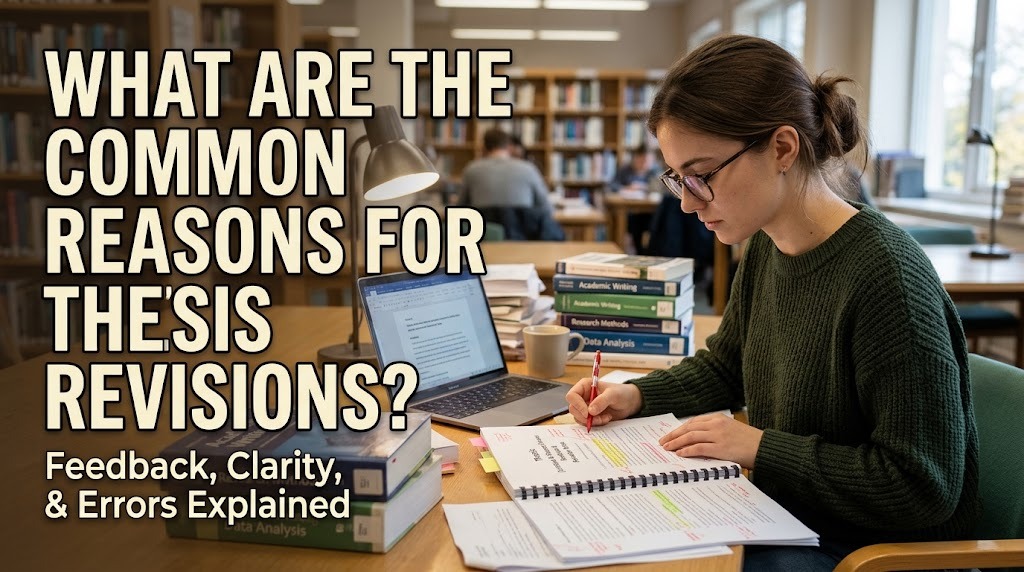
Thesis revision is a normal part of the academic research process. After submitting a draft or attending a thesis examination, students may receive comments from supervisors and examiners requesting improvements to certain sections. These corrections can range from simple writing adjustments to more substantial changes involving research methods, data analysis, and academic arguments.
Understanding the common reasons for thesis revisions can help students prepare for the feedback process and avoid repeated mistakes. Each correction usually addresses an aspect of the research that needs clarification, improvement, or adjustment to meet academic standards. By recognizing these issues, students can review their work more carefully and prepare a stronger final thesis.
UNCLEAR RESEARCH BACKGROUND AND PROBLEM STATEMENT
One common reason for thesis revisions is an unclear research background. The background should explain the issue being studied, provide relevant context, and show why the research is necessary. If the discussion is too general or does not connect clearly to the research problem, supervisors may ask students to reorganize or strengthen the explanation.
The problem statement may also require revision when the research questions are too broad, unclear, or inconsistent with the research objectives. Students need to ensure that the questions describe what the study intends to investigate. Supporting the background with relevant data, previous studies, and appropriate references can also improve its credibility. A clear research foundation helps readers understand the purpose and direction of the study.
WEAK THEORETICAL FRAMEWORK AND INSUFFICIENT REFERENCES
Another frequent reason for thesis corrections is an incomplete theoretical framework. The literature review should provide relevant concepts, theories, and previous research that support the study. If the sources are outdated, insufficient, or unrelated to the research topic, supervisors may request additional references or a more focused discussion.
Students may also need to improve how they connect theories with the research problem. Simply collecting definitions from different sources does not necessarily create a strong theoretical foundation. The discussion should explain how relevant concepts relate to the research objectives and provide a basis for interpreting the findings. Using credible academic sources and applying a consistent citation style can help strengthen this section.
INCONSISTENCIES IN RESEARCH METHODOLOGY
Research methodology explains how a study is conducted, including its design, participants, data collection procedures, and analysis techniques. Revisions may be requested when the chosen method does not clearly match the research questions or when important procedural details are missing. For example, students may need to explain how participants were selected or why a particular data collection technique was used.
Consistency between the research objectives and methodology is essential. A method should be appropriate for the type of information needed to answer the research questions. Supervisors may also ask students to clarify research instruments, sampling procedures, or analysis techniques. Improving these explanations helps readers understand the research process and evaluate whether the methods support the conclusions.
ERRORS IN DATA ANALYSIS AND DISCUSSION OF FINDINGS
Problems in data analysis can also lead to thesis revisions. Students may present results without explaining what they mean or fail to connect the findings with the research questions. In other cases, tables and figures may contain inconsistent labels, incomplete information, or explanations that do not accurately reflect the data.
The discussion section requires more than repeating the results. Students need to interpret their findings and explain how they relate to relevant theories or previous studies. If the interpretation is not sufficiently supported by evidence, examiners may request further explanation. Reviewing calculations, checking data presentation, and ensuring that conclusions are based on actual findings can help reduce errors in this section.
GRAMMAR, FORMATTING, AND ACADEMIC WRITING PROBLEMS
Writing quality is another common reason for thesis revision. A thesis may contain grammatical mistakes, unclear sentences, repetitive explanations, or inconsistent terminology. These problems can make the research difficult to understand even when the underlying information is relevant. Students may need to improve sentence structure, paragraph organization, and transitions between ideas.
Formatting and citation errors can also result in corrections. Universities often provide specific guidelines for headings, page numbering, tables, figures, references, and document layout. Students should review these requirements carefully and ensure that citations match the reference list. Consistent formatting and clear academic language help make the final thesis more organized and professional.
CONCLUSION
The common reasons for thesis revisions include unclear research backgrounds, weak theoretical frameworks, inconsistent methodologies, problems in data analysis, and errors in academic writing or formatting. These issues may appear at different stages of the research process and can require different levels of correction depending on their impact on the overall thesis.
Students can reduce repeated revisions by reviewing each chapter carefully, using credible references, checking research consistency, and following university guidelines. It is also important to understand feedback from supervisors and examiners before making changes. By addressing the identified problems systematically, students can improve their research quality and prepare a more complete final thesis.
Recent Posts

Bagaimana Sistem SKS pada Program Kuliah... 22.11.2026/47 View

How Does Technology Make Daily Evaluation... 21.11.2026/74 View

Apa Strategi Menghadapi Kesenjangan antara Kompetensi... 21.11.2026/75 View

Mengapa Inventaris Aset Penting bagi Kelancaran... 21.11.2026/72 View

When Should Musicians Join a Record... 21.11.2026/75 View
