

What Are the Differences Between OTP Codes Sent Through SMS Email and Authenticator Apps?
Digital security has become increasingly important as people use online platforms for banking, shopping, communication, and other everyday activities. Many services require users to verify their identities before allowing access to personal accounts or completing sensitive transactions. One common security method is the One-Time Password (OTP), which provides temporary authentication through a code that users must enter during the verification process.
However, OTP codes are not always delivered through the same method. Some platforms send verification codes through SMS or email, while others use authenticator applications installed on mobile devices. Each method has different features, advantages, and security limitations. Understanding these differences can help users choose a more appropriate authentication method and protect their digital accounts.
UNDERSTANDING THE DIFFERENT METHODS OF OTP VERIFICATION
An OTP code, or One-Time Password, is a temporary authentication code used to confirm a user's identity. It is commonly required when logging in, creating an account, resetting a password, or approving an online transaction. Unlike regular passwords, OTP codes are designed to be used once or within a limited validity period.
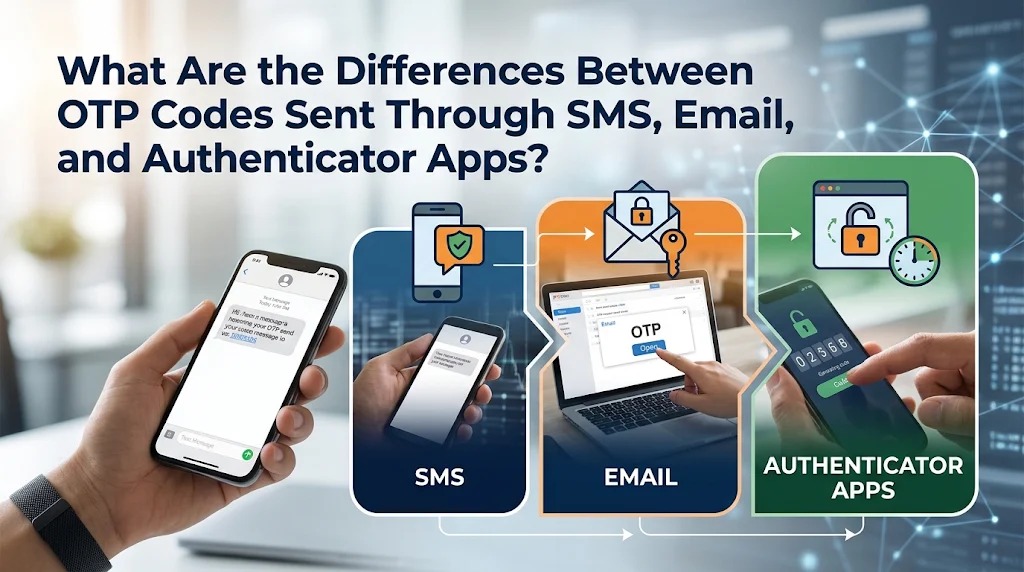
Digital platforms provide different ways to deliver these codes based on their security systems and available technologies. SMS-based OTP uses mobile networks to send verification codes to registered phone numbers. Email-based OTP delivers codes to users' registered email addresses, while authenticator applications generate temporary codes directly on supported devices.
Although all three methods serve a similar authentication purpose, their security levels and practical features are different. Some depend on mobile network availability, while others require internet access or synchronization between devices. Users should understand these characteristics before deciding which method is most suitable for their digital activities.
SMS-BASED OTP AND HOW IT WORKS
SMS-based OTP is one of the most familiar authentication methods because it uses ordinary text messages. When users request verification, the platform generates a temporary code and sends it to their registered mobile number. Users then enter the code into the application or website to complete the authentication process.
One advantage of this method is its simplicity. Users do not usually need to install additional applications because almost every mobile phone can receive SMS messages. This makes SMS verification convenient for people who are not familiar with more advanced security technologies.
However, SMS-based OTP also has several security limitations. Criminals may attempt to intercept messages through SIM swapping, in which a victim's mobile number is transferred to a SIM card controlled by an attacker. Other risks include mobile network weaknesses and unauthorized access to a person's phone.
SMS delivery can also experience delays because of weak signals, network congestion, or temporary service disruptions. As a result, users may receive verification codes after their validity periods have expired. Although SMS-based OTP is convenient, it should not be considered the strongest authentication option for highly sensitive accounts.
EMAIL-BASED OTP AND ITS SECURITY FEATURES
Email-based OTP delivers temporary verification codes through a user's registered email address. When an authentication request is made, the platform sends a message containing the code to the associated email account. Users must open the message and enter the code to complete the verification process.
This method can be convenient because people often use email accounts across multiple devices, including smartphones, tablets, and computers. It also allows users to receive verification messages without depending on mobile SMS services. For individuals who frequently access their email accounts, this method can be relatively easy to manage.
However, email-based OTP depends heavily on the security of the email account itself. If criminals gain access to someone's inbox, they may also obtain verification codes sent by other platforms. This becomes particularly dangerous when the same email address is used for password recovery across several digital services.
To improve security, users should activate two-factor authentication on their email accounts and create strong, unique passwords. They should also avoid opening suspicious attachments or clicking unfamiliar links. Protecting the email account is essential because it may serve as an important gateway to other digital accounts.
AUTHENTICATOR APPS AND HOW THEY GENERATE OTP CODES
Authenticator applications provide another way to generate temporary verification codes without relying on SMS or email delivery. These applications are installed on a trusted device and generate codes based on a shared secret or authentication setup established when an account is connected. Many commonly used authenticator apps generate time-based one-time passwords (TOTP) that change at regular intervals.
One major advantage is that authenticator applications can generate codes without requiring mobile network coverage or an active internet connection at the moment the code is created. This makes them useful when users are traveling or experiencing communication problems. The generated codes can be entered directly into the supported application or website.
Authenticator apps can also reduce certain risks associated with SMS and email verification. For example, they are not directly vulnerable to SIM swapping in the same way as SMS-based codes. However, they are not completely immune to attacks because criminals may still steal verification information through phishing or gain access to an unlocked device.
Users should protect their phones with strong screen locks and keep their authenticator applications secure. They should also save recovery codes when provided by the service and store them in a safe location. If a device is lost, recovery information can help restore access to protected accounts.
COMPARING THE SECURITY AND CONVENIENCE OF EACH METHOD
SMS, email, and authenticator applications all provide additional identity verification, but they offer different levels of protection and convenience. SMS-based OTP is easy to use because it works through ordinary text messaging. However, its dependence on mobile networks and phone numbers creates certain security weaknesses.
Email-based OTP is useful for users who frequently access their email accounts from different devices. Nevertheless, its security depends on how well the email account is protected. If someone gains unauthorized access to the inbox, they may also obtain verification codes from other services.
Authenticator applications generally offer stronger protection against certain threats, particularly SIM swapping and dependence on communication networks. However, users must protect the device containing the application and prepare recovery options in case it becomes unavailable.
The most suitable method depends on the type of account and the user's security needs. For sensitive services such as banking and important personal accounts, users should consider stronger authentication options supported by the platform. They should also remember that no OTP method guarantees complete protection without good security practices.
HOW TO CHOOSE A SAFER OTP VERIFICATION METHOD
Choosing an OTP verification method should begin with understanding the importance of the account being protected. Accounts containing financial information, personal documents, or private communication require greater attention than accounts used for less sensitive activities. Users should prioritize authentication methods that offer strong protection against common cyber threats.
When available, authenticator applications can be a practical option for users who want to reduce dependence on SMS messages. Users should also consider passkeys, which use cryptographic credentials and can provide stronger resistance to phishing than traditional OTP-based methods. The availability of these features depends on the digital platform.
Another important consideration is account recovery. Users should make sure they can regain access if their phone is lost, damaged, or replaced. Keeping recovery codes in a secure location and maintaining updated account information can prevent unnecessary access problems.
Regardless of the chosen method, users must never share verification codes with other people. They should only enter codes through official applications or websites and remain alert to suspicious login notifications. Combining secure authentication methods with strong passwords and responsible digital behavior provides more effective account protection.
CONCLUSION
SMS, email, and authenticator applications are three common methods of delivering or generating OTP codes. SMS verification offers simplicity, email verification provides flexibility, and authenticator applications can reduce dependence on mobile networks while providing stronger protection against certain attacks.
Each method has advantages and limitations, so users should choose according to their account security needs and available platform features. For important digital accounts, stronger authentication methods and reliable recovery options are worth considering. By understanding these differences and protecting confidential verification information, users can improve their digital security and reduce the risk of unauthorized access.
Recent Posts

Bagaimana Sistem SKS pada Program Kuliah... 22.11.2026/34 View

How Does Technology Make Daily Evaluation... 21.11.2026/68 View

Apa Strategi Menghadapi Kesenjangan antara Kompetensi... 21.11.2026/68 View

Mengapa Inventaris Aset Penting bagi Kelancaran... 21.11.2026/66 View

When Should Musicians Join a Record... 21.11.2026/67 View
