

What Are the Differences Between the First Second Third and Fourth Industrial Revolutions?
The Industrial Revolution has transformed the way people work, produce goods, communicate, and live. Over several centuries, technological developments have changed traditional production methods into increasingly advanced industrial systems. Each stage of the Industrial Revolution introduced new inventions that improved productivity and influenced economic growth around the world. However, these changes also created challenges, including shifts in employment, environmental problems, and the need for new skills.
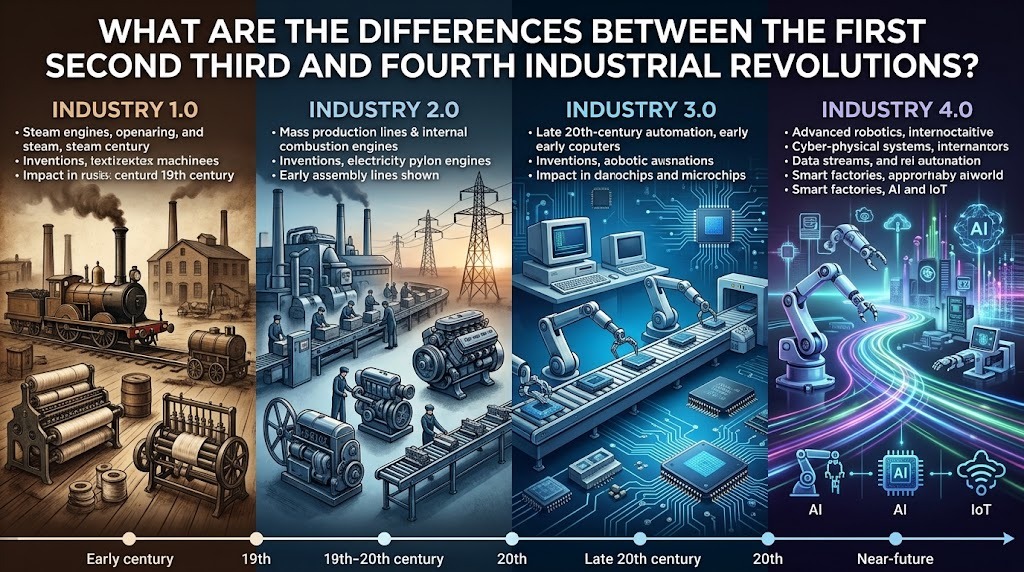
The First, Second, Third, and Fourth Industrial Revolutions have different characteristics based on their main technologies, energy sources, and production methods. The First focused on steam power and mechanization, while the Second introduced electricity and mass production. The Third brought computers and digital technology, and the Fourth connected intelligent machines through artificial intelligence and the Internet of Things. Understanding these differences helps explain how modern industries developed and what people can expect from future technological changes.
THE FIRST INDUSTRIAL REVOLUTION AND THE RISE OF MACHINES
The First Industrial Revolution began in Great Britain in the late 18th century and spread to other regions during the following decades. Its main characteristic was the transition from manual labor to machine-based production. Steam engines became an important source of power for factories, mines, and transportation. Innovations in the textile industry allowed manufacturers to produce fabrics faster and in greater quantities than traditional hand production.
This revolution also encouraged the development of factories and the growth of industrial cities. Many people moved from rural areas to urban centers to seek employment in manufacturing. Steam-powered trains and ships improved the transportation of raw materials and finished products. However, workers often experienced long working hours, low wages, and unsafe conditions. Despite these difficulties, the First Industrial Revolution established the foundations of modern industrial manufacturing.
THE SECOND INDUSTRIAL REVOLUTION AND MASS PRODUCTION
The Second Industrial Revolution developed during the late 19th century and continued into the early 20th century. Unlike the First Industrial Revolution, which relied heavily on steam power, this period was characterized by the widespread use of electricity, steel, and advanced manufacturing techniques. Electricity made it possible to power industrial equipment more flexibly, while improvements in steel production supported the construction of stronger buildings, bridges, railways, and machines.
One of the most significant developments was mass production, which enabled factories to manufacture large quantities of standardized products efficiently. The assembly line became an important production method, particularly in the automobile industry. Transportation and communication also advanced through innovations such as automobiles, telephones, and improved railway networks. These changes helped businesses expand into larger markets and reduced the cost of many products. Nevertheless, growing industrial activity increased resource consumption and contributed to pollution in many industrial areas.
THE THIRD INDUSTRIAL REVOLUTION AND DIGITAL TECHNOLOGY
The Third Industrial Revolution, also known as the Digital Revolution, emerged during the second half of the 20th century. Its development was driven by computers, electronics, telecommunications, and information technology. These innovations allowed businesses to process information faster, control industrial equipment more accurately, and improve communication between different departments. As a result, manufacturing became increasingly dependent on digital systems rather than solely on mechanical equipment.
The expansion of the internet further changed how businesses and individuals exchanged information. Industrial robots and computer-controlled machines began performing repetitive tasks with greater precision and consistency. Digital technology also transformed education, banking, shopping, and transportation. For example, people could communicate across long distances through email and access information online without visiting physical libraries. However, this revolution also introduced concerns about data security, privacy, and unequal access to technology. It created the digital foundation for the connected industries that emerged in the next stage.
THE FOURTH INDUSTRIAL REVOLUTION AND SMART INDUSTRY
The Fourth Industrial Revolution, widely known as Industry 4.0, builds on digital technology by connecting machines, software, sensors, and data systems. Its major technologies include artificial intelligence (AI), the Internet of Things (IoT), cloud computing, big data, and advanced robotics. These technologies allow industrial equipment to collect information, communicate with other systems, and support decisions based on real-time data. Unlike earlier revolutions, Industry 4.0 emphasizes the integration of digital intelligence with physical production processes.
For example, a smart factory can use sensors to monitor machine performance and identify possible equipment failures before they interrupt production. AI systems can analyze information to improve product quality, while connected devices help businesses track inventory and shipments. These capabilities can increase efficiency, reduce waste, and support more flexible manufacturing. However, implementing Industry 4.0 may require expensive infrastructure, skilled employees, and strong cybersecurity measures. Automation can also change employment patterns, making digital skills and continuous training increasingly important for workers.
THE MAIN DIFFERENCES BETWEEN THE FOUR INDUSTRIAL REVOLUTIONS
The four Industrial Revolutions differ mainly in their primary technologies, energy sources, and approaches to production. The First Industrial Revolution introduced mechanization through water and steam power. The Second expanded industrial production through electricity, steel, and assembly lines. The Third introduced computers, electronics, and automated systems, while the Fourth connected machines and digital platforms through intelligent technologies.
These stages did not replace one another completely. Instead, newer technologies developed from earlier innovations and often continue to operate alongside them. For example, modern factories may still use mechanical equipment developed during earlier industrial periods while integrating AI-powered monitoring systems. The differences can be summarized as follows:
- First Industrial Revolution: Steam power, water power, and mechanical production.
- Second Industrial Revolution: Electricity, steel production, and mass manufacturing.
- Third Industrial Revolution: Computers, electronics, the internet, and digital automation.
- Fourth Industrial Revolution: Artificial intelligence, connected devices, smart factories, and real-time data analysis.
Each stage increased production capabilities while changing the skills required in the workplace. The First and Second Revolutions expanded factory employment, while the Third and Fourth introduced more sophisticated automation and digital occupations. Although technological progress can eliminate some tasks, it can also create new jobs in engineering, programming, data analysis, and system maintenance. The overall impact depends on how businesses, workers, educational institutions, and governments respond to these changes.
THE IMPACT OF INDUSTRIAL REVOLUTIONS ON MODERN LIFE
The Industrial Revolutions have significantly influenced economic growth, employment, transportation, education, and communication. Mechanized production made many goods more widely available, while electricity and modern transportation helped businesses distribute products over greater distances. Computers and the internet made information easier to access and enabled new services such as online banking, digital learning, and electronic commerce. Today, intelligent systems also help companies improve efficiency and respond more quickly to customer needs.
However, these developments have created challenges that require careful management. Industrial pollution, excessive resource consumption, and unequal access to technology remain important concerns. Automation may reduce demand for certain routine tasks, so workers need opportunities to develop new skills and adapt to changing industries. Governments and businesses can help by supporting education, technical training, environmental protection, and responsible technological development. By balancing innovation with social and environmental responsibility, societies can make industrial progress more beneficial to a wider range of people.
CONCLUSION
The First, Second, Third, and Fourth Industrial Revolutions represent different stages in the development of modern industry. The First introduced steam-powered machinery, the Second expanded electricity and mass production, the Third brought computers and digital automation, and the Fourth connected intelligent systems through AI, IoT, and real-time data. Each stage built on previous innovations and changed how people work, communicate, and produce goods.
Understanding these differences helps individuals and businesses prepare for technological change. Although industrial innovation can improve productivity and create new opportunities, it also requires investment in education, workforce development, and environmental sustainability. By developing relevant skills and using technology responsibly, society can adapt to future industrial developments and achieve more inclusive economic progress.
Recent Posts

Bagaimana Sistem SKS pada Program Kuliah... 22.11.2026/50 View

How Does Technology Make Daily Evaluation... 21.11.2026/79 View

Apa Strategi Menghadapi Kesenjangan antara Kompetensi... 21.11.2026/79 View

Mengapa Inventaris Aset Penting bagi Kelancaran... 21.11.2026/75 View

When Should Musicians Join a Record... 21.11.2026/80 View
