

What Are The Effects Of Looting On Archaeological Sites And Artifacts?
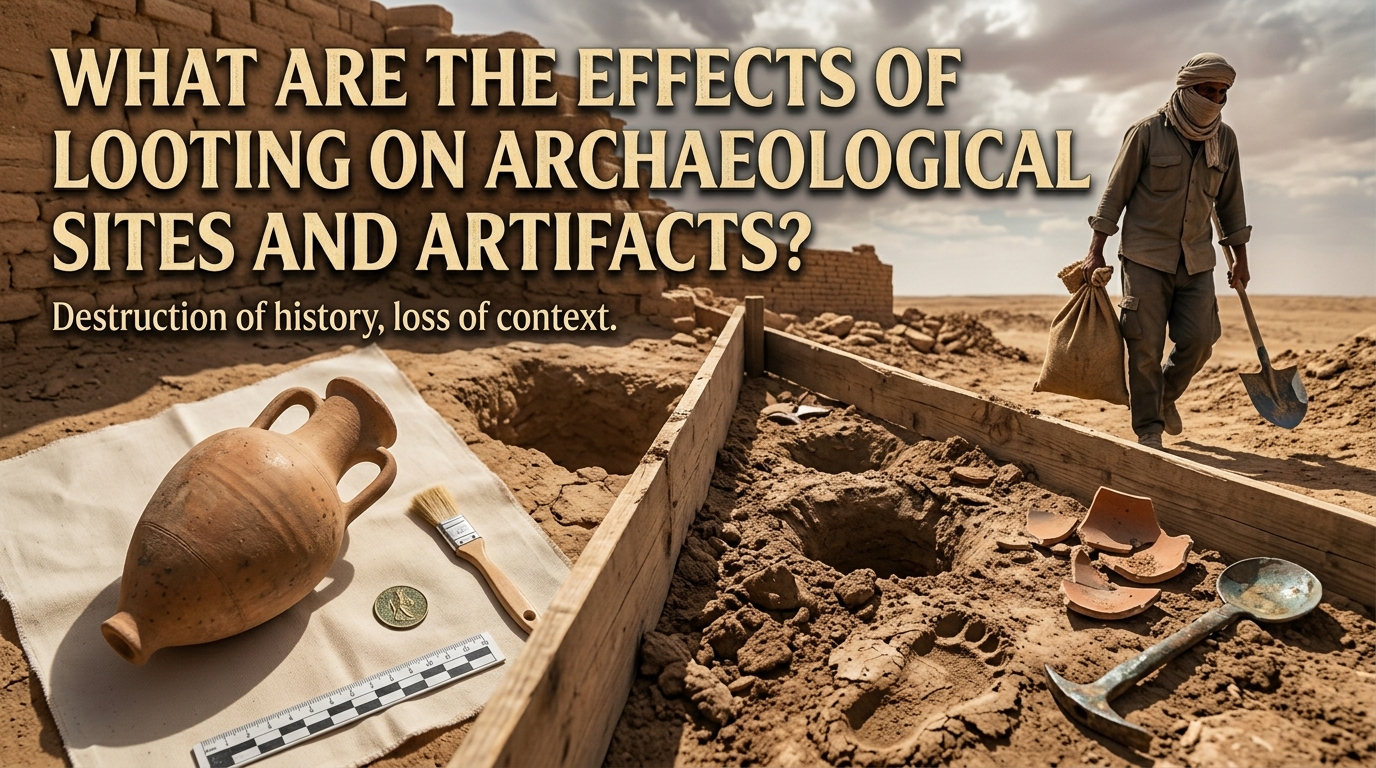
Archaeological sites and ancient artifacts provide valuable evidence about human history, cultural traditions, and the development of ancient civilizations. From pottery and jewelry to temples and burial grounds, these remains help researchers understand how people lived, worked, traded, and practiced their beliefs. However, looting is a serious threat to archaeological heritage because it destroys historical evidence and removes objects from their original locations.
Looting occurs when people illegally remove artifacts or excavate archaeological sites without proper authorization and documentation. Although stolen objects may eventually appear in private collections or the art market, their removal can permanently damage the information they contain. Understanding the effects of looting is essential for protecting archaeological sites, preserving cultural heritage, and safeguarding historical knowledge for future generations.
WHAT IS ARCHAEOLOGICAL LOOTING?
Archaeological looting is the unauthorized removal of artifacts or other cultural materials from archaeological sites, often for financial gain. Looters may target ancient tombs, temples, settlements, shipwrecks, and abandoned historical buildings. Commonly stolen objects include coins, sculptures, pottery, jewelry, religious items, and ancient tools.
Unlike controlled archaeological excavation, looting usually takes place without systematic recording or scientific investigation. Looters may dig through soil layers, break structures, or remove objects without documenting where they were found. This destroys important relationships between artifacts and their surroundings. The main difference between archaeology and looting is the careful preservation of evidence and context, not simply whether an ancient object is removed from the ground.
THE LOSS OF IMPORTANT HISTORICAL INFORMATION
One of the most damaging effects of looting is the permanent loss of archaeological information. The location of an artifact can reveal how it was used, who may have owned it, and how it relates to other objects at the same site. When looters remove artifacts without documentation, researchers lose evidence that cannot always be recovered later.
For example, a coin discovered alongside pottery and building remains may help archaeologists understand the age and economic activities of a settlement. If the coin is stolen and separated from its original context, much of this information may disappear. Archaeological context is often as valuable as the artifact itself because it helps researchers reconstruct the past using scientific evidence. Looting therefore damages not only individual objects but also our ability to understand entire civilizations.
DAMAGE TO ARCHAEOLOGICAL SITES AND HISTORICAL STRUCTURES
Looting can cause severe physical damage to archaeological sites. Unauthorized digging may collapse walls, destroy floors, disturb burial chambers, and damage structures that have survived for centuries. Even small holes can disrupt soil layers and expose fragile materials to environmental conditions that accelerate their deterioration.
The damage may become more extensive when looters use heavy equipment or repeatedly target the same location. Ancient tombs and ceremonial spaces can lose their original layout, making it difficult to understand their purpose and construction. Once an archaeological site is disturbed or destroyed, its original condition may be impossible to restore. Preventing unauthorized excavation is therefore essential for protecting both the physical remains and the historical evidence they contain.
THE DESTRUCTION OF CULTURAL HERITAGE AND IDENTITY
Ancient artifacts often have deep cultural, spiritual, and historical significance for local communities. Religious objects, ancestral remains, traditional artworks, and ceremonial items may represent beliefs and traditions that have been passed down through generations. When these objects are stolen, communities can lose important connections to their heritage.
Looting may also weaken opportunities for cultural education and historical understanding. Objects removed from their original communities may be displayed or sold without explaining their cultural meaning or historical background. In some cases, their removal can cause distress, particularly when burial places or sacred sites are disturbed. Protecting cultural heritage means respecting the communities connected to it, not simply preserving objects as valuable collectibles.
HOW LOOTING FUELS THE ILLEGAL ARTIFACT TRADE
Looting is closely connected to the illegal trade in antiquities. Stolen objects may pass through dealers, intermediaries, and private collectors before reaching their final destination. This trade can make it difficult to establish an artifact's true origin and determine whether it was obtained legally.
High demand for rare or valuable objects can create financial incentives for further looting. When artifacts are purchased without reliable ownership records or proof of lawful excavation, buyers may unintentionally or knowingly support the destruction of archaeological sites. Responsible collecting and transparent provenance records are important for reducing this risk. Museums, dealers, and collectors can help protect heritage by checking an object's documented history and complying with applicable laws.
THE IMPACT OF LOOTING ON ARCHAEOLOGICAL RESEARCH
Looting makes archaeological research more difficult and less reliable. Researchers depend on accurately recorded locations, soil layers, artifact relationships, and excavation records to develop interpretations of past societies. When these details are destroyed, scholars may be unable to answer important questions about settlement patterns, trade, religious practices, and technological development.
Stolen artifacts may still provide some information through their materials, designs, or inscriptions. However, researchers often cannot establish their full historical significance without reliable information about where and how they were discovered. Looting creates permanent gaps in the archaeological record, limiting the knowledge available to future researchers. It can also force institutions to spend time and resources investigating stolen objects rather than conducting new research or preserving existing sites.
ECONOMIC AND SOCIAL CONSEQUENCES OF LOOTING
Although looting may generate short-term profits for those selling stolen artifacts, it can create wider economic and social harm. Communities may lose opportunities to develop sustainable cultural tourism, educational programs, and heritage-related employment. Damaged archaeological sites may also require expensive conservation work or become unsuitable for public access.
Looting can undermine trust between local communities, researchers, museums, and authorities. When cultural resources disappear, residents may feel excluded from decisions about their own heritage. Responsible heritage management can support local education, community participation, and sustainable economic opportunities while protecting historical resources. Preserving archaeological sites can therefore provide long-term benefits that extend beyond academic research.
HOW LOOTING AFFECTS MUSEUMS AND CULTURAL INSTITUTIONS
Museums and cultural institutions have an important responsibility to protect and interpret historical objects. When looted artifacts enter collections, institutions may face questions about ownership, authenticity, legal acquisition, and ethical responsibility. Objects without reliable provenance can be difficult to research and may create disputes with countries or communities seeking their return.
To address these concerns, institutions can examine acquisition records, investigate suspicious objects, and cooperate with relevant authorities and source communities. Provenance research helps establish an artifact's ownership history and identify potential links to illegal excavation or trafficking. When evidence shows that an object was unlawfully removed, appropriate legal and ethical procedures may support its restitution. Transparent collection practices help strengthen public trust and discourage the market for looted antiquities.
HOW ARCHAEOLOGICAL LOOTING CAN BE PREVENTED
Preventing looting requires cooperation between governments, archaeologists, museums, law enforcement agencies, and local communities. Strong legal protections and effective enforcement can discourage illegal excavation and the sale of stolen cultural objects. Site monitoring, security measures, and accurate archaeological records can also help authorities identify vulnerable locations and respond to damage.
Public education is equally important because people may not realize how much information is lost when artifacts are removed without documentation. Communities can help protect sites by reporting suspicious activities and participating in local heritage initiatives. Buyers and collectors should request reliable provenance records and avoid purchasing objects suspected of being illegally obtained. International cooperation and responsible collecting practices can reduce demand for stolen artifacts and support the protection of archaeological heritage worldwide.
WHY ARCHAEOLOGICAL SITE PRESERVATION MATTERS
Archaeological sites contain evidence that cannot always be replaced once it is destroyed. Their artifacts, structures, and environmental remains help explain how civilizations developed, exchanged ideas, and adapted to changing conditions. Protecting these places ensures that researchers can continue investigating historical questions using reliable evidence.
Preservation also allows future generations to learn about their cultural heritage through museums, educational programs, and carefully managed historical sites. Conservation may involve restricting access to vulnerable locations, documenting structures, and storing recovered artifacts under suitable conditions. Protecting archaeological sites preserves both physical objects and the knowledge embedded in their original context. This responsibility benefits researchers, local communities, and society as a whole.
CONCLUSION
Looting has serious consequences for archaeological sites and artifacts. It destroys historical context, damages ancient structures, weakens cultural identity, fuels illegal trade, and limits the ability of researchers to reconstruct the past. Even when a stolen object survives physically, the information lost through its removal may be impossible to recover.
Addressing this problem requires effective laws, responsible collecting, community participation, and long-term heritage conservation. Museums and collectors must also pay close attention to the documented origins of historical objects. By preventing looting and protecting archaeological sites, society can preserve valuable cultural resources and ensure that future generations continue to learn from humanity's shared history.
Recent Posts

Bagaimana Sistem SKS pada Program Kuliah... 22.11.2026/50 View

How Does Technology Make Daily Evaluation... 21.11.2026/80 View

Apa Strategi Menghadapi Kesenjangan antara Kompetensi... 21.11.2026/79 View

Mengapa Inventaris Aset Penting bagi Kelancaran... 21.11.2026/75 View

When Should Musicians Join a Record... 21.11.2026/80 View
