

What Are the Effects of Low Political Literacy on Society?
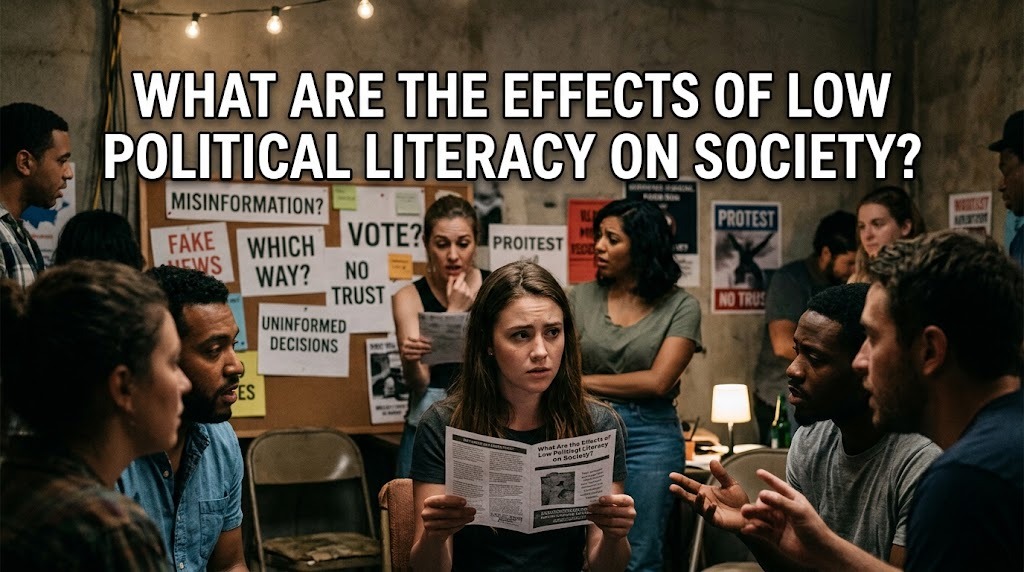
Political literacy helps people understand political issues, public institutions, civic rights, responsibilities, and democratic processes. When people have limited political knowledge or difficulty evaluating political information, they may find it harder to understand public affairs and participate meaningfully in civic life.
Low political literacy does not mean that everyone with limited knowledge will respond to political information in the same way. Its effects can vary depending on access to education, information, media environments, and individual circumstances. However, limited political literacy can create challenges when people need to understand complex political issues or evaluate competing claims.
MAKING POLITICAL INFORMATION HARDER TO UNDERSTAND
One possible effect of low political literacy is difficulty understanding political information. Government policies, laws, elections, and public institutions can involve unfamiliar terms and complicated processes.
Without sufficient background knowledge, people may have trouble understanding who is responsible for a particular decision or how a policy affects different groups. This can make public discussions more difficult to follow.
Developing basic political knowledge can help individuals understand important concepts and connect political information with events in their communities. This knowledge can provide a foundation for more informed engagement with public issues.
INCREASING THE RISK OF ACCEPTING UNVERIFIED INFORMATION
The digital environment provides access to a large amount of political information. Some information may be incomplete, misleading, inaccurate, or presented without sufficient context.
People with limited information-evaluation skills may find it more difficult to identify unsupported claims. UNESCO emphasizes the importance of media and information literacy, including the ability to access, evaluate, and use information effectively.
Developing critical thinking can help people examine the source of a claim, look for supporting evidence, compare different sources, and determine whether additional verification is needed.
REDUCING MEANINGFUL CIVIC PARTICIPATION
Another possible effect is difficulty participating in civic life. People may be less familiar with how public institutions work or what forms of civic participation are available to them.
Civic participation can include learning about public issues, joining community activities, expressing opinions respectfully, volunteering, and taking part in democratic processes when legally eligible. The Council of Europe describes democratic citizenship as involving rights, responsibilities, and participation in civic and political processes.
Better political knowledge can help people understand these opportunities and make participation more meaningful. However, participation is influenced by many factors beyond political literacy, including access, interest, resources, and social circumstances.
MAKING POLITICAL DISCUSSIONS MORE DIFFICULT
Political discussions can involve different viewpoints, interests, and interpretations. Limited political literacy may make it harder for people to understand the arguments being presented or distinguish between evidence and unsupported claims.
When people lack relevant background information, discussions may become focused on assumptions rather than the substance of an issue. This can make it more difficult to communicate with people who have different perspectives.
Learning about political issues and practicing respectful discussion can support better communication. The Council of Europe identifies dialogue, respect for diversity, human rights, and peaceful conflict resolution as important elements of democratic culture.
MAKING INFORMED DECISION-MAKING MORE CHALLENGING
Informed decision-making requires access to relevant information and the ability to evaluate it. Limited political literacy can make it more difficult to compare policy proposals, understand institutional roles, or assess political claims.
This does not mean people with limited political knowledge are incapable of making decisions. Rather, it highlights the value of developing knowledge and information-evaluation skills so individuals have more tools for understanding public issues.
Improving political literacy through education, reliable information, critical thinking, and civic learning can help people become more familiar with political processes. These skills can support independent judgment without requiring everyone to share the same political views.
CONCLUSION
The effects of low political literacy on society can include greater difficulty understanding political information, evaluating claims, participating in civic life, and discussing public issues constructively.
Improving political literacy can provide people with useful knowledge and skills for navigating public affairs. Through education, reliable information, critical thinking, and respectful civic engagement, individuals can become better prepared to understand political issues and form their own informed judgments.
Recent Posts

Bagaimana Sistem SKS pada Program Kuliah... 22.11.2026/33 View

How Does Technology Make Daily Evaluation... 21.11.2026/67 View

Apa Strategi Menghadapi Kesenjangan antara Kompetensi... 21.11.2026/67 View

Mengapa Inventaris Aset Penting bagi Kelancaran... 21.11.2026/65 View

When Should Musicians Join a Record... 21.11.2026/66 View
