

What Are the Judging Criteria for Each MAPSI Competition Category?
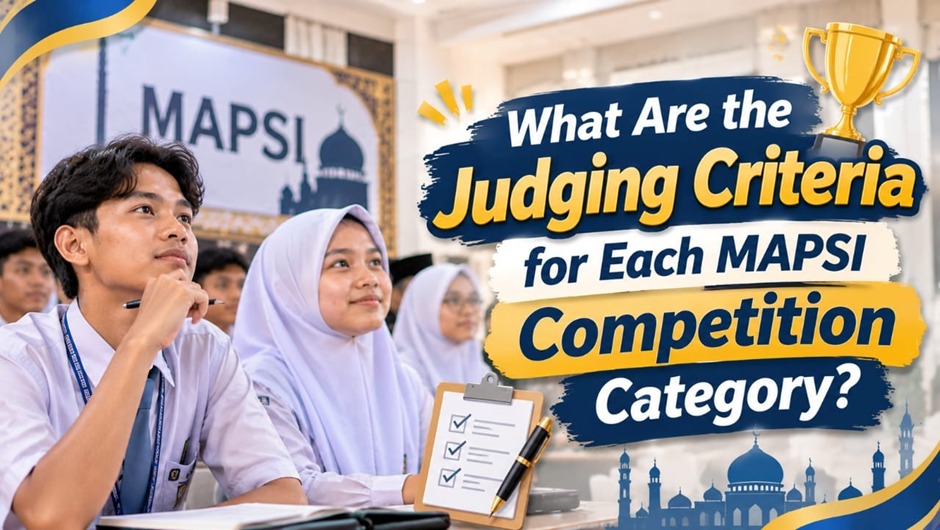
The MAPSI Competition (Islamic Education and Arts Competition) is an educational event that allows students to demonstrate their knowledge, religious abilities, creativity, and understanding of Islamic values. Through various competition categories, students can develop their talents while gaining valuable experiences in a competitive learning environment.
One important aspect of MAPSI is the judging process. Each competition category may have different assessment standards depending on the skills being demonstrated. Judges generally consider factors such as technical ability, accuracy, creativity, presentation, discipline, and compliance with competition rules.
Understanding the judging criteria helps students prepare more effectively and avoid common mistakes. Although the exact scoring system can differ between organizers and competition levels, the following are common assessment aspects that may be used in MAPSI competitions.
1. QURANIC RECITATION COMPETITION
In Quranic recitation categories, judges generally assess students' ability to read the Quran correctly and beautifully. One of the main criteria is Tajweed accuracy, which includes the correct pronunciation of Arabic letters, appropriate articulation points, and proper application of recitation rules.
Judges may also evaluate fluency, voice quality, rhythm, and confidence. Participants are expected to maintain a consistent reading pace without unnecessary mistakes or interruptions. Proper manners when handling and reciting the Quran may also be considered according to the event guidelines.
2. ISLAMIC KNOWLEDGE COMPETITION
Islamic knowledge competitions assess students' understanding of religious subjects and their ability to answer questions accurately. The evaluation may cover topics such as Islamic history, Quranic knowledge, Hadith, worship practices, and basic Islamic teachings.
Judges generally consider the correctness of answers, understanding of concepts, and speed of response when the competition uses a timed format. Students may also be assessed on their ability to explain religious concepts clearly. Accuracy and depth of knowledge are essential because participants must demonstrate genuine understanding rather than simply memorize information.
3. WUDU AND PRAYER PRACTICE COMPETITION
This category evaluates students' ability to perform ablution (wudu) and prayer correctly according to Islamic teachings. Judges assess the accuracy of movements, the pronunciation of required recitations, the proper sequence of actions, and the overall performance.
For wudu, important aspects include washing the required body parts correctly, reciting the intention, maintaining the proper order, and reading the prayer after completion. For prayer, judges may examine body positions, recitations, and the accuracy of movements from the beginning until the final greeting. Accuracy, order, and correct practice are essential assessment components.
4. ADHAN AND IQAMAH COMPETITION
The Adhan and Iqamah category assesses students' ability to deliver the call to prayer with correct pronunciation and appropriate delivery. Judges generally pay attention to pronunciation, vocal clarity, rhythm, and the accuracy of the recitation.
Participants should pronounce Arabic words clearly and follow the correct sequence of the Adhan and Iqamah. Voice control and confidence may also influence the overall performance. Students should practice regularly to maintain a clear voice and avoid pronunciation mistakes.
5. QURANIC MEMORIZATION COMPETITION
The Quranic memorization category, also known as Hifzhil Quran, evaluates students' ability to memorize and recite selected Quranic passages accurately. Judges may assess memorization accuracy, fluency, Tajweed, and pronunciation.
Participants should demonstrate strong recall without frequent pauses or assistance. They also need to maintain proper articulation and apply Quranic recitation rules throughout their performance. Consistent memorization and accurate recitation are important factors in achieving a good result.
6. KHAT AL-QURAN AND ISLAMIC CALLIGRAPHY COMPETITION
These categories assess students' artistic abilities in writing Arabic letters and creating Islamic calligraphy. Judges may consider letter formation, proportions, spacing, composition, and overall neatness.
In Khat Al-Quran, attention is given to the accuracy and consistency of Arabic writing according to the required script. In Islamic calligraphy, judges may also consider artistic creativity, visual balance, and the arrangement of decorative elements. Students should ensure that their work is both visually attractive and correct in its Arabic writing.
7. KHITABAH OR ISLAMIC SPEECH COMPETITION
The Khitabah category evaluates students' ability to deliver Islamic speeches with clear messages and effective communication. Judges generally consider speech content, language, delivery style, voice, expression, and confidence.
A good speech should have an appropriate topic, a well-organized structure, and messages that are relevant to Islamic teachings. Participants are also expected to use understandable language, appropriate gestures, and effective intonation. Public speaking skills and mastery of the material are important elements of this category.
8. ISLAMIC MACAPAT COMPETITION
The Islamic Macapat category combines traditional Javanese poetry with Islamic messages. Judges may assess students' understanding of the lyrics, pronunciation, vocal quality, rhythm, and suitability of the performance.
Participants should maintain the correct Macapat rhythm and melodic patterns while delivering meaningful religious messages. Clear pronunciation and appropriate vocal expression can make the performance more effective. Students should also understand the meaning of the lyrics so they can communicate the message naturally.
9. ISLAMIC INFORMATION TECHNOLOGY COMPETITION
The Islamic Information Technology category, commonly known as TIKI, encourages students to demonstrate their digital skills through technology-based activities related to Islamic education. Assessment may include technical accuracy, creativity, presentation, and the relevance of the content.
Students need to understand the task requirements and use available technology effectively. Their work should communicate Islamic messages accurately while maintaining an organized and attractive presentation. Digital creativity and responsible technology use are important aspects of this category.
10. ISLAMIC STORYTELLING COMPETITION
The Islamic Storytelling category evaluates students' ability to present stories containing Islamic values and positive moral messages. Judges may assess story comprehension, pronunciation, expression, voice variation, and presentation skills.
Participants should understand the story and communicate its message clearly to the audience. Facial expressions, gestures, and appropriate changes in voice can make the storytelling more engaging. Students should also maintain a natural presentation and demonstrate confidence throughout the performance.
11. RELIGIOUS SONG DUET COMPETITION
The Religious Song Duet category assesses two participants performing an Islamic song together. Judges generally consider vocal quality, musical accuracy, harmony, rhythm, and stage presentation.
Participants should maintain balanced voices and coordinate their singing throughout the performance. Proper timing, clear lyrics, and good cooperation between singers are also important. A successful duet demonstrates both individual singing ability and strong musical coordination.
12. REBANA MUSIC COMPETITION
The Rebana category evaluates students' musical abilities through traditional Islamic percussion performances. In the 2026 Central Java MAPSI elementary school guidelines, the assessment distinguishes between vocal performance, musical performance, and presentation.
Participants need to maintain accurate rhythms, coordinate percussion instruments, and perform together as a group. Judges may also consider vocal harmony, musical arrangement, synchronization, and overall stage appearance. Teamwork and musical consistency are important because the quality of the performance depends on cooperation among group members.
13. GENERAL JUDGING RULES IN MAPSI COMPETITIONS
Although each MAPSI category has different assessment standards, several general rules apply throughout the competition. Participants are expected to follow the official technical guidelines, respect the judges, and complete their performances according to the assigned time limits.
In the 2026 Central Java MAPSI elementary school guidelines, most final scores are calculated by adding the scores from three judges, with an exception for the Islamic knowledge and BTQ category. Participants may also receive penalties for certain violations, such as arriving late when called to perform. Following the rules, maintaining discipline, and demonstrating fair competition are therefore important parts of the assessment process.
FlipHTML5+1
TIPS TO ACHIEVE HIGHER SCORES IN MAPSI COMPETITIONS
Understanding the judging criteria is only the first step toward achieving good results. Students also need proper preparation, regular practice, and guidance from teachers to improve their performance.
Here are several practical tips to help participants prepare:
- Understand the Rules: Read the official technical guidelines for the selected category.
- Practice Consistently: Train regularly to improve technical abilities and confidence.
- Master the Materials: Study the relevant religious knowledge and competition requirements.
- Improve Performance: Pay attention to pronunciation, presentation, accuracy, and creativity.
- Manage Time: Practice completing performances within the allocated duration.
- Accept Feedback: Use suggestions from teachers and mentors to correct mistakes.
- Maintain Sportsmanship: Respect judges, competitors, and the final competition results.
By following these steps, students can prepare more effectively and demonstrate their abilities with greater confidence.
CONCLUSION
The MAPSI Competition judging criteria are designed to evaluate different aspects of students' abilities, including religious knowledge, technical skills, creativity, accuracy, and presentation. Each category has its own assessment standards based on the type of performance or activity being conducted.
Understanding these criteria allows students to prepare more strategically and focus on the skills that matter most in their chosen categories. Teachers can also use the assessment guidelines to provide more effective training and guidance.
It is important to remember that official judging criteria may differ depending on the MAPSI education level, organizing committee, region, and competition year. Therefore, participants should always refer to the latest official technical guidelines issued by the organizer. Ultimately, MAPSI is not only about winning awards but also about developing knowledge, talent, discipline, and positive Islamic values.
Recent Posts

How Does Technology Make Daily Evaluation... 21.11.2026/63 View

Apa Strategi Menghadapi Kesenjangan antara Kompetensi... 21.11.2026/64 View

Mengapa Inventaris Aset Penting bagi Kelancaran... 21.11.2026/60 View

When Should Musicians Join a Record... 21.11.2026/59 View

Daily Evaluation or Daily Planning Which... 21.11.2026/67 View
