

What Are the Main Differences Between Early Humans and Modern Humans?
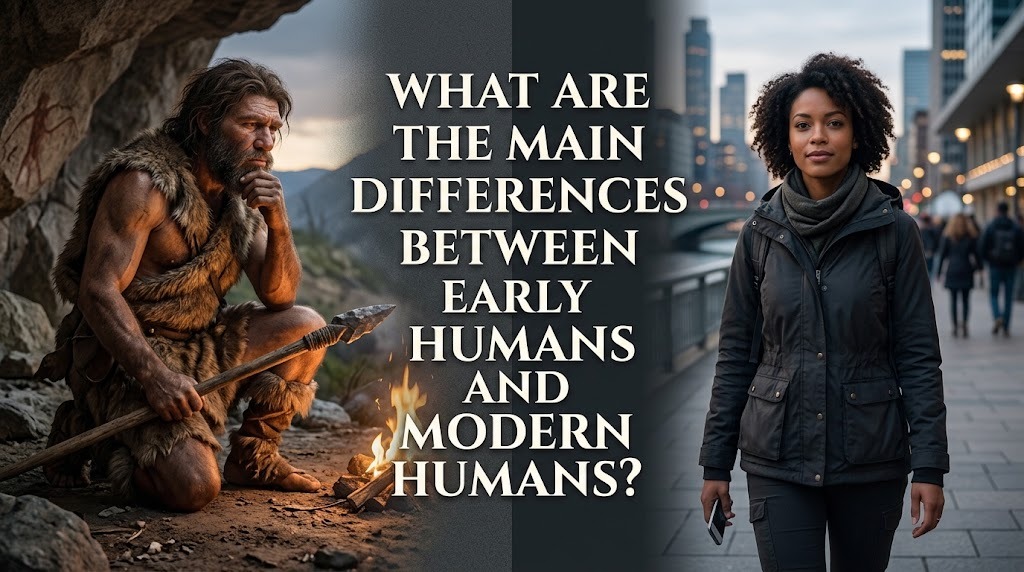
Human evolution is a long process that has shaped the way people look, think, communicate, and live today. Early humans developed various physical and behavioral adaptations that helped them survive in different environments. Over millions of years, changes in anatomy, brain development, technology, and social organization contributed to the emergence of modern humans. However, human evolution was not a simple, straight line from primitive ancestors to advanced people. Several human species existed at different times, and some even lived alongside one another.
Understanding the main differences between early humans and modern humans helps explain how our species developed and adapted to changing conditions. These differences can be seen in physical characteristics, brain development, tools, communication, and lifestyle. Scientific evidence from fossils, archaeological discoveries, and genetic research provides valuable information about this remarkable history.
PHYSICAL APPEARANCE AND BODY STRUCTURE
One of the main differences between early humans and modern humans is their physical appearance. Early human species had different body shapes, skull structures, and facial features depending on their evolutionary stage. For example, some early human relatives had smaller brains, more prominent brow ridges, and longer arms compared with modern humans. Certain species also had robust bodies that helped them survive physically demanding environments. However, not all early humans looked alike because human evolution involved many different species with distinct characteristics.
Modern humans, scientifically known as Homo sapiens, generally have rounded skulls, relatively flat faces, prominent chins, and lighter brow ridges than many earlier human species. Their skeletons are also generally more gracile, meaning less robust, although body size and shape vary considerably among individuals and populations. Modern humans have an upright posture and are well adapted to walking on two legs over long distances. These characteristics developed through a complex evolutionary history rather than appearing all at once. Fossil evidence helps scientists identify how human anatomy changed across different periods.
BRAIN DEVELOPMENT AND INTELLIGENCE
Brain development is another important difference between many early human species and modern humans. Some early human species had smaller average brain volumes than modern humans, although brain size varied considerably across species. For instance, Homo habilis generally had a smaller brain than Homo sapiens, while some later human species, such as Neanderthals, had brain volumes that overlapped with or exceeded the modern human average. Therefore, brain size alone cannot determine intelligence or cognitive ability. Scientists also examine brain organization, behavior, and archaeological evidence to understand how ancient humans thought and solved problems.
Modern humans possess complex cognitive abilities that support abstract thinking, planning, learning, and creative problem-solving. They can develop sophisticated systems of knowledge and pass information between generations through education and cultural practices. These abilities help people create scientific theories, develop technologies, and solve problems that require long-term planning. Nevertheless, the exact cognitive abilities of extinct human species cannot be measured directly, and archaeological evidence suggests that several earlier human groups demonstrated considerable intelligence. The development of human cognition was gradual and involved multiple biological and cultural changes.
TOOLS AND TECHNOLOGICAL DEVELOPMENT
Early humans developed tools to obtain food, process animal remains, prepare materials, and improve their chances of survival. Some of the earliest known stone tools date back more than three million years, although researchers continue to investigate who made them and how toolmaking developed. Over time, different human species created increasingly varied tools, including sharpened stones, cutting implements, and hunting equipment. The development of fire use also provided important advantages, such as warmth, protection, and the ability to cook food. These innovations helped early human populations adapt to different environments and expand into new regions.
Modern humans benefit from accumulated scientific knowledge and highly developed technology. People can produce electricity, operate computers, build complex transportation systems, and communicate instantly across continents. These achievements are possible because knowledge can be recorded, shared, tested, and improved across generations. Modern technology also allows humans to study their own evolutionary history through genetic analysis, medical research, and advanced imaging. The major difference is not that earlier humans lacked intelligence, but that modern societies have developed extensive systems for preserving and building upon knowledge.
LANGUAGE AND COMMUNICATION
Communication played an important role in human evolution because it allowed individuals to cooperate, share information, and maintain social relationships. Early humans likely used a combination of gestures, facial expressions, vocal sounds, and other forms of communication. Some extinct human species may have possessed complex vocal communication, but the exact nature of their languages remains uncertain because spoken language does not leave direct fossil evidence. Scientists study the anatomy of the vocal tract, hearing capabilities, archaeological findings, and genetic evidence to investigate the origins of human language. However, the precise timing and development of language remain subjects of scientific research.
Modern humans use complex languages to communicate detailed information, express emotions, discuss abstract ideas, and preserve cultural knowledge. Language can be spoken, written, signed, or communicated through digital platforms. It enables people to explain complicated concepts, organize communities, and collaborate on projects involving thousands or even millions of individuals. Writing systems have also made it possible to preserve information long after the original speaker or writer has died. These communication systems have played a major role in the growth of education, science, and modern civilization.
LIFESTYLE AND FOOD SOURCES
Early human lifestyles were strongly influenced by their environments and the resources available to them. Many early human populations relied on hunting animals, gathering fruits, collecting seeds, and finding other naturally available foods. Their daily activities often required considerable physical effort, and they moved between locations when food or water became scarce. Shelter choices depended on local conditions and could include caves, rock shelters, or temporary structures. However, lifestyles differed among human species and communities, so not every early human group followed the same survival strategy.
Modern humans live in a wide range of environments and use many different methods to obtain food. Agriculture, animal domestication, food processing, and global trade have transformed how many societies produce and distribute resources. Permanent settlements have also supported the development of cities, specialized occupations, and large communities. Nevertheless, modern lifestyles are diverse, and some communities continue to rely partly or entirely on hunting, gathering, fishing, or small-scale farming. The main difference is the widespread use of organized food production, infrastructure, and technology in many modern societies.
SOCIAL ORGANIZATION AND CULTURAL DEVELOPMENT
Early humans depended on social cooperation to improve their chances of survival. Working together could help them find food, protect vulnerable group members, care for children, and share valuable knowledge. Archaeological evidence from some ancient human sites suggests that certain groups cared for injured or disabled individuals, although researchers must interpret these findings carefully. Evidence of symbolic objects, pigments, ornaments, and burials also suggests that some earlier human populations engaged in meaningful social and cultural practices. The exact beliefs and social structures of these groups are often difficult to reconstruct.
Modern humans have developed diverse social systems, including families, villages, cities, governments, educational institutions, and international organizations. Cultural traditions are transmitted through language, storytelling, art, religious practices, formal education, and digital communication. These systems allow large populations to cooperate beyond immediate family or small social groups. Modern societies can also preserve laws, historical records, and shared knowledge through written documents and institutions. However, complex culture did not suddenly appear in the modern era, because evidence indicates that cultural behavior has deep roots in earlier human populations.
MIGRATION AND ADAPTATION TO THE ENVIRONMENT
Human evolution involved repeated migrations and adaptations to changing environments. Early members of the human lineage evolved in Africa, and several human species eventually spread into parts of Asia and Europe. Different populations adapted to variations in temperature, food availability, altitude, and other environmental conditions. For example, Neanderthals lived in parts of Europe and western Asia and possessed physical characteristics suited to challenging environments. These migrations were not a single journey undertaken by one group but a series of movements across many generations.
Modern humans originated in Africa and spread to other parts of the world, with major expansions occurring over tens of thousands of years. As populations migrated, they adapted to local conditions through a combination of biological changes, cultural practices, and technological innovation. Genetic evidence also shows that modern humans interbred with some archaic human populations, including Neanderthals and Denisovans. This means that the history of human evolution includes both population replacement and interaction between different groups. Today, humans continue to adapt to environmental challenges, although technology and cultural practices can reduce the need for certain biological adaptations.
HOW SCIENTISTS IDENTIFY THE DIFFERENCES
Scientists use several methods to compare early humans with modern humans. Fossils provide evidence about body structure, skull shape, teeth, and changes in anatomy over time. Archaeological discoveries, including stone tools, animal remains, ornaments, and ancient living sites, help researchers understand how human populations obtained food and organized their activities. Genetic research provides additional information about relationships between ancient populations and modern humans. By combining these sources, scientists can develop more reliable explanations of human evolution.
Each type of evidence has limitations, so researchers compare findings from different fields before drawing conclusions. Fossils cannot directly reveal every aspect of intelligence or spoken language, while archaeological objects may have several possible interpretations. Genetic evidence can clarify ancestry and population relationships, but it does not independently explain every cultural or behavioral development. New discoveries can also change earlier interpretations. This scientific approach helps ensure that explanations of human evolution are based on evidence rather than assumptions.
CONCLUSION
The main differences between early humans and modern humans can be observed in physical characteristics, brain development, technology, communication, lifestyle, and cultural organization. Over millions of years, members of the human lineage developed different adaptations that helped them survive and respond to changing environments. Modern humans possess sophisticated language, advanced technologies, and extensive systems for sharing knowledge, but many important abilities developed gradually and have roots in earlier human populations.
Human evolution was not a simple progression in which every new species was necessarily better than the previous one. Different human species had distinct strengths and adaptations, and some lived at the same time or interbred with one another. Fossils, archaeological discoveries, and genetic research continue to improve our understanding of this history. Studying these differences helps explain not only where modern humans came from but also how biological evolution and cultural development have shaped human life today.
Recent Posts

Bagaimana Sistem SKS pada Program Kuliah... 22.11.2026/51 View

How Does Technology Make Daily Evaluation... 21.11.2026/81 View

Apa Strategi Menghadapi Kesenjangan antara Kompetensi... 21.11.2026/81 View

Mengapa Inventaris Aset Penting bagi Kelancaran... 21.11.2026/77 View

When Should Musicians Join a Record... 21.11.2026/82 View
