

What Are the Most Common Mistakes Found During Thesis Revision?
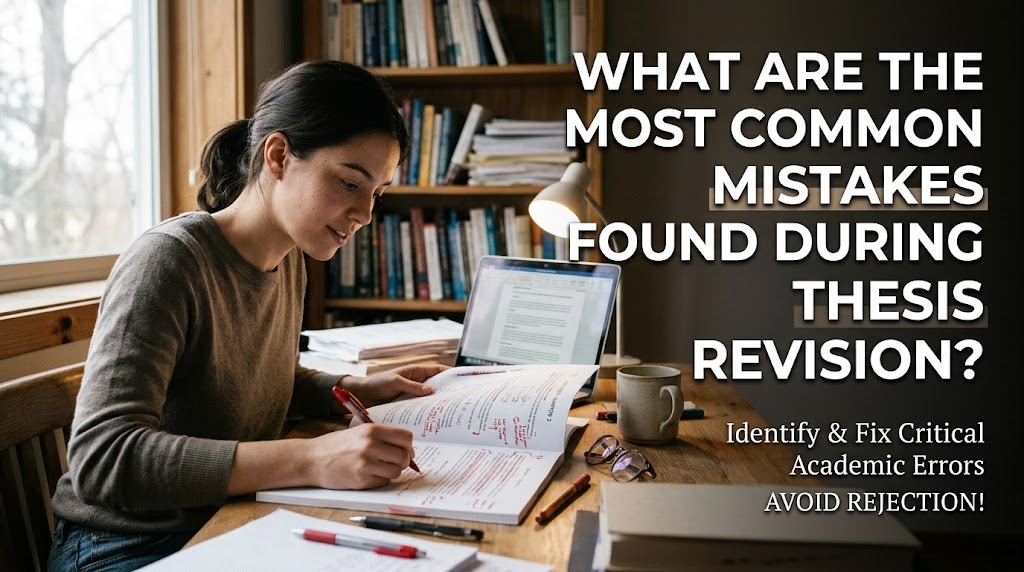
Thesis revision is an important stage in completing academic research. During this process, students review their work, respond to supervisor feedback, and correct sections that need improvement. Although revisions are intended to strengthen a thesis, students may still make mistakes when interpreting comments or applying corrections. These errors can lead to repeated revisions and make the writing process take longer than expected.
Understanding the most common mistakes during thesis revision can help students work more carefully and avoid unnecessary corrections. Mistakes may involve research content, writing structure, methodology, data analysis, or document formatting. By recognizing these problems, students can approach revisions more systematically and produce a thesis that meets academic requirements.
MISUNDERSTANDING THE SUPERVISOR'S FEEDBACK
One common mistake during thesis revision is misunderstanding the feedback provided by a supervisor. Students may interpret comments differently from what the supervisor intended, especially when the instructions are brief or refer to complex research issues. As a result, they may revise the wrong section or make changes that do not address the actual problem.
To avoid this mistake, students should read each comment carefully and identify the specific issue that needs to be corrected. If an instruction is unclear, they should ask the supervisor for further explanation rather than making assumptions. It is also useful to create a list of revision points and record the actions taken for each comment. This approach helps students ensure that the requested improvements are properly addressed.
CHANGING CONTENT WITHOUT CHECKING ITS CONNECTION TO OTHER CHAPTERS
Another frequent mistake is changing one section of a thesis without considering its relationship with other chapters. For example, revising the research objectives may affect the research questions, methodology, discussion, and conclusion. If students update only one section, the thesis may contain inconsistent information.
Maintaining consistency between thesis chapters is essential because each part should support the overall direction of the research. After making substantial changes, students should review related sections to ensure that the information remains connected. They should also check whether the title, objectives, research questions, and conclusions still reflect the same research focus. Reviewing the entire document after major revisions can help prevent contradictions and improve its overall coherence.
MAKING CHANGES WITHOUT PROVIDING SUFFICIENT EVIDENCE
Students sometimes make revisions by adding statements or changing arguments without checking whether the information is supported by reliable academic sources. This can happen when they want to respond quickly to supervisor feedback without reviewing the relevant literature. Consequently, the revised discussion may contain unsupported claims or explanations that are not sufficiently connected to the research findings.
A strong academic argument should be supported by appropriate theories, previous studies, or research evidence. Students should verify the relevance and credibility of sources before using them in their thesis. They should also ensure that additional references genuinely support the points being discussed. By checking the evidence behind every important claim, students can improve the accuracy and credibility of their academic writing.
IGNORING FORMATTING, CITATION, AND LANGUAGE CONSISTENCY
Another mistake is focusing only on research content while overlooking technical details. Students may correct the discussion or methodology but forget to check headings, page numbers, tables, figures, citations, and reference lists. Inconsistent formatting can make a thesis appear less organized and may result in additional corrections during the final review.
Academic writing consistency also includes grammar, terminology, sentence structure, and citation style. Students should follow the formatting guidelines established by their university and use the required reference style consistently. After completing the main revisions, they can review the document for spelling errors, incomplete citations, duplicated references, and inconsistent terms. Careful proofreading helps ensure that the final document is clear and professionally presented.
FAILING TO REVIEW AND DOCUMENT COMPLETED REVISIONS
Some students assume that a correction is complete as soon as they have edited the relevant sentence or paragraph. However, they may forget to compare the revised section with the original supervisor comment. This can result in incomplete corrections, overlooked instructions, or new errors introduced during editing.
To prevent this problem, students should maintain a thesis revision checklist or a revision table. Each item can include the supervisor's comment, the section that needs attention, the action taken, and its completion status. Once all corrections have been made, students should read the revised document again and check whether each comment has been addressed. Keeping track of revisions makes the process easier to monitor and helps students prepare for the next consultation.
CONCLUSION
The most common mistakes found during thesis revision include misunderstanding supervisor feedback, making disconnected changes between chapters, using unsupported arguments, overlooking formatting and citation requirements, and failing to review completed corrections. These problems can affect the clarity, consistency, and academic quality of a thesis. If they are not identified early, students may need to repeat certain revisions.
Students can reduce these mistakes by organizing feedback, checking the connection between chapters, verifying academic sources, following university guidelines, and using a revision checklist. Communication with supervisors is also important whenever instructions require further clarification. Through careful evaluation and systematic corrections, students can make the thesis revision process more effective and prepare a stronger final academic document.
Recent Posts

Bagaimana Sistem SKS pada Program Kuliah... 22.11.2026/47 View

How Does Technology Make Daily Evaluation... 21.11.2026/74 View

Apa Strategi Menghadapi Kesenjangan antara Kompetensi... 21.11.2026/75 View

Mengapa Inventaris Aset Penting bagi Kelancaran... 21.11.2026/72 View

When Should Musicians Join a Record... 21.11.2026/75 View
