

What Are the Most Common Types of Psychometric Tests?
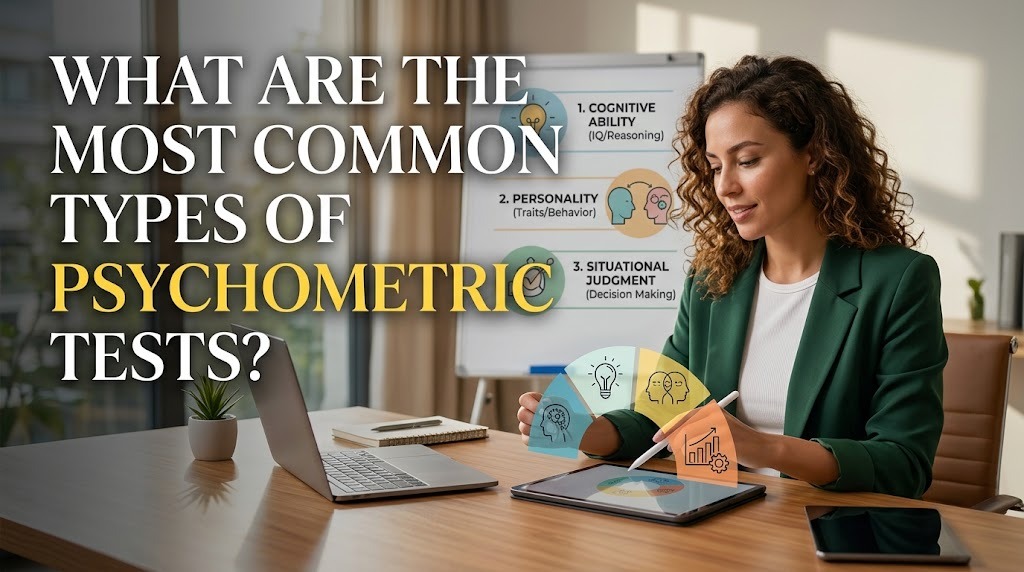
Psychometric tests are assessments designed to measure specific aspects of a person's abilities, characteristics, or preferences. In recruitment, employers use these tests to gather information about candidates that may be relevant to job performance. The results can help recruiters understand how applicants process information, solve problems, and approach different workplace situations.
There are several types of psychometric tests, and each serves a different purpose. Some focus on cognitive abilities, while others examine personality traits, workplace judgment, or specific skills. Understanding these categories can help job applicants prepare more effectively and recognize what employers may be looking for during the selection process.
COGNITIVE ABILITY TESTS
Cognitive ability tests measure mental skills that are useful for understanding information, solving problems, and learning new concepts. These assessments may examine reasoning, memory, attention, and the ability to recognize patterns. Employers often use them when a position requires employees to process information accurately or make decisions based on complex situations.
For example, a cognitive assessment may ask candidates to identify patterns in a sequence, interpret written information, or determine relationships between different concepts. These questions evaluate how applicants approach problems rather than simply testing their knowledge of a particular subject. However, results should be interpreted in relation to the job requirements because cognitive ability is only one factor that can influence workplace performance.
NUMERICAL REASONING TESTS
Numerical reasoning tests assess a candidate's ability to understand and interpret numerical information. Questions may involve percentages, ratios, averages, tables, charts, or basic mathematical calculations. These tests are particularly relevant to positions that require employees to analyze figures, prepare reports, or make decisions involving numerical data.
For instance, an applicant may be asked to calculate a percentage increase in sales or compare financial information presented in a chart. Success requires both mathematical accuracy and the ability to identify the information needed to solve a problem. Candidates can prepare by reviewing basic mathematical concepts, practicing sample questions, and learning to manage their time without sacrificing accuracy.
VERBAL AND LOGICAL REASONING TESTS
Verbal reasoning tests evaluate how well candidates understand written information and draw conclusions from a passage. Questions may ask applicants to determine whether a statement is supported by the text, identify the main idea, or recognize a logical conclusion. These assessments can be useful for roles involving communication, documentation, research, and information analysis.
Meanwhile, logical reasoning tests focus on identifying patterns, relationships, and rules. Candidates may need to complete a sequence, interpret diagrams, or determine which conclusion follows from a set of conditions. Although verbal and logical reasoning tests examine different skills, both require careful analysis rather than relying on assumptions. Regular practice can help applicants become familiar with common question formats and improve their ability to recognize relevant information.
PERSONALITY AND BEHAVIORAL ASSESSMENTS
Personality tests explore patterns in how individuals tend to think, feel, or behave. Depending on the assessment, questions may examine characteristics related to organization, sociability, cooperation, emotional responses, or preferences for working independently. Employers may use the results to understand how a candidate's working style could relate to the responsibilities of a particular position.
Behavioral assessments may also examine how applicants typically respond to workplace situations. For example, a questionnaire might explore preferences for teamwork, decision-making, or handling competing priorities. These assessments should not be treated as definitive predictions of future behavior or as simple pass-or-fail measures. Candidates should answer honestly, while employers should interpret results carefully and avoid assuming that one personality profile is automatically better than another.
SITUATIONAL JUDGMENT AND SKILLS TESTS
Situational judgment tests present candidates with realistic workplace scenarios and ask them to choose or rank possible responses. The scenarios may involve resolving disagreements, prioritizing tasks, responding to customer concerns, or making decisions under pressure. Employers use these assessments to explore how applicants understand workplace challenges and evaluate possible courses of action.
In addition, some recruitment processes include skills-based assessments that measure abilities directly related to a role. These may involve writing tasks, data interpretation, technical problems, or practical exercises. Unlike general reasoning assessments, skills tests focus more closely on specific competencies needed for the job. Their usefulness depends on how closely the questions or exercises reflect actual responsibilities and whether candidates are evaluated using clear, consistent criteria.
CONCLUSION
The most common types of psychometric tests include cognitive ability, numerical reasoning, verbal reasoning, logical reasoning, personality assessments, situational judgment tests, and skills-based assessments. Each type measures different aspects of a candidate's abilities or preferences, allowing employers to gather information relevant to recruitment decisions.
Understanding these psychometric assessment types can help applicants prepare for different selection procedures and approach tests with greater confidence. However, no single assessment can provide a complete picture of a candidate. Test results should be considered alongside qualifications, experience, interviews, and practical skills to support a fair and informed hiring process.
Recent Posts

Bagaimana Sistem SKS pada Program Kuliah... 22.11.2026/61 View

How Does Technology Make Daily Evaluation... 21.11.2026/87 View

Apa Strategi Menghadapi Kesenjangan antara Kompetensi... 21.11.2026/85 View

Mengapa Inventaris Aset Penting bagi Kelancaran... 21.11.2026/83 View

When Should Musicians Join a Record... 21.11.2026/87 View
