

What Are the Most Effective Independent Learning Methods for Semester Evaluation?
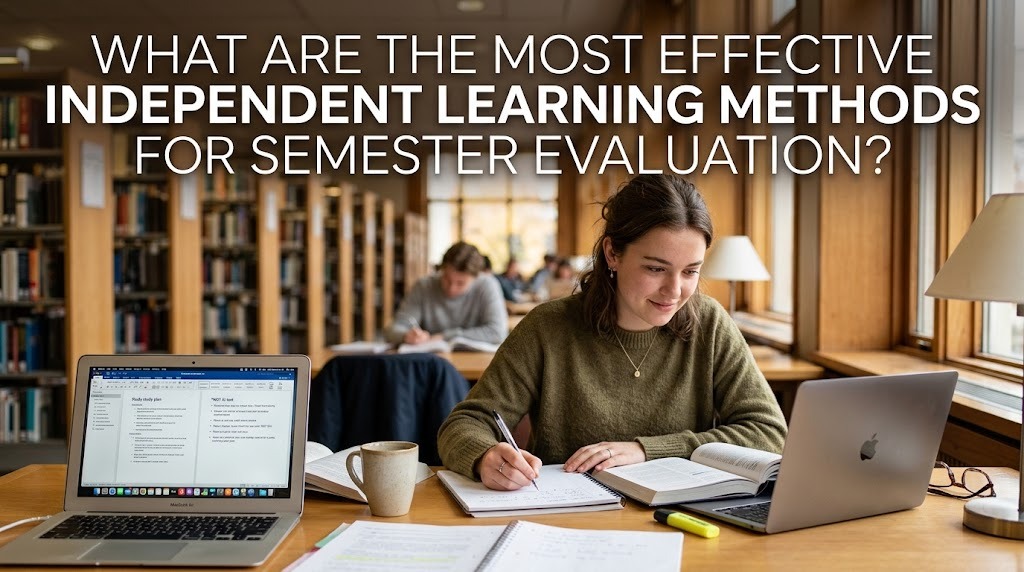
Independent learning is an important part of preparing for semester evaluation because it helps students understand lessons, strengthen their knowledge, and develop effective study habits. Instead of depending entirely on teachers or classroom explanations, students take responsibility for organizing their study time, identifying learning difficulties, and finding suitable ways to understand academic material. However, studying independently does not simply mean spending long hours reading textbooks. Students need effective methods that improve understanding, support memory, and help them apply knowledge during examinations. By choosing the right learning strategies, students can prepare more confidently and achieve better academic results.
UNDERSTANDING INDEPENDENT LEARNING
Independent learning is a process in which students take an active role in managing their own education. They decide what to study, establish learning goals, select appropriate resources, and evaluate their understanding of the material. During semester evaluation preparation, this approach allows students to review lessons at their own pace and spend more time on difficult subjects. It also encourages responsibility, discipline, and problem-solving skills that are valuable beyond formal education.
Effective independent learning still benefits from guidance and feedback from teachers, classmates, and reliable educational resources. Students should recognize when they can solve a problem independently and when they need additional explanations. This balance prevents misunderstandings from continuing unnoticed. By combining personal initiative with appropriate support, students can develop a stronger understanding of academic concepts and become more confident in their ability to learn.
CREATING A REALISTIC STUDY SCHEDULE
A realistic study schedule helps students organize their preparation and avoid last-minute pressure before semester evaluation. Students should list the subjects and topics they need to review, then allocate study time according to their difficulty and importance. Subjects that require more practice may need longer or more frequent sessions, while familiar topics can be reviewed more briefly. A well-organized schedule also ensures that students have enough time to revisit important material before the examination.
Students should divide large topics into smaller learning tasks that are easier to complete. For example, instead of planning to study an entire textbook in one evening, they can focus on one chapter, complete practice questions, and review the results. Short breaks between focused study sessions can help maintain concentration and reduce fatigue. The schedule should remain flexible enough to accommodate unexpected difficulties or changes in priorities. Consistency is more valuable than creating an ambitious plan that is difficult to follow.
USING ACTIVE RECALL TO STRENGTHEN MEMORY
Active recall is an effective independent learning method that requires students to retrieve information from memory without immediately checking their notes. Instead of repeatedly reading the same paragraph, students can close their books and explain the main ideas in their own words. They can also answer questions, write down important concepts from memory, or use flashcards to test their understanding. These activities help students identify which information they remember and which topics need further review.
During semester evaluation preparation, active recall can be applied to almost any subject. Students studying science can explain important processes, while those learning history can recall events and describe their relationships. For mathematics, students can solve problems without looking at worked examples. After completing each activity, they should compare their answers with reliable learning materials and correct any mistakes. Regular practice makes revision more purposeful and helps students prepare for examinations that require them to retrieve and apply knowledge independently.
APPLYING SPACED REPETITION
Spaced repetition involves reviewing information at intervals rather than attempting to learn everything in one long session. This method supports long-term retention by giving students repeated opportunities to recall material over time. For example, a student may review a topic on the day it is learned, revisit it the following day, and review it again several days later. The exact intervals can vary depending on the difficulty of the material and how well the student remembers it.
This method is particularly useful when students need to remember definitions, formulas, vocabulary, historical information, or important academic concepts. Students can use a calendar, notebook, or digital flashcard application to organize their revision sessions. Topics that remain difficult should be reviewed more frequently, while familiar material can be revisited less often. Spaced repetition works best when combined with active recall because students repeatedly retrieve information instead of merely rereading it. Starting early gives students more opportunities to strengthen their understanding before semester evaluation.
PRACTICING WITH QUESTIONS AND MOCK EXAMINATIONS
Practice questions help students understand how academic knowledge is tested during semester evaluation. By answering questions independently, students can discover whether they can apply concepts rather than simply recognize information in their notes. Practice materials may include textbook exercises, teacher-provided questions, previous assessments when available, and sample examinations. Students should choose questions that match the topics and expected difficulty of their upcoming evaluations.
Mock examinations can provide additional preparation by simulating actual examination conditions. Students can set a time limit, work without unnecessary distractions, and answer questions in the order they choose. Afterward, they should review incorrect answers carefully to understand the reasons behind their mistakes. These mistakes may reveal gaps in knowledge, difficulties interpreting questions, or problems managing time. Repeating this process helps students improve accuracy, develop examination strategies, and approach semester evaluation with greater confidence.
MAKING SUMMARY NOTES AND MIND MAPS
Summary notes help students organize complex information into a more manageable format. Rather than copying entire textbook passages, students should identify key concepts, essential definitions, important examples, and relationships between ideas. Writing summaries in their own words encourages deeper processing and makes the material easier to review later. These notes are especially useful when students need to revisit several chapters within a limited preparation period.
Mind maps provide another way to organize information visually. Students place the main topic at the center and connect it to related concepts, explanations, and examples. This approach can help them recognize relationships between ideas and understand how different parts of a subject fit together. However, summaries and mind maps should not replace practice questions or memory testing. Students should use these tools to organize their understanding, then test themselves to determine whether they can explain and apply the information without assistance.
USING DIGITAL LEARNING RESOURCES EFFECTIVELY
Digital learning resources can make independent study more flexible and accessible. Students can use educational videos, digital textbooks, interactive exercises, online quizzes, and learning platforms to review difficult topics. These resources are particularly helpful when classroom explanations are insufficient or when students need to see a process demonstrated step by step. Choosing resources that match the curriculum helps ensure that independent study supports the learning objectives of semester evaluation.
However, students should evaluate the accuracy and relevance of online information before relying on it. Educational materials from teachers, established learning platforms, and reputable institutions are generally preferable to unverified content. Students should also avoid switching constantly between applications, social media, and unrelated websites because these distractions can reduce concentration. Digital tools are most effective when used for a clear purpose, such as understanding a difficult concept or completing a practice quiz. Combining technology with textbooks, handwritten notes, and independent problem-solving can create a balanced learning experience.
EVALUATING PROGRESS AND IMPROVING STUDY HABITS
Evaluating personal learning progress helps students determine whether their independent study methods are effective. After completing a study session or practice examination, they should review what they have learned, identify remaining difficulties, and decide what needs attention next. Keeping a simple record of completed topics, practice scores, and recurring mistakes can reveal patterns in academic performance. This information helps students make informed adjustments instead of following the same study routine regardless of its results.
Students should also establish realistic learning goals and review them regularly. If they consistently struggle with a particular subject, they may need additional practice, a different explanation, or support from a teacher. If a method produces good results, they can continue using it while refining their routine. Adequate sleep, balanced meals, regular breaks, and a suitable study environment also support effective learning. By combining self-evaluation with healthy habits, students can build a sustainable preparation strategy and improve their readiness for semester evaluation.
CONCLUSION
The most effective independent learning methods for semester evaluation include creating a realistic study schedule, practicing active recall, applying spaced repetition, solving examination questions, and organizing information through summary notes and mind maps. Digital learning resources can provide additional support when selected carefully and used with clear objectives. Students should also evaluate their progress regularly and adjust their methods according to their learning needs. By studying consistently and taking responsibility for their preparation, students can strengthen their understanding, improve memory, and approach semester evaluation with greater confidence.
Recent Posts

Bagaimana Sistem SKS pada Program Kuliah... 22.11.2026/60 View

How Does Technology Make Daily Evaluation... 21.11.2026/87 View

Apa Strategi Menghadapi Kesenjangan antara Kompetensi... 21.11.2026/85 View

Mengapa Inventaris Aset Penting bagi Kelancaran... 21.11.2026/83 View

When Should Musicians Join a Record... 21.11.2026/87 View
