

What Are the Most Famous Colonial Era Buildings in Indonesia?
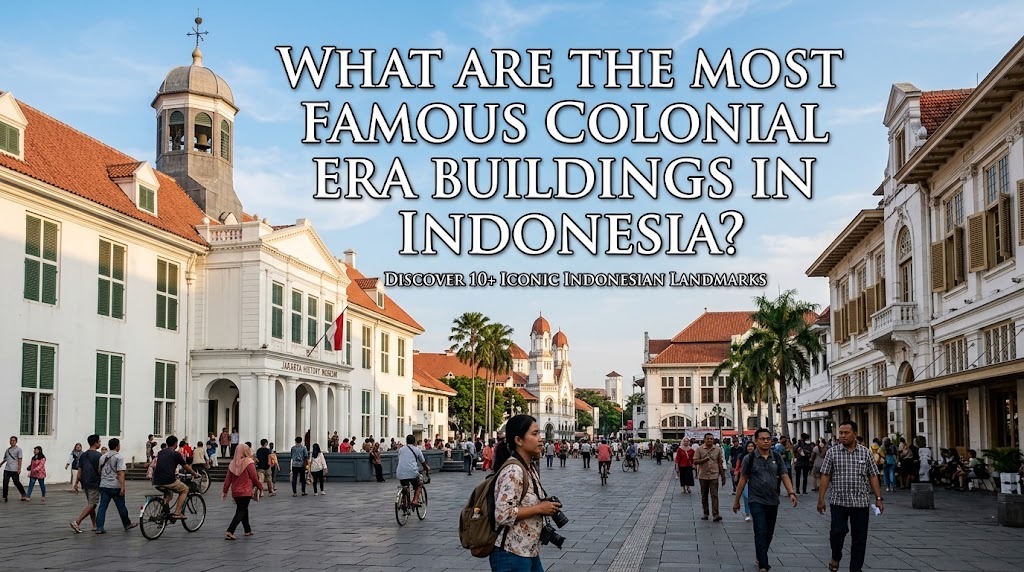
Indonesia has many colonial-era buildings that reflect the country's complex history and architectural development. Constructed during different periods of European colonial influence, these structures once served as government offices, railway stations, commercial centers, residences, and administrative facilities. Today, many remain important landmarks that help people understand how colonial rule influenced Indonesian cities and communities.
The most famous colonial buildings in Indonesia are valued not only for their distinctive architecture but also for their historical and cultural significance. Some have been transformed into museums, government offices, or tourist attractions, while others remain part of everyday urban life. Preserving these buildings helps maintain historical evidence and supports public understanding of Indonesia's past.
LAWANG SEWU IN SEMARANG
Lawang Sewu is one of Indonesia's best-known colonial-era buildings, located in Semarang, Central Java. Construction began in 1904 for the Nederlandsch-Indische Spoorweg Maatschappij, a railway company that played an important role in developing railway transportation in the Dutch East Indies. The building's many doors and windows contributed to its popular name, which means “a thousand doors” in Javanese.
Its architecture features spacious corridors, large windows, and decorative details that reflect European influences adapted to a tropical environment. Lawang Sewu is also associated with events during Indonesia's struggle for independence, making it significant beyond its original railway function. Today, it is a historic tourist attraction in Semarang, where visitors can explore its architecture and learn about the history of Indonesian railways.
GEDUNG SATE IN BANDUNG
Gedung Sate is a prominent historic building in Bandung, West Java, recognized for its distinctive central tower and carefully designed facade. Construction began in 1920, and the building was completed in 1924. It was originally developed as an administrative building for the Department of Government Enterprises of the Dutch East Indies.
The building combines European architectural influences with design elements often associated with regional and tropical architecture. Its tower is decorated with an ornament resembling a skewer, which contributed to the popular name Gedung Sate. Today, it serves as the office of the Governor of West Java and remains an important example of colonial architecture in Indonesia that continues to function as a public institution.
JAKARTA OLD TOWN AND ITS HISTORIC BUILDINGS
Jakarta Old Town, also known as Kota Tua Jakarta, preserves a collection of buildings connected to the development of Batavia during the Dutch colonial period. The district was an important center for colonial administration and trade, and its historic structures reflect the commercial and political activities that shaped the city. Many buildings feature European architectural characteristics, including symmetrical facades, large windows, and decorative details.
One of its most recognizable landmarks is the Jakarta History Museum, which occupies the former City Hall of Batavia. Other museums and historic structures around Fatahillah Square provide opportunities to explore the area's architectural and cultural history. Today, Kota Tua Jakarta is a popular destination for visitors interested in museums, historic streets, and the development of Indonesia's capital.
THE JAKARTA CATHEDRAL AND BANK INDONESIA MUSEUM
Jakarta contains several other important buildings connected to the colonial period, including Jakarta Cathedral and the building that now houses the Bank Indonesia Museum. Jakarta Cathedral, officially the Cathedral of Our Lady of the Assumption, is a notable example of neo-Gothic architecture. Its pointed arches, tall towers, and detailed interior design reflect a European religious architectural tradition adapted to its Indonesian setting.
The Bank Indonesia Museum occupies a historic building that was originally associated with the banking activities of the Dutch East Indies. Its exhibitions explain the development of money, banking, and economic institutions in Indonesia. Although these buildings have different original purposes, both demonstrate how colonial-era architecture can reveal aspects of religious, commercial, and institutional history.
THE ROLE OF COLONIAL BUILDINGS IN MODERN INDONESIA
Many colonial-era buildings continue to serve useful functions rather than existing only as historical monuments. Some operate as museums, government offices, cultural centers, and public attractions. Their continued use can help maintain public interest while preserving architectural features that might otherwise be neglected.
However, maintaining these structures requires careful planning. Changes in use, environmental conditions, pollution, and insufficient maintenance can damage historic materials and architectural details. Historic building preservation involves regular maintenance, suitable restoration methods, accurate historical documentation, and cooperation between government agencies, property owners, and local communities. Responsible conservation helps ensure that these buildings remain valuable cultural resources for future generations.
CONCLUSION
Some of the most famous colonial-era buildings in Indonesia include Lawang Sewu in Semarang, Gedung Sate in Bandung, the historic buildings of Jakarta Old Town, Jakarta Cathedral, and the Bank Indonesia Museum. Each has a distinct architectural character and historical background, reflecting different aspects of colonial administration, transportation, religion, and commerce. Their continued existence provides valuable insight into the development of Indonesian cities.
Protecting these buildings helps preserve architectural heritage and encourages people to learn about the country's complex past. Through careful restoration, educational programs, and responsible tourism, colonial-era buildings can remain useful and meaningful parts of modern Indonesian society. Their preservation also helps future generations understand how historical events and cultural interactions have shaped the built environment.
Recent Posts

Bagaimana Sistem SKS pada Program Kuliah... 22.11.2026/51 View

How Does Technology Make Daily Evaluation... 21.11.2026/81 View

Apa Strategi Menghadapi Kesenjangan antara Kompetensi... 21.11.2026/81 View

Mengapa Inventaris Aset Penting bagi Kelancaran... 21.11.2026/77 View

When Should Musicians Join a Record... 21.11.2026/82 View
