

What Are the Signs of High Visual Intelligence?
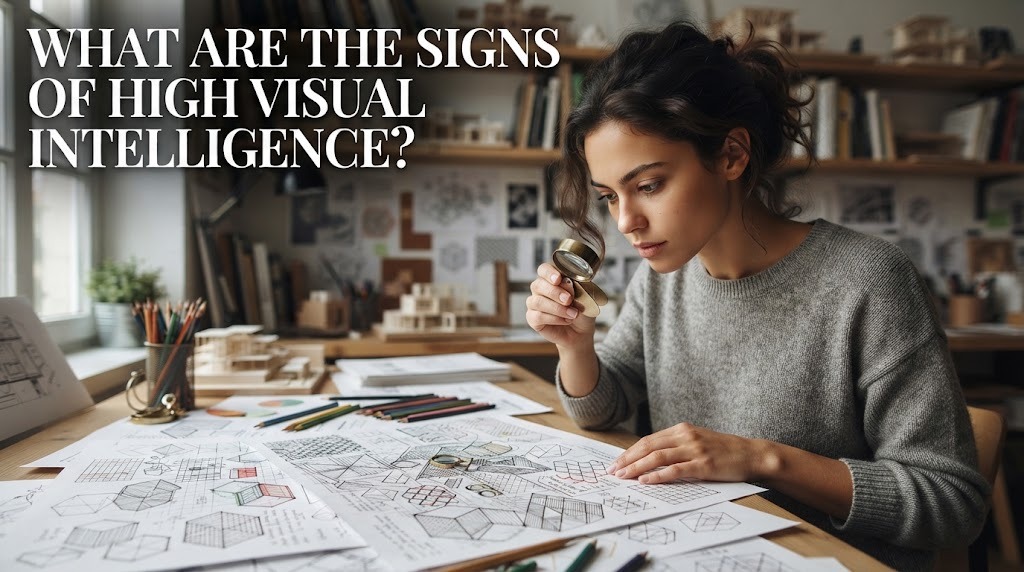
Visual intelligence is the ability to understand, interpret, remember, and organize visual information. People use this ability when recognizing shapes, understanding directions, imagining objects, and identifying patterns. Someone with high visual intelligence may process visual information quickly and understand relationships between objects more easily. This skill can be useful in education, work, creativity, and everyday activities.
High visual intelligence does not mean that someone must be good at drawing or art. It can appear in many different ways, including strong spatial awareness, visual memory, observation skills, and problem solving. Recognizing these signs can help people understand their strengths and find suitable ways to develop them further.
WHAT IS HIGH VISUAL INTELLIGENCE?
High visual intelligence refers to a strong ability to process and understand information through visual and spatial relationships. A person with this ability may quickly recognize patterns, imagine how objects look from different angles, or understand diagrams without needing lengthy explanations. They can often connect separate visual elements and see how they work together.
This skill is different from eyesight because it involves how the brain processes information rather than simply how clearly someone sees. Visual intelligence can be especially useful when dealing with maps, charts, designs, models, and other visual materials. It can also support visual learning and creative thinking in different situations.
STRONG SPATIAL AWARENESS
One common sign of high visual intelligence is strong spatial awareness. People with this ability can understand where objects are positioned in relation to one another. They may find it easier to navigate unfamiliar places, arrange furniture, or understand directions. They can often imagine how objects will fit together before physically moving them.
For example, someone may look at an empty room and quickly imagine where a table, chair, or cabinet could be placed. They may also understand maps and floor plans without much difficulty. This ability shows that the brain can create and manipulate mental images of physical spaces.
EASILY RECOGNIZES PATTERNS AND DETAILS
Another sign is the ability to recognize patterns, differences, and visual details relatively quickly. A person may notice changes in an image, identify repeated shapes, or understand relationships between colors and forms. They may also notice small details that other people overlook.
Pattern recognition is useful in many situations. Students may identify relationships in diagrams, while designers can recognize visual balance and composition. People working with data may also notice trends in charts or graphs more easily. These abilities demonstrate how visual pattern recognition can support practical thinking.
HAS A STRONG VISUAL MEMORY
People with high visual intelligence may have a strong ability to remember images, locations, shapes, and visual arrangements. They may remember where an object was placed or recall the appearance of a particular location. Some people can also remember information more effectively when it is presented through images or diagrams.
Visual memory can support learning and everyday tasks. For example, a student may remember a diagram from a lesson even after some time has passed. Someone else may remember a route by recalling buildings, signs, or landmarks along the way. This ability allows visual information to become a useful memory reference.
CAN VISUALIZE OBJECTS FROM DIFFERENT ANGLES
Another important sign is the ability to mentally rotate or transform objects. A person may imagine what an object would look like if it were turned, moved, enlarged, or viewed from another direction. This skill is sometimes called spatial visualization.
This ability can be useful in areas such as architecture, engineering, design, construction, and crafts. However, it is not limited to professional fields. Everyday activities such as assembling furniture or packing items into a small space can also require mental visualization. Strong spatial visualization skills can make these tasks easier to understand.
ENJOYS VISUAL AND CREATIVE ACTIVITIES
A person with high visual intelligence may naturally enjoy activities involving images, shapes, design, photography, drawing, video editing, or visual organization. They may feel comfortable experimenting with layouts and combining different visual elements. However, enjoying these activities alone does not prove that someone has high visual intelligence.
The important point is how the person interacts with visual information. Someone may enjoy photography because they naturally notice composition, lighting, perspective, and balance. Another person may enjoy organizing spaces because they can easily imagine how different elements will work together. These activities can provide opportunities to use and develop visual thinking skills.
CONCLUSION
High visual intelligence can appear through several abilities, including strong spatial awareness, visual memory, pattern recognition, observation, and mental visualization. People with these strengths may find it easier to understand visual information and recognize relationships between objects. These skills can be useful in education, professional activities, creative work, and everyday problem solving.
It is also important to remember that visual intelligence exists on a spectrum and can be developed through practice. Drawing, puzzles, visual games, mind mapping, and observation exercises can help strengthen these abilities. Recognizing personal strengths can be a useful first step toward developing better visual thinking and spatial skills.
Recent Posts

Bagaimana Sistem SKS pada Program Kuliah... 22.11.2026/12 View

How Does Technology Make Daily Evaluation... 21.11.2026/63 View

Apa Strategi Menghadapi Kesenjangan antara Kompetensi... 21.11.2026/64 View

Mengapa Inventaris Aset Penting bagi Kelancaran... 21.11.2026/61 View

When Should Musicians Join a Record... 21.11.2026/59 View
