

What Are the Tips for Creating an Effective Mind Map for Students?
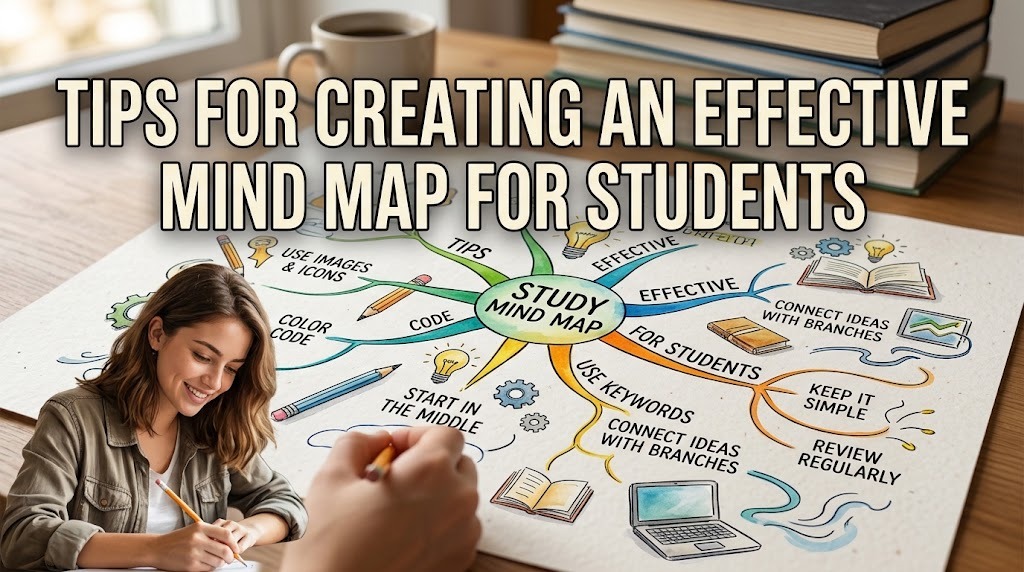
Mind mapping can help students organize learning materials in a visual and structured way. However, creating an effective mind map requires more than placing information around a central topic. Students need to choose relevant keywords, arrange ideas logically, and make the map easy to read. A well-designed mind map can support understanding, review, and information recall. By following several practical tips, students can create mind maps that are useful for different subjects and learning needs.
START WITH ONE CLEAR MAIN TOPIC
The first tip is to begin with one clear main topic. Students should place the topic in the center of the page so that all related information can be connected to it. The main topic should be specific enough to guide the entire mind map. For example, instead of using a broad topic such as Education, students could focus on Online Learning or Study Skills.
A clear central topic helps prevent the mind map from becoming too broad. After deciding on the topic, students can identify the most important ideas related to it. These ideas will become the main branches of the map. Starting with a clear focus creates a strong foundation for organizing the rest of the information.
USE SHORT AND MEANINGFUL KEYWORDS
Students should use short keywords or phrases instead of copying long paragraphs. Keywords make the mind map easier to read and allow important concepts to stand out. They also encourage students to identify the essential meaning of the information. A good keyword should be specific enough to remind students of the larger concept.
For example, instead of writing a complete explanation about the benefits of exercise, students could use keywords such as Physical Health, Energy, Sleep, and Stress. These terms can then be connected to supporting information. Using meaningful keywords keeps the map concise without removing important ideas.
ORGANIZE IDEAS INTO LOGICAL BRANCHES
Another important tip is to arrange information through logical branches. Each main branch should represent an important category related to the central topic. Smaller branches can then contain examples, explanations, characteristics, or supporting details. This creates a clear hierarchy between general and specific information.
Students should group related ideas together instead of placing them randomly. They can also use arrows when they need to show a particular process or relationship. A logical structure makes it easier to follow the information from the central topic to specific details. This can improve the clarity and usability of the mind map.
USE VISUAL ELEMENTS WITH PURPOSE
Visual elements such as colors, symbols, icons, and simple drawings can make a mind map easier to understand. Students can use these elements to distinguish categories or highlight important information. For example, a symbol can represent an example, while an arrow can show a sequence or connection. These visual cues can help students locate information more quickly.
However, students should avoid adding too many decorative elements. Excessive colors or drawings can make the map crowded and distract from the learning material. The main purpose of visual elements should be to support meaning and organization. A simple and readable design is often more useful than a complicated one.
KEEP THE MIND MAP SIMPLE AND READABLE
An effective mind map should not contain unnecessary information. Students should focus on the most relevant concepts and supporting details. If a map becomes too crowded, they can divide the topic into several smaller maps. This can make each map easier to understand and review.
Students should also leave enough space between branches so that information does not overlap. Clear handwriting or readable digital text is important, especially when the map will be reviewed later. A simple structure can make it easier to identify the main points at a glance. Readability should always be a priority when creating a study mind map.
REVIEW AND UPDATE THE MIND MAP
Students should not consider a mind map finished after creating it for the first time. They can review and update the map when they learn new information or discover that some concepts need clarification. Checking the map against reliable learning materials can also help students identify inaccurate or incomplete information.
The completed map can then be used for active recall. Students can look at a keyword and try to explain the related concept without reading their textbook. They can also use the map as a starting point for practice questions or exam preparation. Regularly using the map can turn it into a useful long-term study resource.
CONCLUSION
Creating an effective mind map requires students to focus on clear topics, meaningful keywords, logical branches, purposeful visual elements, and readable organization. Students should avoid filling the map with unnecessary information or excessive decoration. Reviewing and updating the map can also help keep the information accurate and useful. Mind mapping works best when students actively use it to recall and explain what they have learned. With consistent practice, it can become a practical study strategy for organizing, understanding, and reviewing learning materials.
Recent Posts

Bagaimana Sistem SKS pada Program Kuliah... 22.11.2026/28 View

How Does Technology Make Daily Evaluation... 21.11.2026/65 View

Apa Strategi Menghadapi Kesenjangan antara Kompetensi... 21.11.2026/65 View

Mengapa Inventaris Aset Penting bagi Kelancaran... 21.11.2026/62 View

When Should Musicians Join a Record... 21.11.2026/63 View
