

What Benefits Do Students Gain From Science Olympiad Participation?
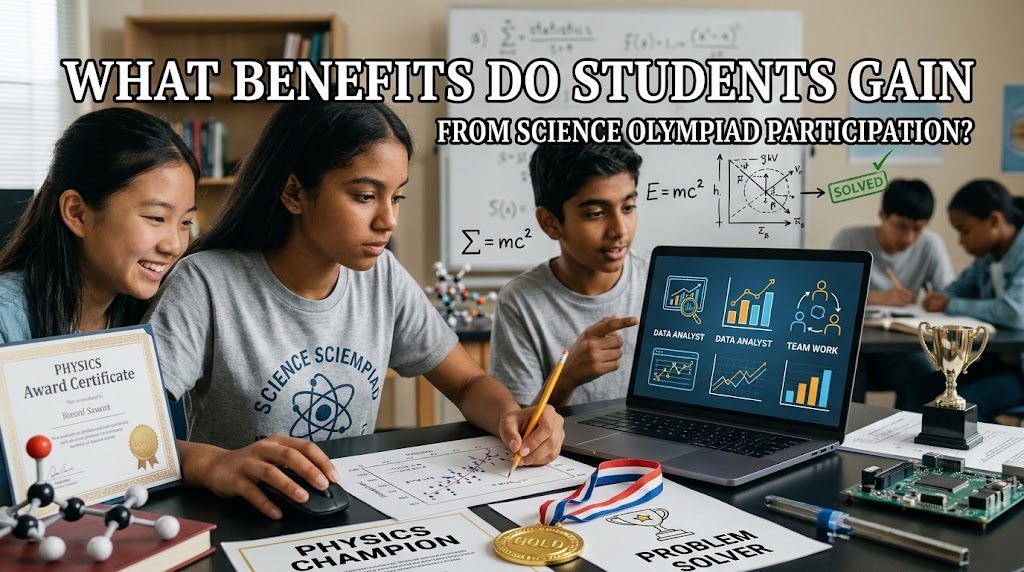
Participating in a Science Olympiad provides students with opportunities to develop academic knowledge, practical abilities, and personal qualities. These competitions encourage students to explore scientific subjects more deeply while challenging themselves to solve complex problems. Beyond competing for awards, students can gain valuable experiences that support their educational and personal development.
Science Olympiads also introduce students to different ways of thinking and learning. Through training, experiments, discussions, and competition activities, participants can improve their understanding of science and discover new interests. These experiences can become useful foundations for future academic opportunities and careers.
DEEPENING SCIENTIFIC KNOWLEDGE
One of the main benefits of participating in a Science Olympiad is gaining a deeper understanding of scientific subjects. Students explore topics in physics, chemistry, biology, mathematics, and other fields beyond the materials commonly discussed in regular classrooms.
Olympiad preparation encourages participants to understand scientific principles rather than simply memorize definitions. They learn how theories work, why certain phenomena occur, and how scientific concepts relate to everyday situations.
This deeper learning experience can strengthen their academic foundation. Students may also become more interested in exploring scientific topics independently and discovering new areas of knowledge.
IMPROVING CRITICAL THINKING SKILLS
Science Olympiad questions often require students to examine information, recognize patterns, and develop logical conclusions. These activities help participants strengthen their critical thinking abilities.
Instead of relying on memorized answers, students must understand the information presented and determine which concepts are relevant to each problem. Some questions may involve unfamiliar situations that require careful analysis and flexible reasoning.
These skills are useful beyond competitions. Students can apply critical thinking when evaluating information, completing school assignments, discussing different ideas, and making decisions in everyday life.
DEVELOPING PROBLEM-SOLVING ABILITIES
Participating in a Science Olympiad helps students become more familiar with challenging problems. Competition questions may involve several steps, mathematical calculations, or the application of multiple scientific concepts.
Through consistent practice, students learn how to break complicated problems into smaller parts. They also become more comfortable testing different approaches and checking whether their solutions are logically correct.
This process develops patience and persistence. Students gradually understand that difficult problems can be approached systematically rather than avoided when the answers are not immediately clear.
ENHANCING EXPERIMENTAL AND PRACTICAL SKILLS
Some Science Olympiad activities involve laboratory experiments, scientific observations, and practical investigations. These experiences allow students to connect theoretical knowledge with real scientific processes.
Participants may learn how to use laboratory equipment, measure quantities, identify variables, and record experimental results. They also gain experience following procedures and observing safety requirements.
Practical activities help students understand that science is not limited to textbooks. Scientific knowledge can be tested through observation and experimentation, while experimental results provide evidence that supports or challenges an explanation.
BUILDING CONFIDENCE AND SELF-DISCIPLINE
Science Olympiad preparation requires commitment, regular practice, and the willingness to face difficult learning challenges. As students make progress, they can develop greater confidence in their abilities.
Completing practice questions, understanding unfamiliar concepts, and participating in competitions can provide a sense of achievement. Even when students make mistakes, they have opportunities to recognize their weaknesses and improve.
The preparation process also encourages self-discipline. Participants learn to manage their study schedules, follow learning targets, and remain consistent even when the materials become difficult.
STRENGTHENING TIME MANAGEMENT SKILLS
Students who participate in Science Olympiads usually need to balance competition preparation with regular schoolwork and other responsibilities. This situation encourages them to organize their time more effectively.
They may create study schedules, prioritize difficult subjects, and divide large learning materials into smaller tasks. These habits help prevent last-minute preparation and make learning more manageable.
Time management is an important ability for academic success. Students who develop this skill can use it when preparing for examinations, completing assignments, and managing future responsibilities.
EXPANDING FRIENDSHIPS AND NETWORKING OPPORTUNITIES
Science Olympiads bring together students who share an interest in science and academic achievement. Through training sessions and competitions, participants can meet other learners from different schools and educational backgrounds.
These interactions provide opportunities to exchange knowledge, discuss scientific topics, and learn different problem-solving approaches. Students may also develop friendships with people who share similar interests.
Building these connections can create a supportive learning environment. Participants can motivate one another, share educational resources, and maintain communication even after the competition ends.
ENCOURAGING CURIOSITY AND INDEPENDENT LEARNING
Science Olympiad participation encourages students to ask questions and explore topics beyond the classroom curriculum. They may become interested in understanding how natural phenomena occur or how scientific discoveries influence modern life.
To answer these questions, students often need to read additional references, watch educational explanations, and investigate unfamiliar concepts independently.
This habit develops intellectual curiosity and lifelong learning. Rather than waiting for information to be provided by teachers, students become more active in finding answers and expanding their knowledge.
PROVIDING ACADEMIC AND CAREER OPPORTUNITIES
Participating in a Science Olympiad can provide valuable experiences that support students' future educational plans. Competition achievements may become part of an academic portfolio and demonstrate their interest in scientific subjects.
Depending on the competition and institution, certain achievements may also provide opportunities for recognition, scholarships, or further academic programs. However, these benefits depend on the specific selection requirements and policies.
The experience can also help students explore potential career interests. Fields such as medicine, engineering, biotechnology, computer science, and environmental research may become more familiar through scientific learning activities.
TEACHING RESILIENCE AND A POSITIVE ATTITUDE TOWARD FAILURE
Not every participant achieves the results they expect. Some students may struggle with difficult questions, receive lower practice scores, or fail to advance to the next competition stage.
These experiences can teach students how to respond constructively to setbacks. They learn to evaluate mistakes, identify areas for improvement, and continue practicing instead of giving up immediately.
Resilience is valuable because academic development requires continuous effort. Students who develop a positive attitude toward challenges can become more prepared to handle difficulties in school and other aspects of life.
CONCLUSION
Science Olympiad participation provides benefits that extend beyond academic competition. Students can deepen their scientific knowledge, improve critical thinking, strengthen problem-solving abilities, and gain practical experience through experiments and investigations.
These competitions also encourage confidence, discipline, time management, collaboration, and resilience. By participating actively and learning from every experience, students can develop valuable skills that support their education, personal growth, and future career opportunities.
Recent Posts

Bagaimana Sistem SKS pada Program Kuliah... 22.11.2026/48 View

How Does Technology Make Daily Evaluation... 21.11.2026/76 View

Apa Strategi Menghadapi Kesenjangan antara Kompetensi... 21.11.2026/78 View

Mengapa Inventaris Aset Penting bagi Kelancaran... 21.11.2026/73 View

When Should Musicians Join a Record... 21.11.2026/78 View
