

What Can Aquatic Robots Measure in Commercial Fish Farms?
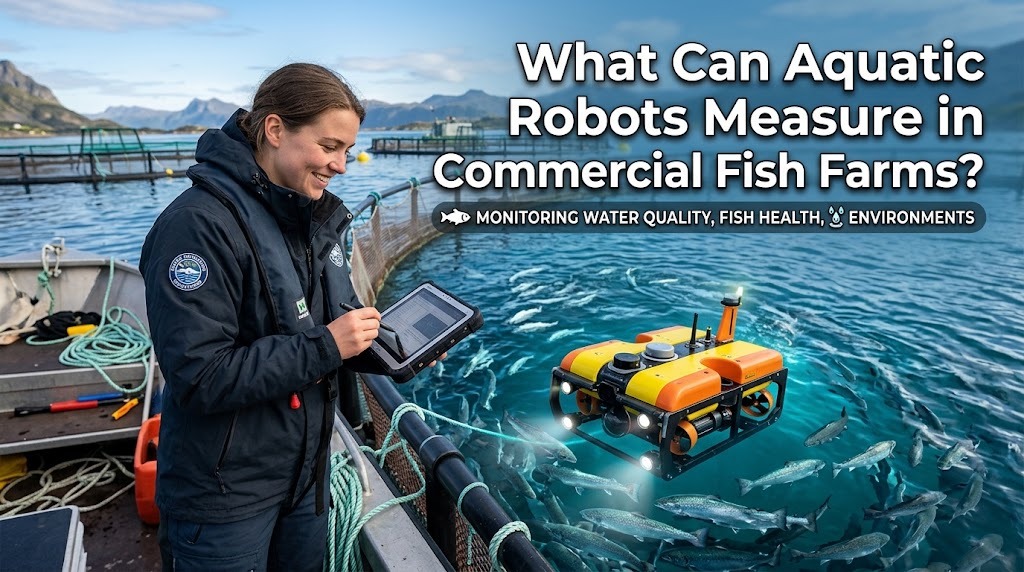
Commercial fish farms depend on stable water conditions to maintain fish health, support growth, and improve production efficiency. However, monitoring large ponds, tanks, and underwater environments manually can require significant time and labor. Aquatic robots provide a practical solution by collecting measurements and inspecting conditions beneath the water's surface. Equipped with specialized sensors, cameras, and navigation systems, these robots help farmers make informed decisions about water quality, fish behavior, and farm management.
WATER QUALITY PARAMETERS
Aquatic robots can measure several important water quality parameters, including temperature, dissolved oxygen, pH, and electrical conductivity. Water temperature influences fish metabolism and feeding activity, while dissolved oxygen indicates how much oxygen is available for aquatic organisms. pH measurements help farmers identify whether water conditions are becoming too acidic or alkaline. Depending on the equipment installed, robots may also measure salinity, turbidity, and oxidation-reduction potential. These measurements help farmers detect changes that could affect fish health and production.
DISSOLVED OXYGEN AND TEMPERATURE
Dissolved oxygen and water temperature are especially important in intensive fish farming. Low oxygen levels can stress fish, reduce feeding activity, and increase the risk of mortality. Temperature changes can also influence oxygen availability and fish metabolism. Aquatic robots can travel through different areas of a pond or tank to collect measurements at multiple locations and depths. This spatial information helps farmers identify areas with poor circulation, insufficient aeration, or unfavorable thermal conditions.
WATER DEPTH AND UNDERWATER CONDITIONS
Aquatic robots can measure water depth and examine underwater structures using pressure sensors, sonar, or other suitable instruments. These measurements help farmers understand tank geometry, monitor water levels, and identify obstacles or damaged equipment. Sonar systems can also map parts of the underwater environment when visibility is limited. In larger facilities, repeated measurements may reveal changes in sediment distribution or structural conditions that require further inspection. The exact information available depends on the robot's sensors and operating environment.
FISH DISTRIBUTION AND BEHAVIOR
Underwater cameras and sonar can help aquatic robots observe fish distribution and movement. These systems may estimate where fish gather, how they respond to feeding, and whether their swimming patterns change. Such observations can provide useful indicators of feeding activity, crowding, or unusual behavior. In clear water, cameras may support visual counting or size estimation, while sonar can be useful when visibility is poor. However, accurate biomass estimates and individual fish identification depend on species, stocking density, sensor quality, and analytical methods.
FEEDING ACTIVITY AND FOOD CONSUMPTION
Aquatic robots can help farmers evaluate feeding behavior by observing how fish respond when feed is distributed. Cameras and acoustic sensors may detect changes in fish activity or identify uneaten feed in suitable conditions. This information can help farmers adjust feeding schedules and reduce unnecessary feed use. Excess feed can increase waste accumulation and contribute to deteriorating water quality. Although robots can provide useful observations, reliable feeding decisions often require combining sensor data with information about fish size, species, health, and growth stage.
SEDIMENT AND WASTE ACCUMULATION
Uneaten feed, fish waste, and organic matter can accumulate on pond bottoms or in tank corners. Some aquatic robots can inspect these areas using cameras, sonar, or specialized sampling instruments. Turbidity sensors can measure water cloudiness, while other sensors may help characterize specific water quality conditions. These measurements can reveal areas that need cleaning, improved circulation, or closer monitoring. However, turbidity alone cannot determine the exact amount or composition of accumulated waste, so additional inspection or sampling may be necessary.
AUTOMATED DATA COLLECTION AND REAL-TIME MONITORING
Aquatic robots can collect repeated measurements and transmit data to farm management systems. When connected to suitable communication networks, they can help operators monitor conditions across multiple locations without manually visiting every sampling point. Software can display trends, generate alerts, and compare current readings with established operating ranges. Historical data can also help farmers recognize recurring changes associated with feeding schedules, weather, or seasonal conditions. Reliable monitoring requires sensor calibration, regular maintenance, and procedures for checking unusual readings.
CHALLENGES OF USING AQUATIC ROBOTS
Despite their benefits, aquatic robots face several operational challenges. Turbidity, algae, poor lighting, currents, and obstacles can affect navigation and sensor performance. Biofouling may cause biological material to accumulate on sensor surfaces, reducing measurement accuracy. Batteries, waterproof enclosures, maintenance costs, and communication limitations can also influence operating efficiency. Farmers must select equipment suited to the species, water conditions, facility design, and measurements required. Regular calibration and comparison with trusted reference instruments are essential for maintaining data quality.
CONCLUSION
Aquatic robots can measure water quality, temperature, dissolved oxygen, pH, depth, turbidity, and other parameters in commercial fish farms. They can also observe fish distribution, feeding activity, and underwater conditions using cameras, sonar, and specialized sensors. By collecting data consistently across different locations, these systems help farmers detect problems and improve management decisions. Their effectiveness depends on appropriate sensor selection, reliable calibration, and integration with existing farm monitoring practices.
Recent Posts

Bagaimana Sistem SKS pada Program Kuliah... 22.11.2026/49 View

How Does Technology Make Daily Evaluation... 21.11.2026/77 View

Apa Strategi Menghadapi Kesenjangan antara Kompetensi... 21.11.2026/78 View

Mengapa Inventaris Aset Penting bagi Kelancaran... 21.11.2026/74 View

When Should Musicians Join a Record... 21.11.2026/79 View
