

What Career Opportunities Are Available in Basic Research?
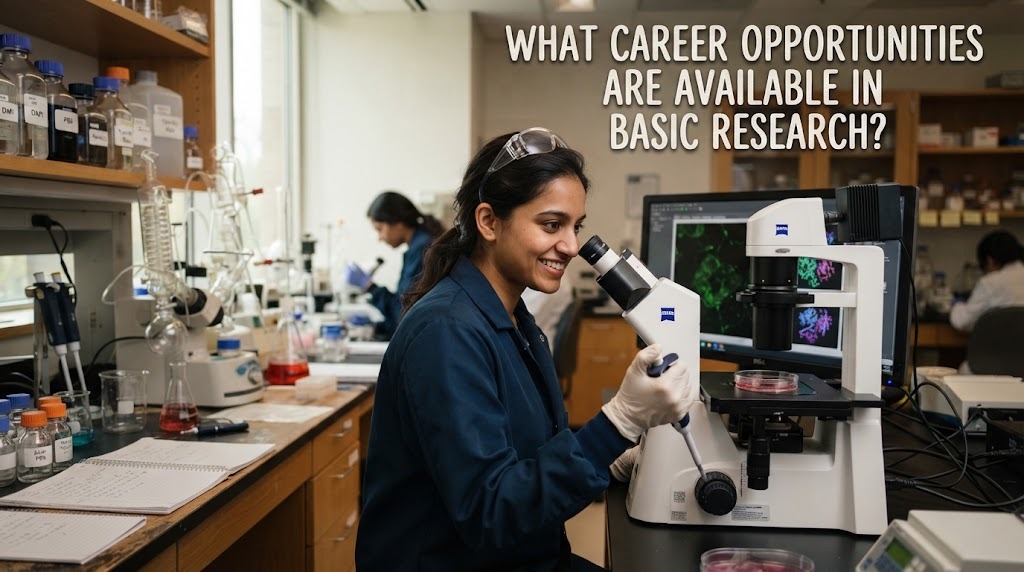
Basic research offers various career opportunities for people interested in science, discovery, and the development of new knowledge. This field focuses on understanding fundamental principles and investigating questions that may lead to future scientific breakthroughs. Professionals in basic research work in universities, government laboratories, research institutions, hospitals, and private companies. Their work contributes to scientific progress in fields such as biology, chemistry, physics, medicine, and technology.
A career in basic research is suitable for individuals who enjoy critical thinking, experimentation, problem-solving, and continuous learning. Although some positions require advanced degrees, other roles are available to people with undergraduate qualifications and relevant technical skills. Understanding the different career options can help students and graduates choose a path that matches their interests and educational backgrounds.
RESEARCH SCIENTIST
Research scientists conduct scientific investigations to expand knowledge and understand fundamental questions. They develop research questions, review existing studies, design experiments, analyze data, and communicate their findings through scientific publications. Depending on their specialization, they may investigate biological processes, chemical reactions, physical phenomena, or the behavior of advanced materials. Their discoveries can provide the foundation for future technologies and practical applications.
Many research scientist positions require a master's degree or doctoral degree, particularly for roles involving independent research and project leadership. Scientists often work in universities, government laboratories, nonprofit research centers, and private research organizations. They may also collaborate with researchers from different disciplines to solve complex scientific problems. This career is suitable for individuals who enjoy investigating unanswered questions and developing new scientific knowledge.
UNIVERSITY LECTURER AND ACADEMIC RESEARCHER
Universities provide opportunities for professionals who want to combine scientific research with teaching. Lecturers and academic researchers investigate scientific questions while helping students understand important concepts and research methods. Their responsibilities may include supervising student projects, preparing academic publications, applying for research grants, and participating in scientific conferences. In some institutions, they also contribute to curriculum development and academic administration.
The qualifications required for these positions depend on the institution and country. A doctoral degree is commonly expected for permanent academic research positions, although some teaching and research support roles may accept lower qualifications. Academic researchers often have opportunities to work on long-term projects and collaborate with international institutions. This career is particularly suitable for people who enjoy both scientific discovery and education.
LABORATORY RESEARCH ASSISTANT
Laboratory research assistants support scientists in conducting experiments and maintaining research activities. Their tasks may include preparing samples, operating laboratory equipment, recording observations, organizing materials, and helping analyze experimental results. They also follow laboratory safety procedures and ensure that research activities are carried out according to established protocols. Their contribution helps research teams maintain accurate and organized scientific investigations.
These positions may be available to candidates with a bachelor's degree, a relevant diploma, or other qualifications depending on the role. Employers often look for attention to detail, practical laboratory skills, teamwork, and an understanding of scientific procedures. Working as a research assistant can provide valuable experience for individuals who want to pursue advanced studies or become independent researchers. It can also help graduates discover which scientific specialization interests them most.
DATA SCIENTIST AND RESEARCH ANALYST
Basic research frequently produces large amounts of information that must be processed and interpreted carefully. Data scientists and research analysts help researchers identify patterns, test hypotheses, and draw conclusions from complex datasets. They may use statistics, programming, mathematical models, and data visualization tools to examine scientific results. Their work supports research in areas such as genetics, climate science, neuroscience, physics, and computational biology.
A career in scientific data analysis usually requires strong analytical skills and knowledge of statistics. Depending on the position, employers may expect qualifications in mathematics, computer science, statistics, or a related scientific discipline. Familiarity with programming languages and research software can also be beneficial. As scientific investigations increasingly rely on computational methods, data-related careers offer opportunities to contribute to research across many fields.
BIOLOGIST AND BIOMEDICAL RESEARCHER
Biologists and biomedical researchers investigate living organisms, biological systems, and the processes that influence health and disease. Their work may focus on genetics, microbiology, cell biology, immunology, neuroscience, or molecular biology. They conduct experiments to understand how organisms function and how biological changes occur under different conditions. Their findings can contribute to future developments in medicine, biotechnology, agriculture, and environmental protection.
These professionals may work in university laboratories, medical research centers, biotechnology companies, or government institutions. Entry-level positions may require a bachelor's degree, while independent research and advanced specialist roles commonly require postgraduate qualifications. Practical laboratory experience and knowledge of scientific methods are valuable for career development. This field is suitable for people who are curious about life sciences and want to contribute to a deeper understanding of biological processes.
PHYSICIST AND CHEMICAL RESEARCHER
Physicists and chemical researchers investigate the fundamental properties of matter, energy, and chemical substances. Physicists may study quantum mechanics, particle physics, optics, or the behavior of materials under different conditions. Chemical researchers investigate molecular structures, chemical reactions, and the properties of substances. Both fields help establish scientific principles that can support future developments in electronics, energy systems, advanced materials, and industrial technologies.
A bachelor's degree can provide access to some technical and laboratory positions, but many independent research roles require a master's degree or doctorate. Professionals in these fields may work at universities, government laboratories, scientific research centers, and industrial research departments. They need strong analytical abilities, mathematical knowledge, and practical research skills. These careers are appropriate for individuals who enjoy exploring the fundamental laws and properties of the physical world.
RESEARCH PROJECT COORDINATOR
Research project coordinators help organize and manage scientific investigations. Their responsibilities may include preparing project schedules, coordinating research teams, monitoring budgets, maintaining documentation, and ensuring that project requirements are followed. They may also communicate with funding organizations, research participants, and partner institutions. Although they may not conduct every experiment themselves, their work helps research projects operate efficiently.
Qualifications vary according to the employer and the complexity of the research. A bachelor's degree in a relevant discipline, together with project management or administrative experience, may be sufficient for some positions. Knowledge of research ethics, documentation, budgeting, and communication is often valuable. This career is suitable for individuals who want to contribute to scientific progress through organization, coordination, and project management.
SCIENCE WRITER AND RESEARCH COMMUNICATOR
Science writers and research communicators explain scientific discoveries to audiences with different levels of knowledge. They may prepare research summaries, scientific articles, educational materials, institutional reports, or public information campaigns. Their work helps make complex scientific concepts easier to understand and encourages the public to engage with scientific developments. They may also help researchers communicate the significance and limitations of their findings.
A background in science, journalism, communication, or a related field can be useful for this career. Strong writing skills, critical thinking, and the ability to evaluate scientific evidence are particularly important. Some professionals work for universities, research organizations, science publications, or public agencies, while others work independently. This path is a good option for people who enjoy science but prefer communicating knowledge rather than conducting laboratory experiments.
SKILLS NEEDED FOR A CAREER IN BASIC RESEARCH
A successful career in basic research requires curiosity, patience, and a willingness to learn continuously. Researchers must be able to formulate questions, evaluate evidence, recognize limitations, and interpret results objectively. Attention to detail is essential because small errors in experiments or data analysis can affect scientific conclusions. Communication and teamwork are also important because research often involves collaboration among specialists.
Technical skills depend on the chosen discipline. Laboratory researchers may need experience with scientific instruments, while computational researchers may require programming and statistical knowledge. Professionals who work with human participants, animals, or sensitive information must also understand relevant ethical and safety requirements. Building these skills through education, internships, research projects, and practical experience can improve career opportunities.
CONCLUSION
Basic research offers diverse career opportunities, including research scientist, academic researcher, laboratory assistant, data scientist, biomedical researcher, physicist, research coordinator, and science writer. Each role contributes to scientific progress in a different way, from conducting experiments and analyzing data to managing projects and communicating discoveries. The right career depends on an individual's interests, educational qualifications, and preferred working environment.
Students and graduates can prepare for these opportunities by choosing a relevant field of study, developing research skills, and gaining practical experience. Advanced degrees may be necessary for certain specialist and independent research positions, but entry-level technical, analytical, and support roles can provide alternative starting points. With dedication and continuous learning, a career in basic research can offer opportunities to expand scientific knowledge and contribute to future discoveries.
Recent Posts

Bagaimana Sistem SKS pada Program Kuliah... 22.11.2026/45 View

How Does Technology Make Daily Evaluation... 21.11.2026/73 View

Apa Strategi Menghadapi Kesenjangan antara Kompetensi... 21.11.2026/75 View

Mengapa Inventaris Aset Penting bagi Kelancaran... 21.11.2026/71 View

When Should Musicians Join a Record... 21.11.2026/75 View
