

What Causes Regional Languages to Become Endangered in Indonesia?
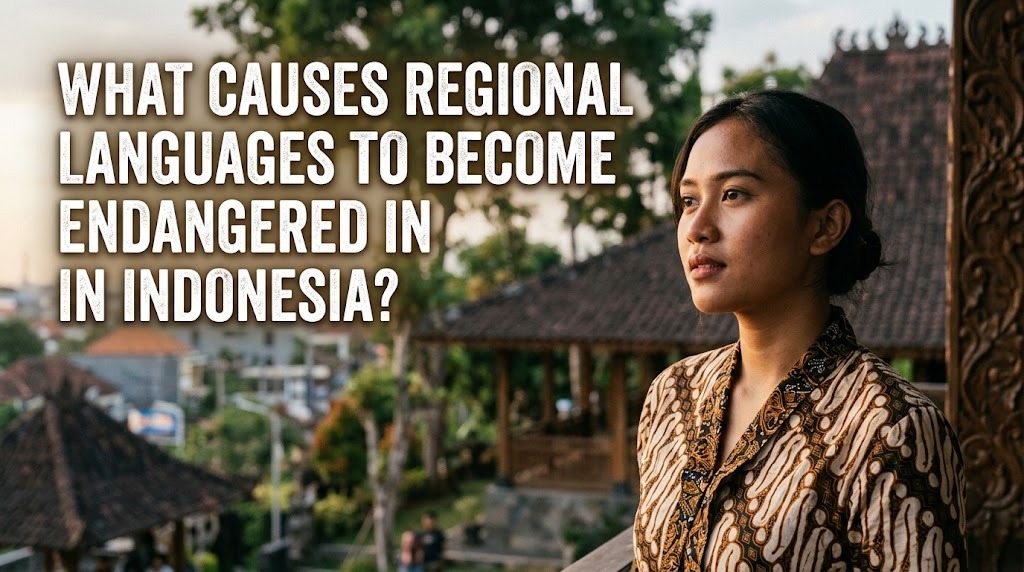
Indonesia is home to hundreds of regional languages that reflect the country's rich cultural diversity. These languages carry traditional knowledge, local histories, customs, and values that have been passed down through generations. However, some regional languages are experiencing a decline in the number of active speakers, particularly among younger generations. When fewer people use a language in everyday communication, the language may become increasingly vulnerable to disappearance. Understanding the causes of endangered regional languages in Indonesia is essential for developing effective preservation efforts and protecting the nation's cultural heritage.
THE DECLINING USE OF REGIONAL LANGUAGES AT HOME
One of the main causes of regional languages becoming endangered is the decreasing use of these languages within families. In the past, many children learned their regional languages naturally by listening to parents, grandparents, and other relatives. Today, some families prefer Indonesian because it is widely used in education, public communication, and daily activities. Although Indonesian helps people communicate across different regions, relying on it exclusively at home can reduce children's opportunities to learn their local languages.
The problem becomes more serious when parents understand a regional language but do not teach it to their children. As a result, younger generations may recognize certain words without being able to hold a complete conversation. When this pattern continues across generations, the number of fluent speakers can decline significantly. Intergenerational language transmission, or the process of passing a language from older generations to younger ones, is therefore essential for language survival. Families can help preserve their languages by using them in everyday conversations, telling traditional stories, and encouraging children to speak without fear of making mistakes.
THE DOMINANCE OF INDONESIAN IN DAILY COMMUNICATION
Indonesian plays an important role as the national language that connects people from different ethnic and linguistic backgrounds. It is widely used in schools, universities, government institutions, workplaces, and public services. This widespread use allows people to communicate effectively even when they have different regional languages. However, regional languages may receive less attention when Indonesian becomes the primary language in nearly every social situation.
In some communities, young people rarely need to use their regional languages outside conversations with older relatives. They may gradually become more comfortable expressing complex ideas in Indonesian because they use it more frequently in education and public life. Over time, limited practice can weaken their vocabulary, fluency, and confidence in speaking their local languages. The challenge is not the use of Indonesian itself but the lack of opportunities to use regional languages alongside it. Encouraging bilingual or multilingual communication can help people maintain their regional languages while benefiting from a shared national language.
THE INFLUENCE OF GLOBALIZATION AND DIGITAL TECHNOLOGY
Globalization has expanded access to international information, entertainment, education, and employment opportunities. Many young Indonesians consume digital content in Indonesian or English through social media, online games, films, music, and video platforms. These languages often dominate popular digital spaces, making them more visible and frequently used than many regional languages. Consequently, young people may spend less time practicing the languages associated with their local communities.
Another challenge is the unequal availability of digital resources for different regional languages. Some languages have extensive written materials, online dictionaries, educational videos, and digital learning resources, while others have very limited documentation. Languages with small speaker populations may receive less attention from content creators and technology developers. Nevertheless, digital technology can support language preservation when communities use it to record conversations, publish traditional stories, create learning materials, and share local-language content online. Making regional languages visible in modern digital environments can help younger generations see them as relevant to contemporary life.
URBANIZATION AND POPULATION MOBILITY
Urbanization and migration can also contribute to the decline of regional languages in Indonesia. People frequently move from villages to cities to pursue education, employment, or better living conditions. In urban areas, residents often come from different linguistic backgrounds, so Indonesian becomes a practical language for communication. Children who grow up in these environments may have fewer opportunities to interact with other speakers of their family's regional language.
Mixed-language households can face additional challenges when parents speak different regional languages. Families may choose Indonesian as a common language because it is easier for everyone to understand. While this choice supports communication, children may not develop strong skills in either parent's regional language unless they receive regular exposure. Migration does not automatically cause language extinction, but it can reduce the everyday social environments in which a language is used. Families can maintain linguistic connections by communicating with relatives in their regional languages, attending cultural gatherings, and teaching children local expressions and stories.
NEGATIVE SOCIAL ATTITUDES AND LIMITED EDUCATIONAL SUPPORT
Social attitudes can influence whether young people feel comfortable speaking their regional languages. In some situations, regional languages may be unfairly associated with rural life, limited education, or outdated traditions. Young people who encounter such stereotypes may avoid speaking their local languages because they want to fit into their social environment. This can gradually weaken their emotional connection to their linguistic and cultural heritage.
Educational support also varies between regions and languages. Some schools provide regional-language lessons or cultural activities, while others have limited teaching materials, trained educators, or classroom time for local languages. When students rarely encounter their regional languages in educational settings, they may assume that these languages have little relevance to academic or professional life. Positive social attitudes and accessible educational resources can help change this perception. Schools can organize storytelling competitions, local-language performances, reading activities, and cultural projects that encourage students to value their languages while continuing to learn Indonesian and foreign languages.
THE LACK OF DOCUMENTATION AND COMMUNITY PRESERVATION
Some regional languages become endangered because they have limited documentation and fewer resources for future learning. When a language is mainly spoken and has few recorded stories, dictionaries, grammatical descriptions, or educational materials, preserving its knowledge can become difficult. If the remaining fluent speakers pass away before their knowledge is recorded or shared, valuable vocabulary, expressions, and oral traditions may be lost. Documentation is particularly important for languages with very small speaker populations.
Community participation is equally important because language preservation cannot depend only on researchers or government programs. Local residents, cultural organizations, teachers, and younger speakers can work together to record traditional stories, collect vocabulary, organize language classes, and create community archives. Governments and educational institutions can support these efforts through funding, teacher training, research, and culturally appropriate learning resources. Combining language documentation with regular everyday use offers a stronger foundation for long-term preservation. A language is more likely to remain alive when people continue using it at home, in community activities, and in new forms of communication.
CONCLUSION
Regional languages become endangered in Indonesia for several interconnected reasons, including declining family transmission, the dominance of Indonesian in public communication, globalization, digital trends, urbanization, negative social attitudes, and limited educational resources. A lack of documentation can make the situation more difficult, particularly when only a small number of fluent speakers remain. However, language decline can be addressed through consistent action by families, schools, communities, researchers, and governments. Using regional languages in everyday conversations, teaching children from an early age, developing digital learning materials, and documenting traditional knowledge can strengthen their future. Protecting regional languages means preserving cultural identity, local knowledge, and Indonesia's linguistic diversity for future generations.
Recent Posts

Bagaimana Sistem SKS pada Program Kuliah... 22.11.2026/48 View

How Does Technology Make Daily Evaluation... 21.11.2026/76 View

Apa Strategi Menghadapi Kesenjangan antara Kompetensi... 21.11.2026/78 View

Mengapa Inventaris Aset Penting bagi Kelancaran... 21.11.2026/73 View

When Should Musicians Join a Record... 21.11.2026/78 View
