

What Challenges Do Researchers Face in Basic Research?
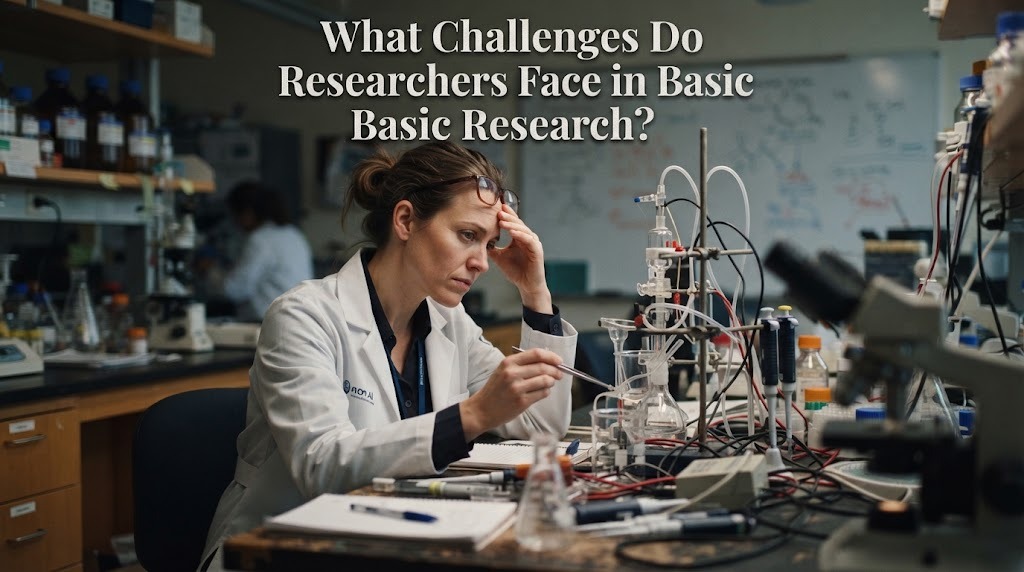
Basic research plays an important role in expanding scientific knowledge and supporting future discoveries. It helps researchers understand fundamental principles, investigate unanswered questions, and develop theories that may contribute to scientific progress. However, conducting basic research is not always easy because researchers often face financial, technical, and methodological challenges.
These challenges can affect the research process, the quality of findings, and the time required to achieve meaningful results. Understanding the difficulties researchers face is important for improving research practices and creating better support systems for scientific development.
LIMITED RESEARCH FUNDING
One of the biggest challenges in basic research is obtaining sufficient funding. Research projects may require laboratory equipment, scientific materials, specialized software, and trained personnel. Without adequate financial support, researchers may struggle to conduct experiments, collect reliable data, or continue long-term investigations. Universities and research institutions must often compete for limited grants and financial resources.
Basic research can also be difficult to fund because its practical benefits are not always immediately visible. Some studies may take years to produce findings that lead to useful applications. As a result, funding organizations may prefer projects with more predictable or immediate outcomes. Stable financial support is essential to help researchers explore important scientific questions without excessive pressure to deliver quick results.
UNCERTAIN AND UNPREDICTABLE RESULTS
Basic research often investigates questions that have no clear answers, making its outcomes difficult to predict. Researchers may develop hypotheses based on existing knowledge, but experiments do not always support their initial expectations. Sometimes, the results reveal unexpected patterns or suggest that established explanations need to be reconsidered. These situations require researchers to remain patient, flexible, and objective.
Uncertainty can also make it difficult to determine how much time and effort a project will require. Some investigations produce useful findings quickly, while others require repeated experiments and additional analysis. Even studies that do not confirm a hypothesis can provide valuable information by helping researchers eliminate incorrect explanations. Accepting uncertainty is therefore an essential part of scientific investigation.
LIMITED ACCESS TO EQUIPMENT AND RESOURCES
Many basic research projects depend on specialized equipment, laboratory facilities, scientific databases, and reliable research materials. However, not every institution has access to the resources needed to conduct advanced investigations. Researchers may have to share equipment, wait for laboratory access, or rely on facilities located at other institutions. These limitations can delay experiments and increase research costs.
Access to scientific information can also affect research quality. Researchers need relevant publications and reliable data to understand previous discoveries and identify gaps in existing knowledge. Institutions with limited budgets may struggle to provide subscriptions to academic journals or maintain modern research infrastructure. Improving access to equipment, information, and collaborative facilities can help researchers conduct more effective studies.
DIFFICULTIES IN RESEARCH METHODS AND DATA ANALYSIS
Choosing appropriate research methods is another important challenge in basic research. Researchers must select procedures that match their questions and produce reliable evidence. Poorly designed experiments, unsuitable measurement tools, or inadequate sample sizes can lead to misleading results. Careful planning is necessary to reduce errors and improve the reliability of scientific conclusions.
Data analysis can also be complex, particularly when researchers work with large datasets, advanced mathematical models, or complicated scientific measurements. They must interpret results accurately and distinguish meaningful patterns from random variation. Researchers also need to consider uncertainty, possible sources of bias, and the limitations of their methods. Using appropriate analytical techniques and seeking expert feedback can help address these difficulties.
LONG RESEARCH TIMELINES
Basic research often requires considerable time because scientific understanding develops through repeated investigation and verification. Researchers may need to conduct multiple experiments, review earlier findings, and refine their hypotheses before reaching meaningful conclusions. Some projects also depend on long-term observations, such as studies of ecological changes or biological development. These requirements can make progress slower than expected.
Long timelines may create pressure when researchers must meet grant deadlines, publish academic papers, or demonstrate measurable progress. Temporary funding and short-term contracts can make it difficult to maintain research teams over several years. However, rushing scientific investigations can reduce the quality of evidence and increase the risk of mistakes. Providing realistic timelines and sustained institutional support can help researchers conduct thorough and responsible studies.
PRESSURE TO PUBLISH RESEARCH FINDINGS
Academic researchers are often expected to publish their findings in scientific journals to share knowledge and contribute to their professional development. Although publication is important, excessive pressure to produce frequent papers can create difficulties. Researchers may have less time to conduct careful experiments, review data thoroughly, or explore questions that require years of investigation. This pressure can also encourage a focus on quantity rather than research quality.
Publishing scientific work can be particularly challenging when findings are unexpected or do not support a popular theory. Some journals may show greater interest in studies with novel or statistically significant results, potentially making other valuable findings harder to publish. A healthy research environment should recognize methodological quality, transparency, and reproducibility alongside publication records. This approach can encourage researchers to prioritize reliable scientific knowledge over rapid output.
ETHICAL ISSUES AND RESEARCH INTEGRITY
Researchers must follow ethical standards to ensure that their work is responsible, transparent, and scientifically reliable. Depending on the subject, basic research may involve human participants, animals, sensitive information, or potentially hazardous materials. Researchers must follow relevant regulations, obtain required approvals, and protect participants or research subjects from unnecessary harm. These responsibilities can require additional planning, documentation, and oversight.
Maintaining research integrity is equally important when collecting, analyzing, and reporting data. Researchers must avoid fabrication, falsification, plagiarism, and misleading interpretations of results. They should also disclose relevant limitations and conflicts of interest. Strong ethical practices protect the credibility of scientific findings and help maintain public trust in research institutions.
CONCLUSION
Researchers face several challenges in basic research, including limited funding, uncertain results, inadequate resources, complex data analysis, long research timelines, publication pressure, and ethical responsibilities. These difficulties can slow scientific progress and make it harder to investigate fundamental questions. Nevertheless, each challenge can be addressed through careful planning, responsible research practices, and stronger institutional support.
Governments, universities, funding organizations, and research institutions all have important roles in improving research conditions. By providing stable funding, modern facilities, realistic project timelines, and an environment that values scientific integrity, they can help researchers produce reliable knowledge. Overcoming these challenges is essential for strengthening basic research and supporting future scientific discoveries.
Recent Posts

Bagaimana Sistem SKS pada Program Kuliah... 22.11.2026/43 View

How Does Technology Make Daily Evaluation... 21.11.2026/72 View

Apa Strategi Menghadapi Kesenjangan antara Kompetensi... 21.11.2026/74 View

Mengapa Inventaris Aset Penting bagi Kelancaran... 21.11.2026/70 View

When Should Musicians Join a Record... 21.11.2026/74 View
