

What Challenges Do Students Face During Science Olympiad Preparation?
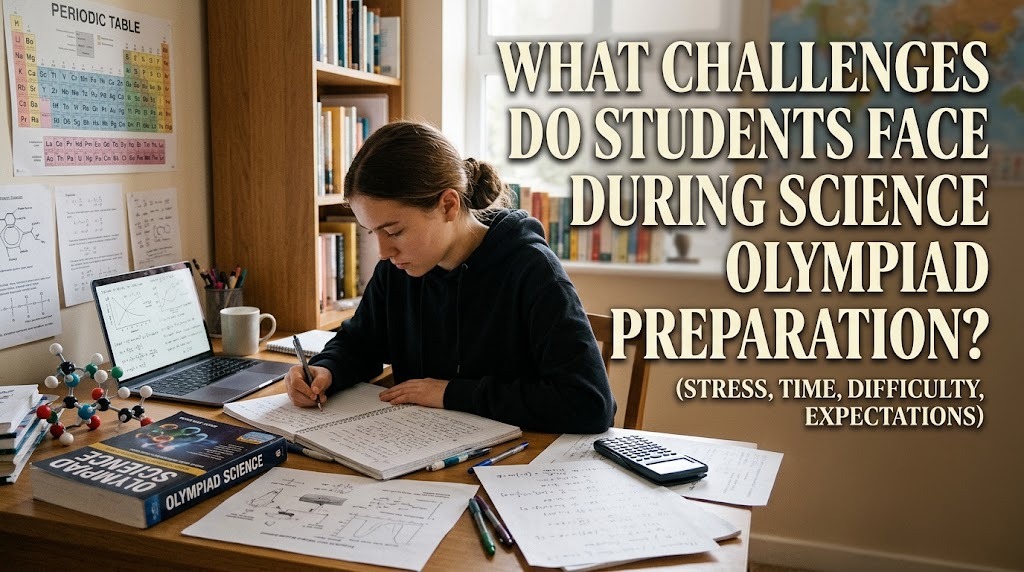
Preparing for a Science Olympiad requires more than memorizing scientific concepts. Students must understand complex theories, solve challenging problems, conduct experiments, and manage their study schedules effectively. The preparation process can be demanding because competitions often test knowledge beyond what students learn in regular classrooms.
Although Science Olympiads provide valuable opportunities to develop academic abilities, students may encounter several obstacles along the way. These challenges can affect their confidence, motivation, and learning progress. Understanding the difficulties students commonly experience can help them develop better preparation strategies and achieve more consistent results.
UNDERSTANDING COMPLEX SCIENTIFIC CONCEPTS
One of the main challenges students face during Science Olympiad preparation is understanding advanced scientific concepts. Subjects such as physics, chemistry, biology, and mathematics often involve theories that are more complicated than ordinary classroom materials.
Students may need to understand abstract principles, mathematical relationships, and scientific processes in considerable detail. Simply memorizing definitions is usually insufficient because competition questions require them to apply concepts in unfamiliar situations.
To overcome this difficulty, students should study fundamental principles before moving to advanced topics. Using diagrams, practical examples, educational videos, and additional reading materials can make complicated concepts easier to understand.
MANAGING A LIMITED STUDY SCHEDULE
Students often have to balance Science Olympiad preparation with regular school assignments, examinations, extracurricular activities, and personal responsibilities. Managing all these activities can become difficult, especially when competition dates are approaching.
Without a clear schedule, students may spend too much time on one subject while neglecting other important topics. This can create unnecessary pressure and reduce the effectiveness of their preparation.
Creating a realistic study timetable can help students organize their responsibilities. Dividing learning materials into smaller sections and setting daily targets also makes the preparation process more manageable.
SOLVING DIFFICULT COMPETITION QUESTIONS
Science Olympiad questions frequently require analytical thinking rather than straightforward answers. Students may encounter unfamiliar problems that combine several scientific concepts or require multiple steps to solve.
This situation can be challenging for students who are accustomed to answering routine classroom questions. They may understand the theory but struggle to determine which concepts or formulas should be applied.
Regular practice with previous competition questions can help students develop problem-solving skills. Reviewing incorrect answers is equally important because it allows them to identify weaknesses and understand different approaches to solving similar problems.
FINDING SUITABLE LEARNING RESOURCES
Another challenge is finding reliable and relevant learning materials. Science Olympiad preparation often requires resources that go beyond standard textbooks, including advanced reference books, practice questions, research articles, and experimental guides.
Students who have limited access to educational resources may find it difficult to study certain topics in sufficient depth. Differences in internet access, school facilities, and learning support can also influence their preparation.
Students can address this challenge by using available school libraries, trusted educational websites, online learning platforms, and guidance from teachers. Selecting resources that match the competition syllabus helps prevent unnecessary confusion and saves study time.
DEVELOPING EXPERIMENTAL AND PRACTICAL SKILLS
Some Science Olympiad fields require students to understand laboratory procedures, conduct experiments, and interpret experimental results. These activities demand practical skills that cannot always be developed through theoretical study alone.
Students may struggle with using laboratory equipment, measuring quantities accurately, controlling variables, or following experimental procedures. Limited laboratory facilities can make these difficulties more challenging.
To improve their practical abilities, students should participate in laboratory activities whenever possible. They can also practice documenting observations, identifying variables, and explaining experimental results to strengthen their scientific understanding.
MAINTAINING MOTIVATION AND CONFIDENCE
Science Olympiad preparation can take weeks or months, making it difficult for students to maintain consistent motivation. Some topics may require repeated practice before students fully understand them, while challenging exercises can create frustration.
Students may also lose confidence when they receive low practice scores or compare their progress with other participants. This can lead to unnecessary pressure and reduce their willingness to continue learning.
Maintaining realistic expectations is important throughout the preparation process. Students should recognize small improvements, evaluate their progress, and treat mistakes as opportunities to learn rather than reasons to give up.
DEALING WITH COMPETITION PRESSURE
The desire to achieve high results can create significant psychological pressure. Students may feel nervous because they want to represent their schools, satisfy their teachers, or meet personal expectations.
Competition anxiety can affect concentration, decision-making, and performance during practice sessions or actual examinations. Even students with strong academic knowledge may struggle when they cannot manage their nervousness.
Developing healthy study habits can help reduce this pressure. Getting enough rest, taking short breaks, practicing under timed conditions, and preparing systematically can make students feel more comfortable facing competition challenges.
IDENTIFYING PERSONAL KNOWLEDGE GAPS
Students sometimes find it difficult to recognize which subjects or concepts they have not fully mastered. They may continue studying familiar topics because those materials feel easier, while avoiding areas that require additional effort.
This habit can create weaknesses that become apparent when students encounter more advanced competition questions. Without proper evaluation, they may not realize how much improvement is still needed.
Taking practice tests and reviewing learning outcomes can help students identify specific knowledge gaps. They should pay attention to recurring mistakes and prioritize topics that require further explanation or additional exercises.
GETTING ENOUGH GUIDANCE AND SUPPORT
Support from teachers, mentors, parents, and fellow students plays an important role in Science Olympiad preparation. However, not every student has access to experienced mentors or structured training programs.
Without sufficient guidance, students may struggle to understand difficult explanations, select appropriate learning materials, or develop effective problem-solving methods. Studying independently can also become challenging when they encounter questions they cannot answer.
Students can seek support through study groups, teacher consultations, online educational communities, and school enrichment programs. Sharing ideas with other learners can provide different perspectives and make difficult subjects easier to understand.
HOW STUDENTS CAN OVERCOME SCIENCE OLYMPIAD CHALLENGES
Overcoming Science Olympiad preparation challenges requires consistency, effective learning strategies, and a willingness to improve. Students do not need to master every topic immediately. Instead, they should focus on building a strong foundation and developing their abilities gradually.
Several practical strategies can support more effective preparation:
- Create a Study Plan: Organize subjects, learning targets, and practice sessions according to available time.
- Practice Regularly: Solve different types of questions to improve analytical thinking and problem-solving abilities.
- Review Mistakes: Identify incorrect answers and understand the concepts behind each mistake.
- Use Reliable Resources: Choose textbooks, practice materials, and educational platforms that match the competition syllabus.
- Ask for Guidance: Discuss difficult topics with teachers, mentors, or other students.
- Maintain Healthy Habits: Get enough sleep, take breaks, and manage stress to support concentration.
Combining these strategies can help students prepare more systematically while maintaining a balanced daily routine.
CONCLUSION
Science Olympiad preparation presents several challenges, including understanding complex concepts, managing study schedules, solving difficult questions, and maintaining motivation. Students may also experience limited learning resources, insufficient practical experience, and pressure to achieve strong results.
However, these difficulties can become valuable learning opportunities when students approach them with effective strategies. Consistent practice, proper guidance, and regular evaluation can help students improve their scientific knowledge and problem-solving abilities. Ultimately, Science Olympiad preparation is not only about achieving competition results but also about developing discipline, curiosity, resilience, and a deeper understanding of science.
Recent Posts

Bagaimana Sistem SKS pada Program Kuliah... 22.11.2026/48 View

How Does Technology Make Daily Evaluation... 21.11.2026/76 View

Apa Strategi Menghadapi Kesenjangan antara Kompetensi... 21.11.2026/78 View

Mengapa Inventaris Aset Penting bagi Kelancaran... 21.11.2026/73 View

When Should Musicians Join a Record... 21.11.2026/78 View
