

What Does a Sample Task Completion Report Memo Look Like?
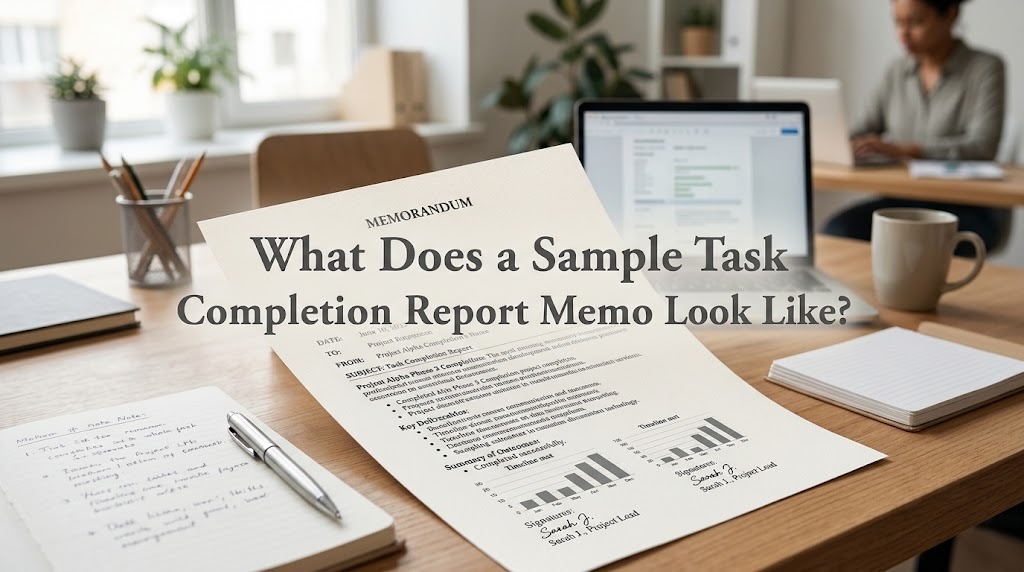
In modern corporate administration and project management workflows, documenting the successful execution of an assigned objective is just as critical as the initial planning phase. When a team or individual completes a major operational task, a formal communication instrument must be submitted to managerial authorities to officially close the project lifecycle. This administrative document is known as a task completion report memo. It serves as an auditable record that confirms all deliverable parameters have been satisfied, resource expenditures align with approved allocations, and operational performance standards have been fully met. Unlike general status updates or informal email check-ins, a structured task completion memo provides detailed closure, accountability, and institutional knowledge for future organizational planning.
Drafting an effective completion report requires a systematic approach that balances executive brevity with comprehensive operational data. This detailed guide breaks down the essential architectural sections, structural requirements, and drafting best practices necessary to construct an authoritative task completion report memorandum.
INSTITUTIONAL HEADER AND ADMINISTRATIVE REGISTRATION
The opening section of a task completion report memo must establish an immediate, clear administrative context through a standardized corporate header block. Placed at the top of the document, this header incorporates four primary fields: Recipient (TO:), Sender (FROM:), Date (DATE:), and Subject Line (SUBJECT:). Addressing the document to the specific project sponsor, department manager, or executive steering committee ensures that the report reaches the exact decision-makers responsible for formal sign-off.
The subject line must be exceptionally clear, descriptive, and structured to highlight the definitive status of the project. A well-crafted subject line, such as "Final Task Completion Report: Q3 Enterprise Software Integration Project," instantly informs busy executives of the document's purpose. Including administrative tracking numbers, project codes, or departmental reference tags within this header block also ensures seamless integration into corporate document management systems and archiving networks.
EXECUTIVE SUMMARY AND OBJECTIVE VERIFICATION
Directly following the administrative header, the memorandum must present a concise executive summary that explicitly confirms the final completion of the assigned task. Applying the Bottom Line Up Front (BLUF) reporting methodology, the opening sentences state clearly that all primary project goals, operational milestones, and deliverable targets have been successfully fulfilled. This upfront confirmation provides immediate clarity to leadership before they review the granular performance data.
In addition to confirming completion, this section briefly reiterates the original scope, baseline objectives, and key performance indicators established at the project's inception. Comparing initial project mandates directly against the final outcomes proves that the team operated strictly within its authorized scope. This objective verification establishes immediate credibility, reassuring executive stakeholders that the task was executed with precision and administrative discipline.
DELIVERABLE BREAKDOWN AND PERFORMANCE METRICS
The core body of a task completion report memo expands on the specific deliverables, operational metrics, and qualitative outcomes achieved during execution. Writers must organize this narrative systematically, breaking down complex operational data into clear, digestible sections that highlight major achievements. Detailing exact technical specifications, system deployment figures, or operational milestones completed demonstrates complete thoroughness and transparency.
Furthermore, every claim of success must be supported by verifiable quantitative metrics, performance data, or official quality assurance testing results. Rather than offering broad assertions of quality, present exact figures such as system uptime percentages, completed audit counts, or user adoption rates achieved upon task wrap-up. Providing rigorous data transforms a simple narrative update into an authoritative, evidence-based performance record that stands up to executive scrutiny.
FINANCIAL ACCOUNTABILITY AND RESOURCE UTILIZATION
When a completed task involves departmental budgets, capital expenditures, or specialized resource allocations, the report must include a detailed financial summary. This section outlines the total approved budget versus the actual final expenditures, explaining any variances, cost savings, or reallocation of unused funds. Demonstrating that the project was finished within authorized financial boundaries highlights fiscal responsibility and effective managerial oversight.
In addition to financial accounting, the narrative should detail how physical assets, software licenses, or specialized human resources were utilized and subsequently decommissioned or reassigned. Documenting the clean return or transition of corporate assets prevents asset leakage and simplifies financial reconciliation for the accounting department. Complete resource transparency reinforces corporate trust and upholds high standards of fiscal governance across the enterprise.
LESSONS LEARNED AND FORMAL CLOSURE SIGN-OFF
The concluding section of a task completion report memo captures valuable operational insights and outlines formal administrative closure procedures. Summarizing key lessons learned, operational challenges overcome, and process improvement recommendations provides immense value for future departmental initiatives. Documenting these real-world insights transforms a single project's experience into reusable institutional knowledge for the entire organization.
Finally, wrap up the memorandum with a clear call to action regarding formal document acceptance, final project sign-off, or archive transition. Provide the contact details of the project lead responsible for answering follow-up technical questions or providing supplementary audit files. Closing with a clear sign-off request ensures that the task is officially logged as complete across all organizational tracking systems.
CONCLUSION
A task completion report memo functions as an essential administrative instrument that confirms project wrap-up, validates deliverable quality, accounts for financial expenditures, and captures institutional knowledge. By incorporating standardized headers, clear executive summaries, detailed performance metrics, financial breakdowns, and formal closure requests, professionals can present comprehensive reports that earn executive approval. Mastering this administrative reporting skill is vital for maintaining organizational accountability, driving operational excellence, and advancing your career in corporate management.
Recent Posts

Bagaimana Sistem SKS pada Program Kuliah... 22.11.2026/53 View

How Does Technology Make Daily Evaluation... 21.11.2026/82 View

Apa Strategi Menghadapi Kesenjangan antara Kompetensi... 21.11.2026/81 View

Mengapa Inventaris Aset Penting bagi Kelancaran... 21.11.2026/77 View

When Should Musicians Join a Record... 21.11.2026/82 View
