

What Factors Affect a Person’s Scientific Literacy Skills?
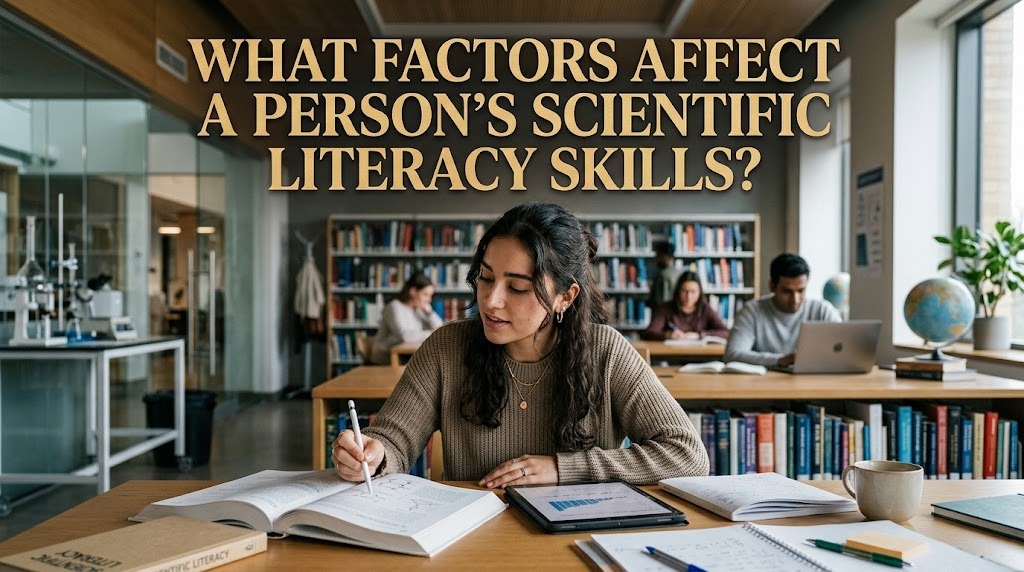
Scientific literacy is an important ability that helps people understand scientific information and apply it to real-life situations. However, not everyone has the same level of scientific literacy because many factors can influence how a person develops this skill. Education, access to information, learning experiences, and the surrounding environment can all play a role. Personal curiosity and the ability to think critically can also affect how someone understands scientific information. Understanding these factors can help schools and communities create better opportunities for developing scientific literacy.
THE ROLE OF EDUCATION
Education is one of the most important factors affecting scientific literacy skills. Schools provide students with opportunities to learn scientific concepts, conduct investigations, and understand how evidence supports conclusions. Effective science education does not only focus on memorizing facts but also encourages students to ask questions and analyze information. Teachers can support this process by using experiments, discussions, projects, and real-life examples. These learning activities can make scientific knowledge easier to understand and apply.
The quality of learning experiences can also influence students' ability to develop scientific literacy. When students are encouraged to investigate problems and explain their reasoning, they have more opportunities to practice critical thinking. In contrast, learning that focuses mainly on memorization may provide fewer opportunities to apply scientific knowledge. Therefore, teaching methods can have an important influence on how students develop scientific literacy. A supportive educational environment can encourage students to become more active learners.
ACCESS TO RELIABLE INFORMATION
Access to information is another factor that can affect scientific literacy. Today, people can find scientific information through websites, digital libraries, educational platforms, and social media. Easy access can provide valuable opportunities for learning and exploration. However, not all online information is accurate or supported by reliable evidence. People therefore need the ability to identify trustworthy sources and evaluate the information they find.
Students who have access to reliable educational resources can explore scientific topics beyond classroom materials. They can read articles, watch educational content, and compare explanations from different sources. At the same time, they need to understand that the availability of information does not automatically mean that the information is correct. Developing information evaluation skills allows people to use digital resources more effectively. This makes access to quality information an important part of scientific literacy development.
LEARNING ENVIRONMENT AND EXPERIENCE
A person's learning environment can strongly influence how scientific literacy develops. Students who receive encouragement from teachers, family members, and peers may have more opportunities to discuss scientific ideas and ask questions. A classroom that allows students to express ideas and investigate problems can create a positive learning experience. Practical activities can also help students connect scientific concepts with situations they encounter outside school. These experiences can strengthen their understanding of science.
Hands-on learning can be particularly useful because students have opportunities to observe, investigate, and analyze results directly. For example, an experiment can help students understand how evidence is collected and interpreted. Real-world projects can also encourage students to use scientific knowledge when solving practical problems. Repeated experiences like these can gradually strengthen scientific reasoning. Therefore, the learning environment should provide opportunities for active participation rather than relying only on passive learning.
PERSONAL INTEREST AND CURIOSITY
Personal interest can also affect the development of scientific literacy. People who are curious about how things work may be more willing to ask questions, explore information, and investigate unfamiliar topics. Curiosity can encourage individuals to continue learning even outside formal educational settings. This can lead them to read scientific content, observe their surroundings, and search for explanations. Over time, these activities can strengthen scientific understanding.
Motivation is also important because developing scientific literacy requires continuous practice. Students who are interested in science may be more willing to participate in experiments, discussions, and research activities. However, interest can also grow when students experience enjoyable and meaningful learning. Teachers and families can help by connecting scientific topics with everyday situations that students recognize. This can make science feel more relevant and encourage continued learning.
CRITICAL THINKING AND DAILY HABITS
A person's existing critical thinking skills can influence how effectively they understand scientific information. Critical thinking helps individuals examine claims, identify evidence, compare explanations, and recognize unsupported conclusions. These abilities are especially important when people encounter scientific information online. Someone who regularly questions information and checks its source may have more opportunities to strengthen scientific literacy.
Daily habits can also contribute to scientific literacy. Reading reliable information, discussing scientific topics, observing natural phenomena, and asking questions about everyday events can provide regular learning opportunities. People can also develop the habit of checking evidence before accepting or sharing information. These simple activities can gradually improve scientific reasoning. Scientific literacy is therefore not developed only through school but can continue to grow through everyday learning experiences.
CONCLUSION
Several factors can affect a person's scientific literacy skills, including education, access to reliable information, learning environments, personal curiosity, and critical thinking abilities. Positive educational experiences can help students understand scientific concepts and apply evidence to real situations. Reliable information and active learning opportunities can further strengthen their ability to evaluate and use scientific knowledge. Personal motivation and daily learning habits can also support continuous development. By improving these different factors, individuals can build stronger scientific literacy and become more informed participants in an increasingly scientific and technological world.
Recent Posts

Bagaimana Sistem SKS pada Program Kuliah... 22.11.2026/33 View

How Does Technology Make Daily Evaluation... 21.11.2026/67 View

Apa Strategi Menghadapi Kesenjangan antara Kompetensi... 21.11.2026/67 View

Mengapa Inventaris Aset Penting bagi Kelancaran... 21.11.2026/65 View

When Should Musicians Join a Record... 21.11.2026/66 View
