

What Factors Led to the Birth of a City?
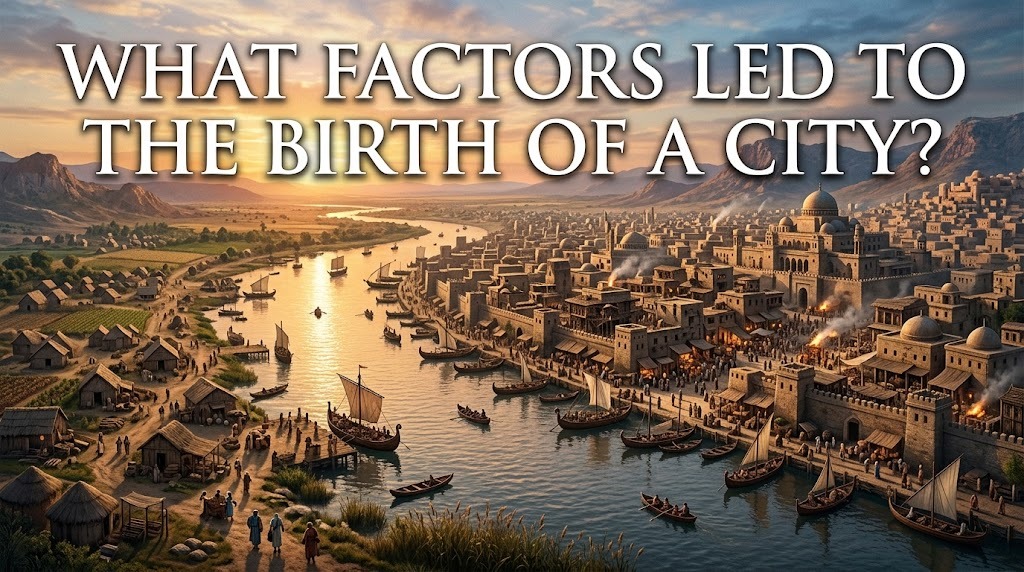
Cities did not appear overnight. Their development began when people established permanent settlements and gradually built communities around shared resources, economic activities, and social needs. Over time, some settlements grew into important centers of trade, government, religion, and culture. Understanding what factors led to the birth of a city helps explain how human civilization developed and why certain locations became major urban centers.
ACCESS TO WATER AND NATURAL RESOURCES
Access to water was one of the most important factors in the formation of early cities. Rivers, lakes, and springs provided drinking water, supported agriculture, and supplied water for livestock. Fertile land near rivers also allowed communities to produce enough food to support larger populations. These advantages encouraged people to settle in one place rather than move constantly in search of resources.
Natural resources such as fertile soil, forests, stone, and minerals also contributed to urban development. Communities that could obtain food and construction materials locally often had better opportunities to grow. As populations increased, settlements developed more organized systems for farming, storing food, and distributing essential resources.
AGRICULTURE AND PERMANENT SETTLEMENTS
The development of agriculture was a major turning point in the birth of cities. When people learned to cultivate crops and domesticate animals, they could produce more reliable food supplies. This allowed communities to establish permanent settlements and support populations larger than those of many earlier mobile groups.
Agricultural surpluses also made it possible for some people to specialize in activities other than farming. Artisans, merchants, builders, and administrators could contribute to the community while relying on food produced by others. Over time, this division of labor encouraged more complex economies and social structures, helping some settlements develop into cities.
TRADE AND ECONOMIC OPPORTUNITIES
Trade encouraged settlements to grow by connecting people, products, and markets. Locations near rivers, coastlines, mountain passes, and major land routes often became meeting points for merchants. Farmers could exchange surplus crops for tools, pottery, textiles, and other goods. These commercial activities created opportunities for employment and attracted people from surrounding regions.
As trade expanded, settlements developed marketplaces, storage facilities, workshops, and transportation networks. Merchants and craftspeople often established permanent businesses near busy trading areas. The concentration of economic activities increased population density and encouraged the development of administrative systems to manage transactions, property, and public order.
GEOGRAPHICAL LOCATION AND TRANSPORTATION
Geography strongly influenced where early cities emerged. Settlements near navigable rivers, natural harbors, and important crossroads could connect different communities more easily. These locations reduced transportation difficulties and helped people move goods, information, and resources over long distances.
Defensive geography could also influence settlement choices. Hills, river bends, and other natural barriers sometimes provided protection against attacks. However, a location suitable for defense was not always ideal for trade or agriculture. The growth of a city therefore depended on how well its geographical advantages supported several needs, including food production, transportation, security, and access to markets.
POLITICAL POWER AND GOVERNMENT
Political organization played an important role in transforming settlements into cities. As communities grew, they needed ways to manage resources, settle disputes, organize public projects, and maintain order. Leaders and governing institutions gradually emerged to coordinate these responsibilities.
Some settlements became administrative centers for kingdoms, chiefdoms, or other political systems. Rulers established palaces, administrative buildings, defensive walls, and storage facilities. These institutions attracted workers, officials, soldiers, and service providers, creating further opportunities for urban growth. In many historical societies, political authority helped determine where cities developed and how their spaces were organized.
RELIGION AND CULTURAL ACTIVITIES
Religious beliefs and cultural traditions also contributed to the formation of cities. Temples, shrines, ceremonial spaces, and other sacred sites often attracted visitors from nearby communities. Regular gatherings created demand for food, accommodation, crafts, and other services. In some societies, religious institutions also managed land, stored agricultural products, and organized labor.
Over time, these activities encouraged permanent construction and the development of specialized occupations. Religious centers could become places where people exchanged knowledge, preserved traditions, and established social connections. Their cultural significance sometimes attracted settlers even when the location offered fewer economic advantages than other areas.
POPULATION GROWTH AND SOCIAL ORGANIZATION
Population growth helped settlements become more complex. As agricultural production improved and trade expanded, more people could live in the same area. Increasing population created demand for housing, roads, markets, water systems, and public facilities.
Larger communities also required stronger forms of social organization. People needed rules governing property, trade, labor, and public responsibilities. Different occupations and social groups emerged, creating more specialized economic and administrative systems. These developments distinguished many early cities from smaller villages, although the transition from village to city occurred differently across regions and historical periods.
SECURITY AND DEFENSE
Security was another factor that influenced the location and growth of early cities. Communities sometimes settled near natural barriers or constructed walls to protect residents, stored food, and valuable goods. In regions affected by conflict, defensible locations could attract people seeking protection from rival groups.
As settlements became wealthier through farming and trade, protecting their resources became increasingly important. Fortifications, gates, watchtowers, and organized defensive forces could help safeguard important urban centers. Nevertheless, defense alone could not guarantee long-term success. Cities also needed dependable resources, economic opportunities, and effective leadership to sustain their populations.
TECHNOLOGY AND INFRASTRUCTURE
Technological developments helped early settlements support larger populations. Improvements in farming tools, irrigation, construction methods, and transportation increased productivity and made it easier to manage shared resources. Irrigation systems, for example, allowed some communities to cultivate land that depended on carefully controlled water supplies.
Construction techniques also enabled people to build larger houses, public buildings, storage facilities, and defensive structures. Roads and bridges improved connections between neighborhoods and surrounding settlements. As infrastructure became more sophisticated, communities could coordinate economic activities and provide services on a larger scale, supporting continued urban growth.
CONCLUSION
The birth of a city resulted from several interconnected factors, including access to water, agricultural development, trade, geography, political organization, religion, population growth, security, and technological progress. These conditions created opportunities for settlements to become larger, more specialized, and more organized. However, no single factor explains the emergence of every city. Each urban center developed through a unique combination of environmental advantages, human decisions, and historical circumstances. Studying these origins reveals how early communities laid the foundations for modern urban life.
Recent Posts

Bagaimana Sistem SKS pada Program Kuliah... 22.11.2026/51 View

How Does Technology Make Daily Evaluation... 21.11.2026/81 View

Apa Strategi Menghadapi Kesenjangan antara Kompetensi... 21.11.2026/81 View

Mengapa Inventaris Aset Penting bagi Kelancaran... 21.11.2026/77 View

When Should Musicians Join a Record... 21.11.2026/82 View
