

What Happens to Indonesian Culture When Regional Languages Disappear?
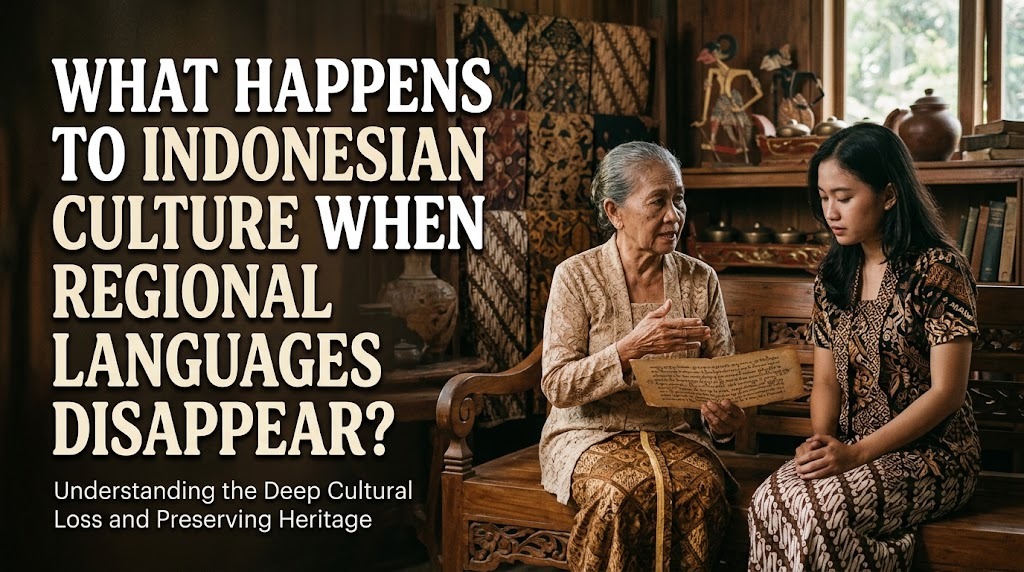
Regional languages are an essential part of Indonesia’s cultural heritage because they preserve local knowledge, traditions, stories, and ways of communicating. Indonesia has hundreds of regional languages that reflect the history and identity of different communities. Each language contains distinctive expressions, vocabulary, and cultural meanings developed over generations. When a regional language disappears, the impact extends beyond the loss of words because important parts of a community’s cultural identity may also become harder to preserve. Understanding these consequences can encourage families, schools, communities, and the government to protect regional languages for future generations.
CULTURAL IDENTITY BECOMES WEAKER
Regional languages help people recognize their cultural roots and understand the history of their communities. Through language, people learn local expressions, traditional greetings, and ways of describing relationships within their society. These elements can create a sense of belonging and distinguish one cultural community from another. When a regional language is no longer spoken, younger generations may find it more difficult to connect directly with some aspects of their cultural heritage.
However, losing fluency in a regional language does not automatically mean losing an entire cultural identity. People can still maintain traditions, participate in ceremonies, and learn their history through Indonesian or other languages. Nevertheless, some cultural meanings may become less familiar when the original language is no longer used. Preserving regional languages helps communities maintain a direct connection with their cultural roots. Encouraging children to learn their ancestral language can strengthen their understanding of where they come from.
TRADITIONAL STORIES AND ORAL HISTORY MAY BE LOST
Many Indonesian communities pass down their history through folktales, legends, proverbs, songs, and stories shared by older generations. These forms of oral tradition often contain lessons about honesty, courage, cooperation, and responsibility. When stories are told in their original regional languages, they may include distinctive expressions, humor, and meanings that are difficult to translate completely. If a language disappears before its stories are recorded, valuable cultural knowledge may be lost.
Oral history can also explain how communities understand their ancestors, local landmarks, customary practices, and important historical events. Translating these stories into Indonesian can help preserve their general meaning, but some details may require additional explanations. Communities can reduce this risk by recording conversations with older speakers, collecting traditional stories, and creating bilingual educational materials. Documenting oral traditions helps protect cultural knowledge before fewer people can share it. These efforts allow future generations to learn about their heritage even when everyday use of the original language declines.
TRADITIONAL CUSTOMS MAY LOSE SOME OF THEIR MEANING
Regional languages are often used in weddings, customary meetings, traditional performances, and community celebrations. Particular words and expressions may communicate blessings, respect, family responsibilities, or the significance of specific rituals. When fewer people understand the language used during these activities, younger participants may find it harder to understand the full meaning behind certain practices. As a result, a tradition may continue physically while some of its original explanations become less familiar.
This does not mean that cultural ceremonies will automatically disappear when their language declines. Communities can explain rituals through translations, educational activities, and guidance from cultural elders. For example, a traditional speech can be presented in its original language alongside an Indonesian explanation so that more people understand its message. Maintaining the language associated with a tradition can help preserve both its practice and its cultural significance. Teaching ceremonial expressions to younger generations can support the continuation of meaningful customs.
LOCAL KNOWLEDGE AND VOCABULARY CAN DISAPPEAR
Regional languages often contain specialized vocabulary related to local plants, animals, landscapes, farming, fishing, food, and traditional occupations. These words reflect knowledge that communities have developed through long experience with their surroundings. Some expressions describe local conditions or practices that may not have direct equivalents in Indonesian. When the language is no longer actively used, younger generations may lose access to this knowledge unless it is documented and taught in other ways.
For example, experienced farmers and fishers may use local terms to describe seasonal changes, traditional tools, or particular environmental conditions. Such vocabulary can provide insight into how communities have adapted to their local environments. Preserving these words does not replace scientific research, but it can contribute to cultural education and the documentation of traditional knowledge. A disappearing language can take specialized cultural and environmental knowledge with it. Recording vocabulary and asking knowledgeable speakers to explain its meaning can help preserve this information for future study.
CULTURAL DIVERSITY IN INDONESIA MAY DECLINE
Indonesia is known for its cultural diversity, which includes different languages, arts, music, customs, and forms of traditional knowledge. Regional languages contribute to this diversity by providing distinctive ways for communities to express ideas and understand their experiences. If more languages disappear, the range of linguistic and cultural expressions available to future generations may become narrower. This loss can affect not only the communities that speak those languages but also Indonesia’s broader cultural heritage.
At the same time, using Indonesian as a common language is important for communication among people from different regions. Protecting regional languages does not require rejecting Indonesian or other languages. Instead, people can develop multilingual abilities that support national communication while maintaining local identities. Schools, cultural organizations, and digital creators can help by producing educational materials and encouraging the use of regional languages in appropriate settings. Cultural diversity becomes stronger when local languages and shared national communication can coexist. Supporting regional languages allows Indonesia to preserve its cultural richness while remaining connected as a nation.
YOUNGER GENERATIONS MAY BECOME DISCONNECTED FROM THEIR HERITAGE
Children usually learn their first language through regular interaction with family members and their surrounding community. When parents and grandparents rarely use a regional language at home, children may have fewer opportunities to learn its vocabulary, expressions, and cultural meanings naturally. Over time, they may understand only a few words or be unable to participate comfortably in conversations with older relatives. This can create a communication gap between generations.
Families can address this challenge by using regional languages in everyday activities, telling traditional stories, and teaching children common greetings and expressions. Schools and community groups can provide additional opportunities through language clubs, cultural performances, and conversations with fluent speakers. Digital resources such as videos, songs, online dictionaries, and language-learning applications can also make learning more accessible. Regular practice is essential for helping younger generations maintain a meaningful connection with their regional languages. When children can use these languages in daily life, they have more opportunities to inherit the cultural knowledge associated with them.
CONCLUSION
When regional languages disappear, Indonesian culture may lose important expressions of cultural identity, traditional stories, customary meanings, local knowledge, and intergenerational connections. The disappearance of a language does not necessarily erase an entire culture, but it can make certain traditions and forms of knowledge more difficult to pass down. Preserving regional languages therefore requires practical efforts from families, schools, communities, cultural organizations, and the government. Speaking these languages at home, documenting oral traditions, teaching children, and creating digital learning resources can all contribute to their survival. Protecting regional languages means helping preserve Indonesia’s cultural diversity for future generations.
Recent Posts

Bagaimana Sistem SKS pada Program Kuliah... 22.11.2026/49 View

How Does Technology Make Daily Evaluation... 21.11.2026/76 View

Apa Strategi Menghadapi Kesenjangan antara Kompetensi... 21.11.2026/78 View

Mengapa Inventaris Aset Penting bagi Kelancaran... 21.11.2026/74 View

When Should Musicians Join a Record... 21.11.2026/78 View
