

What Is an Effective Note-Taking Technique?
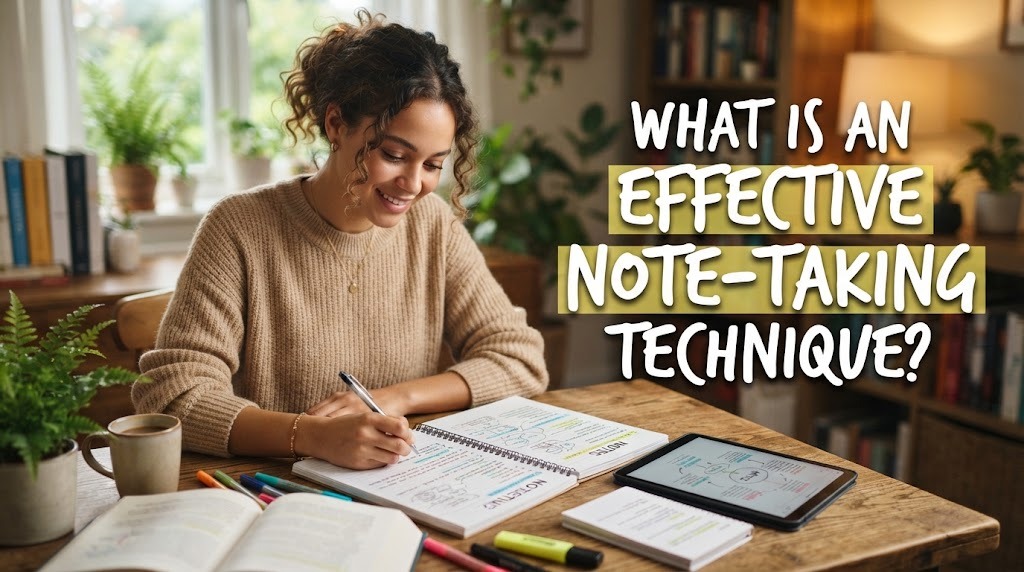
Taking notes is an important learning activity that helps students organize and remember information. However, effective note-taking is not simply about writing down everything a teacher or speaker says. A good technique involves selecting important information, organizing ideas, and reviewing notes regularly. The right method can make studying easier and help students understand lessons more deeply.
WHY IS NOTE-TAKING IMPORTANT?
Note-taking helps learners process information while listening to a lesson, reading a book, or watching an educational presentation. Writing important points can help the brain focus on key information instead of trying to remember every detail. Well-organized notes can also make it easier to review material before an exam.
Good notes can become a personal learning resource. Instead of returning to an entire textbook or recording, students can review a shorter version containing the most important concepts. This makes studying more efficient and can support better memory retention.
USE THE CORNELL NOTE-TAKING METHOD
The Cornell method divides a page into several sections for notes, questions, and summaries. The largest section is used to record important information during a lesson. A smaller section can contain keywords or questions, while the bottom section is used to summarize the main ideas.
This structure encourages students to do more than copy information. After taking notes, they can use the questions to test their memory and read the summary to review the lesson. The Cornell method is especially useful for lectures, classroom discussions, and exam preparation.
TRY THE OUTLINE METHOD
The outline method organizes information according to levels of importance. Main ideas are written first, followed by supporting points and smaller details. Indentation can be used to show the relationship between different ideas.
This technique is useful when a lesson has a clear structure. Students can quickly identify main topics, subtopics, and supporting information when reviewing their notes. It can also prevent notes from becoming a long collection of unrelated sentences.
USE MIND MAPS FOR CONNECTED IDEAS
A mind map presents information visually by placing a central topic in the middle and connecting related ideas around it. Lines, keywords, and short phrases can show how different concepts are related. This method can be useful for subjects that contain many connected ideas.
Mind maps can also make notes easier to review because the information is presented as a visual structure. Students can use different symbols or simple drawings to emphasize important concepts. However, a mind map should remain clear and organized rather than becoming crowded with unnecessary details.
WRITE KEYWORDS INSTEAD OF EVERYTHING
One common mistake is trying to write every sentence exactly as it is spoken. This can make students focus more on writing than on understanding the lesson. Instead, they can record keywords, important facts, definitions, examples, and short explanations.
Using their own words can make notes more meaningful. For example, instead of copying a long textbook definition, students can write a shorter explanation that they genuinely understand. This process requires active thinking and can support better comprehension and recall.
HIGHLIGHT IMPORTANT INFORMATION
Highlighting can make important information easier to find during review. Students can mark definitions, formulas, key concepts, dates, or important examples. However, highlighting too much can make everything appear equally important.
A simple system can make highlighting more useful. For example, one symbol can represent an important concept, another can indicate something that needs further explanation, and another can mark information that should be memorized. The goal is to make notes easier to scan rather than simply adding decoration.
REVIEW NOTES AFTER LEARNING
Taking notes is only the first step. Regular review helps students revisit information before they forget it. Reviewing notes shortly after a lesson can also help identify confusing points while the material is still familiar.
Students can make review more active by covering their notes and trying to explain the information from memory. They can also create questions based on their notes and answer them without looking at the page. This combination of note-taking and active recall can make studying more effective.
KEEP NOTES SHORT AND ORGANIZED
Effective notes do not need to be extremely long. The purpose is to capture the most useful information in a format that is easy to understand later. Using headings, bullet points, keywords, symbols, and short sentences can make notes more organized.
Students should also avoid adding information that does not contribute to understanding the topic. A clean structure makes it easier to locate important information during revision. Whether notes are handwritten or digital, organization is more important than simply making the pages look attractive.
CHOOSE THE RIGHT TECHNIQUE FOR THE SUBJECT
There is no single note-taking method that works perfectly for every subject. Mind maps may work well for topics with many connected concepts, while the outline method can be useful for structured lessons. The Cornell method can be helpful when students need both detailed notes and review questions.
Students can also combine different techniques. For example, they might use an outline for the main lesson and create a small mind map when several concepts are connected. The best technique is the one that helps the learner understand, organize, and remember information.
CONCLUSION
An effective note-taking technique helps students capture important information without writing down everything they hear or read. Methods such as the Cornell method, outline method, and mind mapping can provide different ways to organize knowledge. Using keywords, reviewing notes, and practicing active recall can make note-taking even more useful. By choosing a method that matches the subject and learning style, students can create notes that support better understanding and memory.
Recent Posts

Bagaimana Sistem SKS pada Program Kuliah... 22.11.2026/33 View

How Does Technology Make Daily Evaluation... 21.11.2026/67 View

Apa Strategi Menghadapi Kesenjangan antara Kompetensi... 21.11.2026/67 View

Mengapa Inventaris Aset Penting bagi Kelancaran... 21.11.2026/65 View

When Should Musicians Join a Record... 21.11.2026/66 View
