

What Is Archaeology And Why Is It Important For Understanding History?
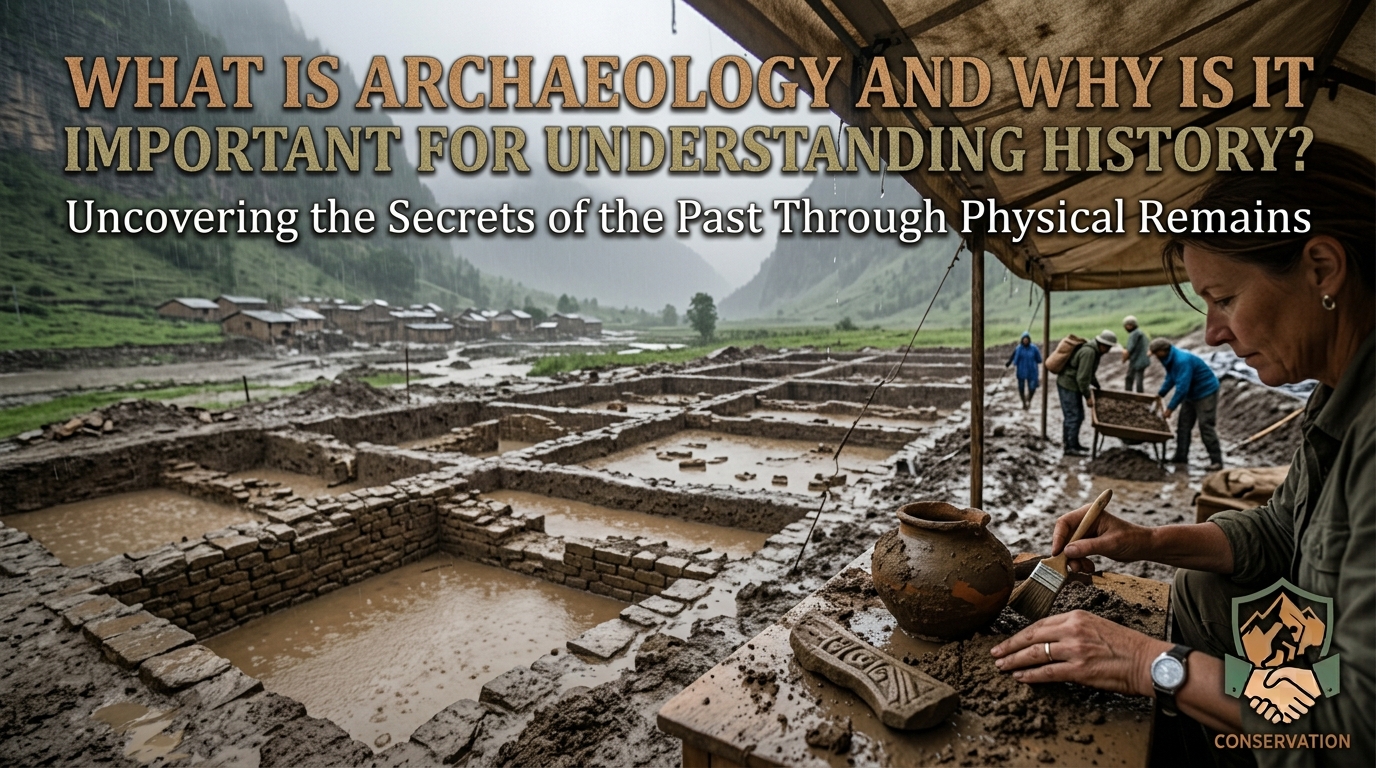
Archaeology is the scientific study of past human life through physical evidence such as tools, pottery, buildings, bones, and ancient settlements. It helps researchers understand how people lived, worked, traded, and interacted with their environment throughout history. Unlike written records, archaeological evidence can reveal information about societies that existed before writing was developed. By examining and interpreting these remains, archaeologists reconstruct aspects of the past and explain how human communities changed over time. Archaeology plays an essential role in understanding history because it provides physical evidence that supports, expands, and sometimes challenges what we know about earlier civilizations.
WHAT IS ARCHAEOLOGY?
Archaeology is a field of study that investigates past human societies through the objects and structures they left behind. These remains, known as archaeological evidence, include stone tools, coins, pottery, monuments, human remains, and traces of ancient settlements. Archaeologists study where these materials were found, how they were made, and how they were used. This information helps explain the daily activities, beliefs, technologies, and social relationships of people in different periods.
Archaeology is closely connected to other disciplines, including anthropology, history, geology, and biology. Researchers may use scientific methods to determine the age of objects, identify ancient materials, or understand past environments. Archaeology is not simply about discovering buried treasures; it is about carefully analyzing evidence to answer questions about human life. Every discovery becomes more meaningful when it is studied within its original historical and environmental context.
WHY IS ARCHAEOLOGY IMPORTANT FOR UNDERSTANDING HISTORY?
Archaeology provides valuable evidence about periods and communities that left few or no written records. Ancient tools, food remains, buildings, and burial sites can reveal how people obtained food, organized their communities, and adapted to environmental changes. These discoveries help historians build a more complete picture of human development. They are especially important when written sources are missing, incomplete, or influenced by the perspectives of their authors.
Archaeological research can also confirm, expand, or challenge existing historical interpretations. For example, the discovery of trade goods in an ancient settlement may demonstrate that its inhabitants had connections with distant regions. Physical evidence helps make historical explanations more reliable when combined with other credible sources. This is why archaeology is an important part of understanding the complexity of the human past.
HOW DO ARCHAEOLOGISTS STUDY THE PAST?
Archaeologists follow systematic methods to investigate and interpret historical remains. The process often begins with research, field surveys, and the identification of promising locations. Researchers may use maps, aerial photographs, satellite images, or ground-penetrating radar to locate possible archaeological features before excavation. If excavation is necessary, every layer of soil and each discovered object must be carefully recorded because their positions can provide important historical information.
After fieldwork, archaeologists analyze and document the collected evidence. Radiocarbon dating can estimate the age of certain organic materials, while stratigraphy helps researchers understand the sequence of deposits at a site. Laboratory analysis may also identify materials, ancient diets, environmental conditions, or patterns of human activity. The findings are then compared with other evidence to develop interpretations that can be evaluated by other researchers.
WHAT CAN ARCHAEOLOGY REVEAL ABOUT ANCIENT CIVILIZATIONS?
Archaeology helps explain how ancient civilizations developed their settlements, technologies, economies, and cultural traditions. Buildings and city layouts can reveal information about urban planning, social organization, and political authority. Tools and manufacturing remains show how people produced goods and adapted their technology to local resources. Meanwhile, pottery, coins, and imported materials can provide evidence of trade and contact between different communities.
Archaeological discoveries can also offer insights into religion, burial customs, food habits, and everyday life. Human remains and animal bones may help researchers study health, diet, and relationships between people and their environment, provided that appropriate scientific and ethical methods are followed. Archaeology reveals more than the lives of rulers and wealthy people because ordinary household objects can explain how everyday communities lived. Together, these findings help create a broader understanding of past civilizations.
THE ROLE OF ARCHAEOLOGY IN PRESERVING CULTURAL HERITAGE
Archaeology contributes to the protection of cultural heritage by identifying historical sites, documenting artifacts, and assessing their significance. Research helps determine which structures and objects require conservation and what kinds of environmental or human threats may damage them. Archaeologists often work with conservators, museums, government agencies, and local communities to protect important remains. Their findings can also support heritage management plans and public education programs.
Preservation is important because archaeological materials are often fragile and cannot be replaced once destroyed. Illegal excavation, looting, construction, pollution, and climate-related hazards can damage sites and remove valuable evidence from its original context. Responsible archaeological practice includes careful documentation, respect for local communities, and compliance with relevant laws. Protecting archaeological sites ensures that future generations can continue learning from the physical evidence of human history.
THE CHALLENGES OF ARCHAEOLOGICAL RESEARCH
Archaeological research involves several challenges, including incomplete evidence, difficult environmental conditions, limited funding, and the risk of damaging fragile materials. Many ancient objects have deteriorated over time, while some sites remain buried beneath modern cities, forests, or underwater landscapes. Researchers must also distinguish reliable interpretations from assumptions because the same artifact may have served different purposes in different societies. These difficulties require patience, careful observation, and strong scientific methods.
Modern technology can improve archaeological research, but it does not eliminate every limitation. Digital mapping, three-dimensional scanning, and remote sensing help researchers document sites and detect changes, while laboratory techniques provide additional information about materials and age. However, technology must be combined with expert interpretation and reliable data. Collaboration between specialists and local communities is also essential for conducting research responsibly and protecting archaeological heritage.
CONCLUSION
Archaeology is the scientific study of past human societies through physical evidence, including artifacts, buildings, and ancient settlements. It is important for understanding history because it reveals information that written records alone may not provide. Through excavation, scientific analysis, and careful interpretation, archaeologists can explain how people lived, developed technologies, exchanged goods, and built civilizations. Archaeology also supports the preservation of cultural heritage and encourages a deeper appreciation of human history. By protecting archaeological evidence and studying it responsibly, we can preserve the knowledge of the past for future generations.
Recent Posts

Bagaimana Sistem SKS pada Program Kuliah... 22.11.2026/49 View

How Does Technology Make Daily Evaluation... 21.11.2026/79 View

Apa Strategi Menghadapi Kesenjangan antara Kompetensi... 21.11.2026/79 View

Mengapa Inventaris Aset Penting bagi Kelancaran... 21.11.2026/75 View

When Should Musicians Join a Record... 21.11.2026/80 View
