

What Is Data Science and Why Is It Important in the Digital Era?
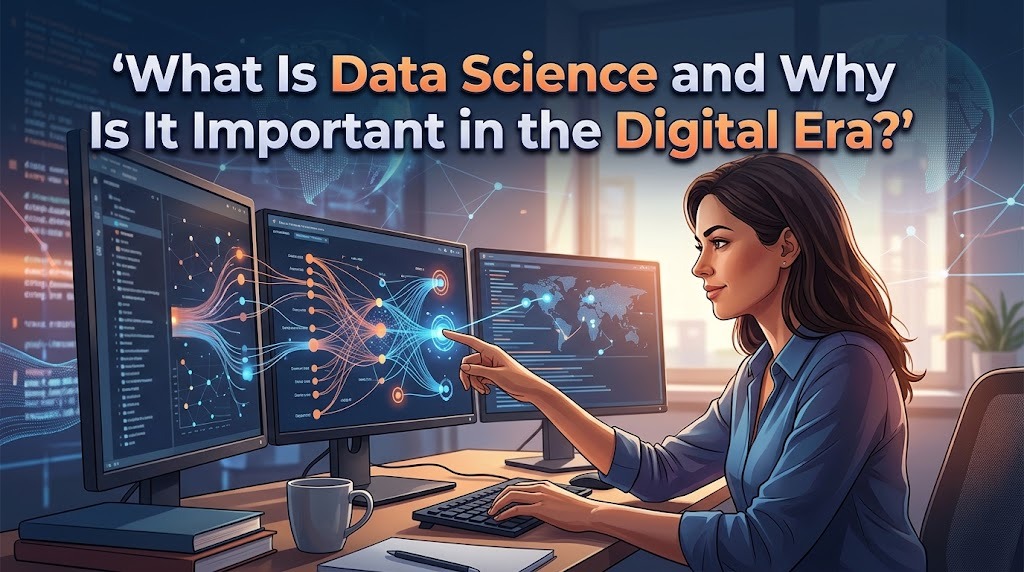
In today's digital era, data science has become an important part of how people, businesses, and organizations understand information and solve problems. Every day, millions of digital activities generate enormous amounts of data through websites, mobile applications, online transactions, social media, and connected devices. However, data alone does not automatically provide useful answers. It must be collected, processed, analyzed, and interpreted to produce meaningful insights. This is where data science plays a significant role by transforming raw information into knowledge that supports better decisions. Understanding data science is increasingly valuable because it helps individuals and organizations adapt to technological developments and changing needs.
WHAT IS DATA SCIENCE?
Data science is a field that combines statistics, mathematics, programming, and analytical methods to extract useful information from data. Its primary purpose is to identify patterns, understand relationships, answer questions, and support decision-making. Data science can work with structured data, such as spreadsheets and transaction records, as well as unstructured data, including text, images, videos, and social media content.
The process involves several activities, including data collection, data cleaning, data analysis, and data visualization. Data scientists may also use machine learning to develop models that recognize patterns or make predictions based on historical information. For example, an online shopping platform can analyze customer purchases to recommend products that match individual interests. Through these methods, data science helps turn complex information into practical solutions that can be understood and applied.
WHY IS DATA SCIENCE IMPORTANT IN THE DIGITAL ERA?
The importance of data science continues to grow because digital technology produces more information than people can efficiently analyze manually. Organizations need reliable methods to understand this information and identify opportunities, risks, and potential improvements. By applying data science, businesses can make decisions based on evidence and measurable patterns rather than relying entirely on assumptions or personal opinions.
Data science also supports innovation, efficiency, and competitiveness across different industries. For example, financial institutions can use data analysis to identify suspicious transactions, while healthcare organizations can examine information to support research and improve service planning. Educational institutions can evaluate student performance to identify learning difficulties and develop more appropriate teaching strategies. In addition, governments can analyze population and public service data to improve planning and resource allocation. These applications demonstrate that data science is not limited to technology companies but can benefit many areas of modern life.
HOW DOES DATA SCIENCE WORK?
The data science process generally begins with identifying a problem or research question. Before collecting information, analysts need to understand what they want to discover and what decisions the results should support. The next step is data collection, which may involve databases, surveys, digital platforms, sensors, or other reliable sources. After collection, the data must be checked for missing values, duplicated records, inconsistencies, and errors that could affect the results.
Once the data is prepared, analysts apply statistical techniques, programming, and analytical models to identify meaningful patterns. Depending on the problem, they may use machine learning to predict outcomes or classify information into specific categories. The findings are then presented through charts, graphs, dashboards, or written reports so that decision-makers can understand them more easily. Finally, the results are evaluated and monitored to determine whether they solve the original problem. Throughout this process, data quality, privacy, security, and responsible interpretation are essential for producing trustworthy conclusions.
WHAT ARE THE APPLICATIONS AND BENEFITS OF DATA SCIENCE?
Data science is used in many industries because each sector generates information that can support better decisions. In business and marketing, companies analyze purchasing behavior, customer preferences, and market trends to develop more relevant products and campaigns. In healthcare, researchers use data to study diseases, evaluate treatments, and identify patterns that may support medical decision-making. In education, institutions can analyze attendance, assessment results, and learning activities to understand student needs and improve educational programs.
Another important application is predictive analytics, which uses historical data and statistical models to estimate possible future outcomes. Retail businesses can use it to forecast product demand, while transportation companies can analyze traffic patterns to improve route planning. Data science also helps organizations automate repetitive tasks, reduce operational waste, and allocate resources more efficiently. Nevertheless, its benefits depend on the quality of the available data, the suitability of analytical methods, and the expertise of the people interpreting the results. Organizations must also protect sensitive information and avoid unfair outcomes caused by biased data or poorly designed models.
WHAT SKILLS ARE NEEDED AND WHAT CHALLENGES DOES DATA SCIENCE FACE?
Learning data science requires a combination of technical skills, analytical thinking, and communication abilities. Beginners can start by learning basic statistics, spreadsheet analysis, and programming languages such as Python. They can then explore tools such as SQL for working with databases and visualization platforms for presenting findings. A strong understanding of problem-solving is equally important because data science involves asking relevant questions, evaluating evidence, and selecting suitable analytical techniques.
Despite its advantages, data science presents several challenges. Poor data quality, limited access to reliable information, privacy concerns, and algorithmic bias can reduce the accuracy or fairness of analytical results. Some projects also require substantial computing resources, specialized knowledge, and time to prepare data properly. Beginners may find programming and statistical concepts difficult at first, but these challenges can be managed through consistent practice, structured learning, and small real-world projects. Developing ethical awareness and clear communication skills is also essential because data scientists must explain their findings and limitations to people who may not have technical backgrounds.
CONCLUSION
Data science is an essential field in the digital era because it helps transform large amounts of raw information into useful knowledge. By combining statistics, programming, data analysis, and machine learning, it enables organizations to understand problems, recognize patterns, predict potential outcomes, and make more informed decisions. Its applications extend across business, healthcare, education, finance, transportation, and public services.
Although data science offers significant opportunities, successful implementation requires reliable data, appropriate analytical methods, strong technical skills, and responsible information management. For beginners, learning the fundamentals and practicing with real datasets can provide a solid foundation for further development. As digital information continues to expand, data science will remain an important tool for innovation, problem-solving, and evidence-based decision-making.
Recent Posts

Bagaimana Sistem SKS pada Program Kuliah... 22.11.2026/46 View

How Does Technology Make Daily Evaluation... 21.11.2026/74 View

Apa Strategi Menghadapi Kesenjangan antara Kompetensi... 21.11.2026/75 View

Mengapa Inventaris Aset Penting bagi Kelancaran... 21.11.2026/72 View

When Should Musicians Join a Record... 21.11.2026/75 View
