

What Is Human Evolution and How Has It Shaped Modern Humans?
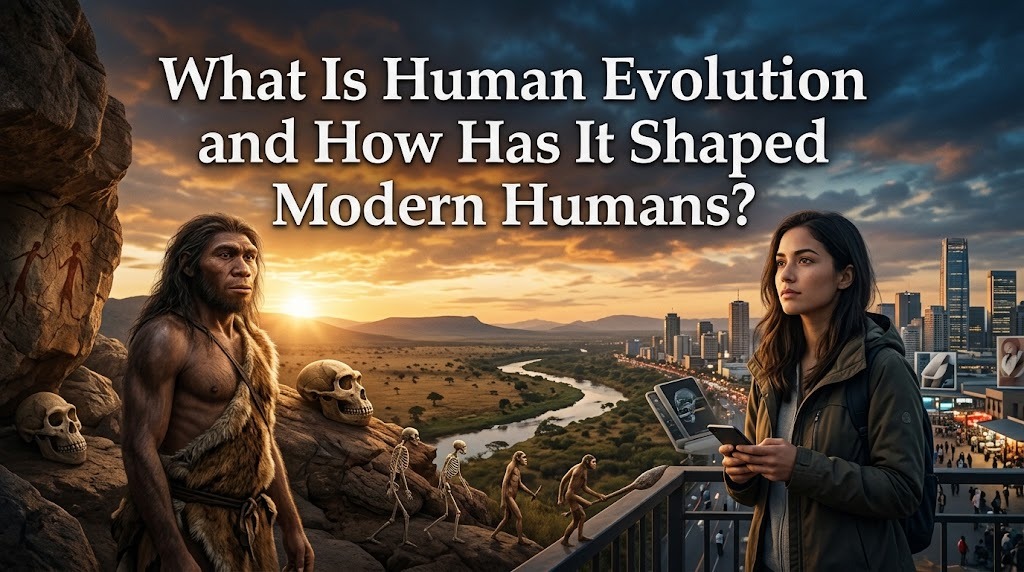
Human evolution is the gradual process through which humans developed from ancient ancestors over millions of years. This process involved changes in physical characteristics, brain development, behavior, and the ability to adapt to different environments. Modern humans, known scientifically as Homo sapiens, are the result of a long evolutionary history influenced by genetic variation, natural selection, and environmental changes.
Understanding human evolution helps explain why humans walk on two legs, have complex brains, communicate through language, and live in diverse societies. It also reveals how early human populations adapted to different climates and developed technologies that improved their chances of survival.
WHAT IS HUMAN EVOLUTION?
Human evolution is the scientific process through which humans and their ancestors changed over generations. It is based on evolutionary mechanisms such as genetic variation, mutation, natural selection, and genetic drift. These processes gradually influenced the physical features and behaviors of ancient human populations.
Human evolution did not happen in a straight line from one species to another. Instead, different human relatives existed at the same time, and some species shared common ancestors. Modern humans belong to the genus Homo and are part of the broader primate family. Scientific evidence from fossils, genetics, and archaeological discoveries helps researchers understand how humans evolved over millions of years.
THE ORIGINS OF MODERN HUMANS
The evolutionary history of humans began long before the appearance of modern humans. Humans and other great apes share common ancestors that lived millions of years ago. Over time, different ancestral populations developed characteristics that distinguished them from other primates.
Homo sapiens evolved in Africa approximately 300,000 years ago. Early modern humans gradually developed physical and behavioral characteristics that helped them survive in changing environments. Later, some human populations migrated beyond Africa and spread across different parts of the world. During these migrations, modern humans also interbred with other human groups, including Neanderthals and Denisovans, leaving small amounts of their DNA in many present-day populations.
HOW WALKING UPRIGHT CHANGED HUMAN LIFE
One of the most important developments in human evolution was bipedalism, the ability to walk regularly on two legs. This characteristic appeared in early human relatives millions of years before modern humans evolved. Walking upright changed the structure of the pelvis, spine, legs, and feet, allowing early hominins to move efficiently on the ground.
Bipedalism also freed the hands for carrying food, transporting objects, and using tools. These abilities supported new ways of finding resources and interacting with the environment. However, walking upright did not immediately lead to modern human intelligence or technology. It was one of several evolutionary changes that contributed to the development of the human species.
THE DEVELOPMENT OF THE HUMAN BRAIN
Brain development played a major role in shaping modern humans. Across human evolutionary history, some species developed larger brains relative to earlier ancestors, although brain size varied between species and did not increase in a simple, continuous pattern. Changes in brain organization, learning abilities, memory, and social behavior also contributed to human development.
A more complex brain helped humans solve problems, plan activities, learn from experience, and cooperate with others. These abilities supported the development of increasingly sophisticated tools, communication systems, and cultural practices. Human intelligence also depends on social learning and accumulated knowledge passed between generations. As a result, modern humans can build on discoveries made by earlier generations instead of learning everything independently.
THE ROLE OF NATURAL SELECTION IN HUMAN EVOLUTION
Natural selection is an evolutionary process in which inherited characteristics that improve reproductive success become more common in a population over generations. Human ancestors experienced different environmental pressures, including changes in temperature, food availability, disease, and habitat. These conditions influenced which inherited traits became more common in particular populations.
For example, variations in skin pigmentation are associated with adaptations to different levels of ultraviolet radiation. Genetic changes also helped some populations develop the ability to digest lactose into adulthood, especially in societies with long histories of dairy farming. These adaptations did not occur in every population because evolutionary changes depend on genetic variation, environmental conditions, and reproductive patterns. Natural selection continues to influence humans today, although modern lifestyles and technology have changed many of the pressures people experience.
HOW HUMAN EVOLUTION SHAPED LANGUAGE AND CULTURE
Human evolution contributed to the physical and cognitive abilities that support complex communication. Modern humans can use spoken language, gestures, facial expressions, and written symbols to share information. Language allows people to explain experiences, transmit knowledge, and coordinate activities with others.
Culture also became an important part of human survival and development. Early communities passed down knowledge about food, tools, shelter, and environmental conditions through learning and social interaction. Over time, cultural practices became more complex, supporting art, traditions, agriculture, and organized societies. Culture can change much faster than genetic evolution, allowing humans to adapt to new situations without waiting for inherited biological changes.
THE IMPORTANCE OF TOOLS AND TECHNOLOGY
Toolmaking was an important part of human evolutionary history. Early human relatives produced simple stone tools that helped them cut materials, process food, and perform other tasks. Later human populations developed more specialized tools and techniques that improved hunting, gathering, and resource management.
Technological development supported major changes in human life. The use of fire helped people prepare food, obtain warmth, and occupy different environments. Much later, agriculture encouraged permanent settlements, population growth, and the development of complex communities. Today, modern technology allows humans to communicate globally, study diseases, explore space, and understand their evolutionary history through advanced scientific methods.
HUMAN EVOLUTION AND MODERN HUMAN DIVERSITY
Modern humans share the same species identity, but individuals and populations display a wide range of physical and genetic differences. These variations developed through a combination of migration, genetic drift, natural selection, and historical interactions between populations. Differences in skin color, hair characteristics, and certain physiological traits reflect complex evolutionary histories rather than separate human origins.
Genetic research also shows that humans share a remarkably large proportion of their DNA. Human populations have moved, mixed, and exchanged genes throughout history, making the idea of completely separate biological groups inaccurate. Human diversity is a natural result of evolutionary processes and historical experiences. Understanding this diversity helps explain human adaptation while recognizing the shared ancestry of all living people.
WHY HUMAN EVOLUTION IS STILL IMPORTANT TODAY
Studying human evolution helps scientists understand human biology, health, and behavior. Evolutionary research can explain why certain genetic conditions exist, how populations adapt to environmental pressures, and how humans are related to other living organisms. It also provides valuable information for studying the history of infectious diseases and the development of resistance to certain treatments.
Human evolution is also important for understanding the relationship between people and the environment. Past climate changes influenced migration, food sources, and survival strategies, offering useful context for studying present environmental challenges. However, evolution does not mean that humans are automatically becoming better or more advanced in every way. It describes changes in inherited characteristics across generations, shaped by specific conditions and reproductive outcomes.
CONCLUSION
Human evolution is a long and complex process that shaped the physical features, intelligence, behavior, and cultural abilities of modern humans. From walking upright and developing more complex brains to creating tools and sharing knowledge, evolutionary changes helped human ancestors adapt to different environments and establish communities.
Modern humans evolved in Africa and later spread across the world, developing diverse characteristics while maintaining a shared evolutionary history. Although technology and culture have transformed human life, biological evolution remains an important scientific concept for understanding human diversity, health, and adaptation. By studying human evolution, we gain a clearer understanding of where humans came from and how our species became what it is today.
Recent Posts

Bagaimana Sistem SKS pada Program Kuliah... 22.11.2026/50 View

How Does Technology Make Daily Evaluation... 21.11.2026/80 View

Apa Strategi Menghadapi Kesenjangan antara Kompetensi... 21.11.2026/79 View

Mengapa Inventaris Aset Penting bagi Kelancaran... 21.11.2026/75 View

When Should Musicians Join a Record... 21.11.2026/80 View
