

What Is Journal Indexing and Why Does It Matter?
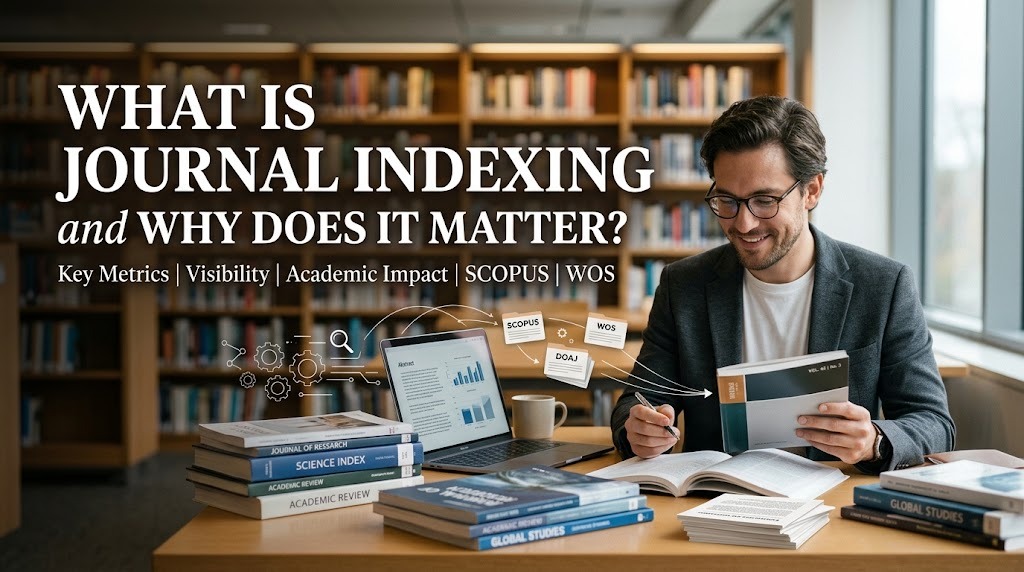
Journal indexing is an important part of academic publishing because it helps researchers discover scholarly articles through organized research databases. When a journal is included in an indexing service, its publication information and articles may become easier to find, access, and cite. This process supports the distribution of academic knowledge and helps connect researchers with relevant studies in their fields.
Understanding journal indexing is useful for students, lecturers, researchers, and academic journal publishers. It can help authors identify suitable publication venues and understand how research is made visible to a wider academic audience. However, being indexed does not automatically guarantee that every article published in a journal is accurate or of high quality. The indexing service, its selection criteria, and the journal's editorial practices should also be considered.
UNDERSTANDING THE MEANING OF JOURNAL INDEXING
Journal indexing is the process through which an academic journal is included in a database or indexing service that organizes scholarly publication information. These services collect details such as journal titles, publication records, article metadata, abstracts, and sometimes links to full-text articles. This information helps users search for academic publications more efficiently.
Different indexing services have different purposes and coverage. Some focus on broad academic disciplines, while others specialize in fields such as medicine, engineering, social sciences, or the humanities. Examples of well-known services and databases include Scopus, Web of Science, PubMed, and DOAJ. Their inclusion criteria and coverage differ, so researchers should understand what each service represents before interpreting a journal's indexing status.
Indexing should also be distinguished from publishing an article online. A journal may have its own website and publish articles regularly without being included in a particular indexing database. Therefore, the existence of an online publication does not automatically mean that the journal is indexed by a recognized service.
HOW JOURNAL INDEXING WORKS
The indexing process generally begins when a journal is evaluated or submitted for consideration by an indexing service. Depending on the database, the evaluation may examine the journal's editorial policies, peer-review procedures, publication regularity, ethical standards, and relevance to the database's scope. Some services also assess the quality and consistency of the journal's published content.
If a journal meets the applicable requirements, the indexing service may include its publication records in the database. Researchers can then search for articles through keywords, author names, article titles, publication years, and other available information. The amount of information displayed depends on the particular service.
Indexing status is not necessarily permanent. A journal may be reviewed periodically, and some databases can discontinue coverage when a publication no longer meets their standards or other applicable requirements. For this reason, authors should check the current indexing status of a journal rather than relying entirely on old announcements or claims on its website.
WHY JOURNAL INDEXING MATTERS FOR RESEARCHERS
One major benefit of journal indexing is improved research discoverability. When academic articles appear in searchable databases, researchers can locate relevant studies without having to visit every journal website individually. This can make literature reviews more efficient and help scholars identify existing knowledge, research gaps, and possible directions for future studies.
Indexing can also support citation and scholarly communication. When an article is easier to discover, other researchers have more opportunities to read it, evaluate its findings, and cite it when relevant. However, indexing does not guarantee that an article will receive citations. Citation activity depends on factors such as the topic, research contribution, accessibility, and interest of the academic community.
For students and lecturers, indexed databases can provide useful starting points when searching for academic references. Researchers can use database filters and publication information to organize their literature searches. Nevertheless, they should still evaluate each article's methodology, evidence, relevance, and limitations before using its findings in academic work.
THE BENEFITS OF JOURNAL INDEXING FOR ACADEMIC PUBLISHERS
For academic publishers, inclusion in a recognized indexing service can increase a journal's visibility among researchers and institutions. Greater discoverability may help the journal reach readers beyond its existing audience and attract submissions from scholars working in related fields. This can support the development of academic communication within a discipline.
Journal indexing can also encourage publishers to maintain consistent editorial and publication practices. The requirements of some indexing services may prompt journals to improve their peer-review procedures, publication schedules, metadata quality, and ethical policies. These improvements can contribute to a more organized publishing process when they are implemented meaningfully.
However, indexing should not be treated as the only measure of a journal's success. A journal's academic contribution also depends on the relevance and quality of its research, the transparency of its editorial process, and its ability to serve its scholarly community. Publishers should prioritize responsible publishing practices rather than pursuing indexing status alone.
HOW TO CHECK WHETHER A JOURNAL IS INDEXED
Researchers should verify a journal's indexing status through the official website of the relevant database or indexing service. For example, authors can use the official Scopus sources list to check coverage in Scopus, or consult the appropriate official journal and collection resources for Web of Science. For open-access journals, the Directory of Open Access Journals (DOAJ) provides a directory of journals that meet its inclusion criteria.
When checking a journal, compare its exact title, International Standard Serial Number (ISSN), publisher, and coverage information. These details help distinguish a legitimate journal record from a similarly named publication. It is also important to check whether the database covers the journal for the publication year relevant to the article being considered.
Avoid relying only on journal logos, screenshots, promotional messages, or statements that a publication is indexed. Such information may be outdated or misleading. If the database provides coverage dates or an active-status indicator, review those details carefully. Verification through an official source is a more reliable way to determine whether a journal is included in a particular indexing service.
CONCLUSION
Journal indexing is the process of organizing and including academic journal information in searchable databases so that researchers can discover scholarly publications more efficiently. It can improve research visibility, support literature searches, facilitate scholarly communication, and encourage publishers to maintain appropriate editorial standards. Its value depends on the purpose and credibility of the indexing service.
However, indexing alone does not guarantee that a journal or every article it publishes is reputable or scientifically sound. Researchers should verify the journal's current status through official database sources and assess its editorial practices and article quality independently. By understanding what journal indexing is and why it matters, students, researchers, and publishers can make more informed decisions when searching for, evaluating, and publishing academic research.
Recent Posts

Bagaimana Sistem SKS pada Program Kuliah... 22.11.2026/43 View

How Does Technology Make Daily Evaluation... 21.11.2026/72 View

Apa Strategi Menghadapi Kesenjangan antara Kompetensi... 21.11.2026/74 View

Mengapa Inventaris Aset Penting bagi Kelancaran... 21.11.2026/70 View

When Should Musicians Join a Record... 21.11.2026/74 View
