

What Is Political Literacy and Why Is It Important?
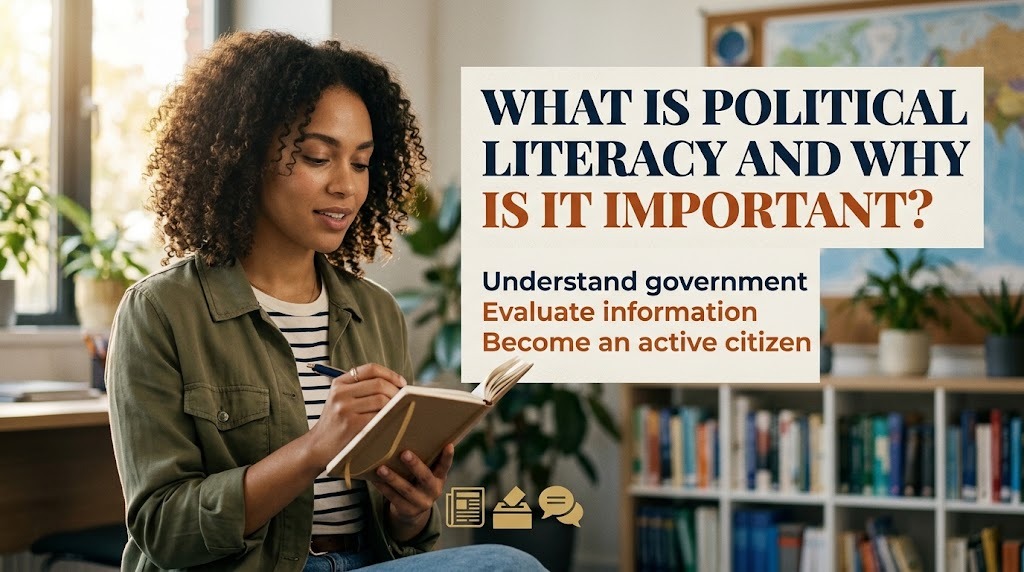
Political literacy refers to the knowledge, understanding, and skills that help people understand political issues, public institutions, rights, responsibilities, and participation in civic life. It is not simply about knowing the names of political figures or political parties. It also involves the ability to understand information, consider different perspectives, and participate responsibly in society.
In a democratic society, people regularly encounter information about government policies, elections, public issues, and decisions that affect their communities. Developing political literacy can help individuals understand this information more carefully and make informed decisions. The Council of Europe describes democratic competence as involving knowledge, skills, attitudes, and values that help people participate effectively in democratic situations.
UNDERSTANDING POLITICAL LITERACY
Political literacy involves more than memorizing political terms. It includes understanding how public institutions work, how decisions are made, and how individuals can exercise their rights and responsibilities in society.
Political literacy is also connected with civic literacy and democratic competence. These areas involve knowledge and skills that allow people to understand public issues and participate in civic and political life.
A politically literate person can ask questions about information, identify relevant evidence, and consider different viewpoints before reaching a conclusion. This does not require everyone to have the same political opinions. Instead, the focus is on developing the ability to understand political information and participate responsibly.
WHY POLITICAL LITERACY MATTERS IN A DEMOCRATIC SOCIETY
Political literacy and democracy are closely connected because democratic systems depend on people being able to understand public issues and participate in civic life. The Council of Europe notes that democratic citizenship involves exercising rights and responsibilities and participating in civic and political processes.
Political literacy can help people understand the relationship between citizens, public institutions, laws, and government decisions. It can also encourage people to listen to different opinions and engage in discussions based on information rather than assumptions.
A democratic culture also involves respect for human rights, diversity, dialogue, peaceful conflict resolution, and participation in public life. These principles are identified by the Council of Europe as important elements of a culture that supports democracy.
HELPING PEOPLE EVALUATE POLITICAL INFORMATION
People encounter political information through news organizations, websites, social media, conversations, and other sources. Therefore, reliable political information is an important part of political literacy.
UNESCO identifies information literacy as the ability to recognize information needs and to locate, evaluate, apply, and create information within social and cultural contexts. Political literacy can build on these abilities by encouraging people to examine political claims carefully.
This is particularly relevant in the digital environment, where information can spread quickly. UNESCO notes that access to reliable information supports informed decision-making, while misinformation and disinformation can create risks for democratic processes.
SUPPORTING RESPONSIBLE CIVIC PARTICIPATION
Civic participation can take many forms. Depending on age, legal rights, and circumstances, people can participate by learning about public issues, discussing community concerns, joining appropriate community activities, expressing opinions respectfully, or taking part in democratic processes.
Political literacy can help people understand both their rights and responsibilities. It can also encourage individuals to consider how public decisions affect different groups within society.
Education has an important role in developing these abilities. UNESCO describes civic education as involving knowledge, values, and participation in public life, while emphasizing the importance of critical thinking and independent judgment.
BUILDING CRITICAL AND INFORMED CITIZENS
Developing political literacy skills can help individuals become more careful when interpreting political information. Important skills include critical thinking, evaluating sources, understanding evidence, recognizing different perspectives, and communicating opinions respectfully.
These skills are particularly useful in the digital era. UNESCO's media and information literacy resources emphasize the importance of questioning information critically, while its work on elections highlights the importance of reliable information for democratic participation.
Political literacy does not mean adopting a particular political viewpoint. Its purpose is to provide people with knowledge and skills that allow them to understand political issues and make their own informed judgments. In this way, political literacy can support meaningful and responsible participation in democratic society.
CONCLUSION
Political literacy is the ability to understand political issues, public institutions, rights, responsibilities, and civic participation while evaluating information critically. It can help people better understand the political environment around them and participate in society in an informed and responsible way.
Developing political literacy skills is especially relevant in an environment where political information is widely available online. By learning to evaluate information, understand different perspectives, and participate respectfully, individuals can strengthen their ability to make informed decisions and engage with democratic life.
Recent Posts

Bagaimana Sistem SKS pada Program Kuliah... 22.11.2026/33 View

How Does Technology Make Daily Evaluation... 21.11.2026/67 View

Apa Strategi Menghadapi Kesenjangan antara Kompetensi... 21.11.2026/67 View

Mengapa Inventaris Aset Penting bagi Kelancaran... 21.11.2026/65 View

When Should Musicians Join a Record... 21.11.2026/66 View
