

What Is Secondary Data And Why Is It Important In Research?
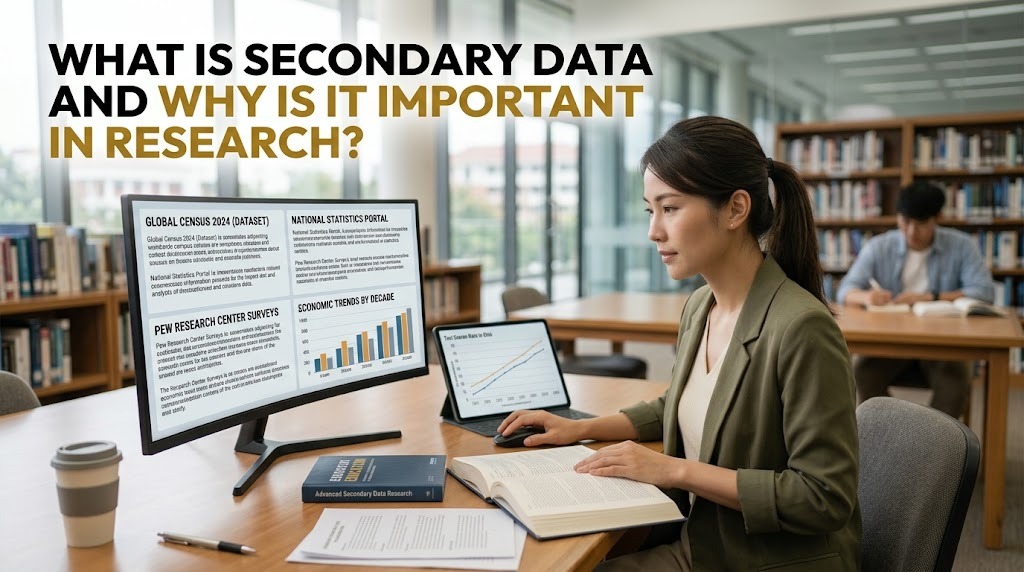
Secondary data is an important source of information in research because it allows researchers to use existing data to understand problems, identify trends, and support conclusions. Instead of collecting all information from the beginning, researchers can analyze data that has already been gathered by other people or organizations. This approach can save time, reduce research costs, and provide valuable insights when the data is relevant and reliable. Understanding secondary data helps students, academics, and professionals conduct research more efficiently and make better decisions.
WHAT IS SECONDARY DATA?
Secondary data refers to information that has already been collected, recorded, or published by another person or organization for a previous purpose. Researchers use this information to answer new research questions or support existing studies. Common sources include books, academic journals, government reports, statistical databases, research publications, and official websites. For example, a student studying unemployment rates may use employment statistics published by a government agency instead of conducting a new survey. Secondary data can be presented in numerical form, such as population statistics, or descriptive form, such as interview transcripts and written reports.
WHY IS SECONDARY DATA IMPORTANT IN RESEARCH?
Secondary data is important because it helps researchers understand a topic without always needing to collect new information. It provides background knowledge, historical information, and evidence that can support research questions and hypotheses. Researchers can also compare existing findings from different sources to identify patterns, changes, and differences over time. In addition, secondary data makes it possible to study large populations or long-term trends that may be difficult to investigate independently. When used correctly, it can improve research efficiency and help researchers develop more informed conclusions.
COMMON SOURCES OF SECONDARY DATA
Secondary data can come from several sources, depending on the research topic and the information required. Government publications often provide statistics about education, health, employment, population, and economic conditions. Academic journals and research papers offer findings from previous studies, while books and educational publications explain established concepts and theories. Researchers can also use reports from international organizations, institutional databases, company records, and reputable online platforms. However, they should prioritize credible and relevant sources and verify the information before using it in their research.
ADVANTAGES OF USING SECONDARY DATA
One major advantage of secondary data is that it can save time and money because researchers do not need to collect every piece of information themselves. It also provides access to large datasets that may cover different regions, populations, or periods. This allows researchers to compare information and identify trends that might not be visible in smaller studies. Another benefit is that previously collected data can help researchers develop research questions and plan future investigations. Nevertheless, the usefulness of secondary data depends on its accuracy, completeness, relevance, and suitability for the research objectives.
LIMITATIONS OF SECONDARY DATA
Although secondary data offers many benefits, it also has limitations that researchers must consider. The information may be outdated, incomplete, inaccurate, or collected for a different purpose from the current research. Some datasets may not include the specific variables or details needed to answer a research question. Researchers may also encounter differences in data collection methods, definitions, and measurement standards, making comparisons difficult. To address these challenges, they should examine the publication date, original source, methodology, and potential biases before drawing conclusions. Careful evaluation helps reduce the risk of misleading interpretations.
HOW TO USE SECONDARY DATA EFFECTIVELY
To use secondary data effectively, researchers should begin by defining their research objectives and identifying the information they need. They should then select sources that are reliable, relevant, and appropriate for the research topic. After collecting the available information, researchers need to check its accuracy, publication date, methodology, and consistency with other sources. The data can then be organized, compared, and analyzed using suitable qualitative or quantitative methods. Finally, researchers should cite the original sources properly, explain important limitations, and present their findings honestly to maintain academic integrity.
THE DIFFERENCE BETWEEN PRIMARY AND SECONDARY DATA
The main difference between primary and secondary data is how the information is obtained and used. Primary data is collected directly by researchers for a specific study through methods such as surveys, interviews, observations, or experiments. In contrast, secondary data already exists and is reused to investigate a research question. Primary data can provide information tailored to a particular objective, but collecting it may require more time, money, and effort. Secondary data is often more accessible and economical, although it may not fully match the researcher's needs. Researchers should choose between these approaches based on their objectives, resources, and the quality of the available information.
CONCLUSION
Secondary data plays a valuable role in research by providing existing information that helps researchers understand issues, analyze trends, and support conclusions. Its main benefits include saving time, reducing costs, and providing access to extensive information. However, researchers must evaluate the credibility, relevance, and accuracy of every source before using it. By selecting appropriate data, applying suitable analysis methods, and providing proper citations, researchers can produce more reliable and meaningful findings. Ultimately, secondary data is an effective research resource when it is used carefully and responsibly.
Recent Posts

Bagaimana Sistem SKS pada Program Kuliah... 22.11.2026/46 View

How Does Technology Make Daily Evaluation... 21.11.2026/74 View

Apa Strategi Menghadapi Kesenjangan antara Kompetensi... 21.11.2026/75 View

Mengapa Inventaris Aset Penting bagi Kelancaran... 21.11.2026/72 View

When Should Musicians Join a Record... 21.11.2026/75 View
